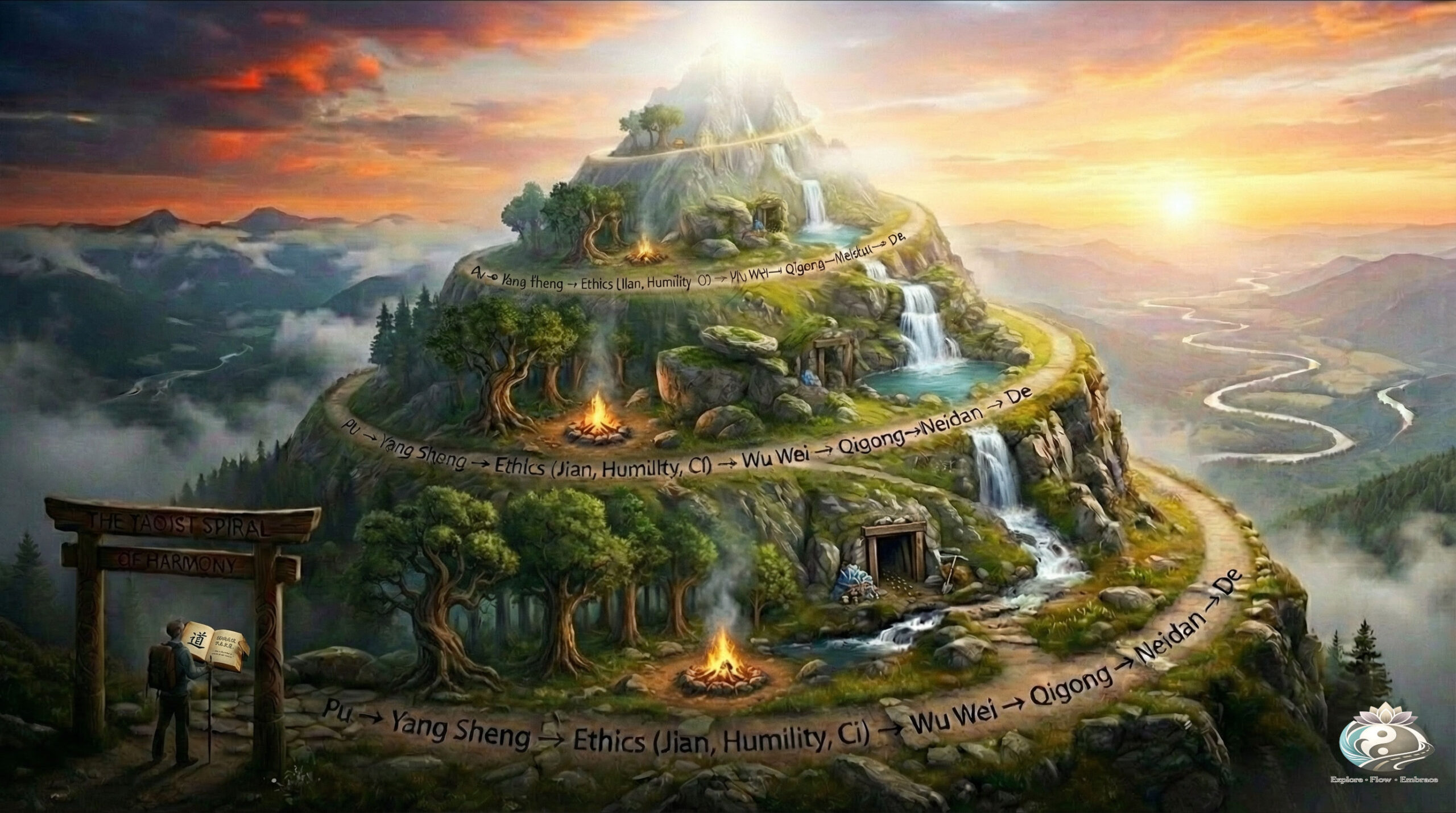
Tired of linear self-improvement? Discover the Taoist Spiral of Harmony, a map for effortless living. Learn how to align your energy (Qi) with the 5 Elements using practices like Wu Wei, Qigong, and Neidan for lasting peace and power. Your guide to cyclical growth.
Forget the Straight Line: Why Life Moves in a Spiral
Our modern world worships the straight line: set a goal, climb the ladder, and never look back. But this creates burnout, frustration, and a feeling that you’re never quite “there.”
Taoism, the ancient Chinese philosophy of natural flow, offers a wiser model: The Taoist Spiral of Harmony.
This isn’t a path to a finish line. It’s a journey of ever-deepening integration—an upward spiral where you return to core lessons like Wu Wei (effortless action) and Yang Sheng (life nourishment), but each time with more clarity, ease, and inner light. It’s a functional map for living in alignment with yourself and the universe’s rhythms, the Five Elements.
Think of the Tao Te Ching as your guidebook for this journey. You don’t just read it once; you return to it at each turn of the spiral, finding deeper meaning as your own experience grows.
A Note on Sources and Direction
Before we go further, two brief notes on what this map is—and what it isn’t.
On sources: This framework blends insights from three distinct traditions. Philosophical Taoism (the Tao Te Ching and Zhuangzi) gives us Wu Wei, Pu, and De. Religious Taoism—specifically the neidan (internal alchemy) tradition—provides the staged refinement of Jing, Qi, and Shen, along with practices like Qigong and Yang Sheng. And the Five Elements come from the School of Naturalists, a correlative cosmology absorbed equally by Taoism, Confucianism, and Chinese medicine. This is a practical synthesis, not a historical reconstruction—the kind of living, integrative approach that many Taoist lineages themselves practice.
On direction: The Tao Te Ching’s core movement is fan—reversal, return. Its imagery is relentlessly downward: water seeking the low place, valleys, the female, the infant. Chapter 40 tells us: “Reversal is the movement of the Tao.” An ascending mountain climb toward “greater light” is structurally closer to modern self-development than to Laozi himself. The defense is that neidan genuinely is a staged, progressive refinement path. The spiral, then, honors that alchemical journey. And as we shall see, the summit of this spiral is not a peak of brightness, but a return to emptiness. The climb is a spiral that brings us full circle to the very source Laozi points to—a descent disguised as an ascent.
The Heart of the Spiral: Your Inner Light (Jing, Qi, Shen)
At the core of your being are the Three Treasures, your fundamental energies:
- Jing: Your foundational life essence—your inherited “battery.”
- Qi: Your daily vital energy—the current flowing from that battery.
- Shen: Your spirit or consciousness—the quality of light that energy emits.
In the Taoist Spiral, these aren’t steps to check off. The path itself grows brighter as you ascend. The goal isn’t to acquire something new, but to refine what you already have. You are alchemically transforming dense Jing into vibrant Qi, and vibrant Qi into luminous Shen—the classical neidan formula of lianjing huaqi, lianqi huashen.
But the alchemical sequence does not stop at Shen. It continues: lianshen huanxu—refining spirit to return to emptiness. And sometimes, beyond that, a fifth stage: merging emptiness with the Tao itself. Even the luminous light you cultivate ultimately dissolves into the formless, into the Tao. This is why the summit of the spiral is always clouded. The destination is not brightness; it is the empty openness from which all brightness arises.
A Note on Terminology: Classical texts use the same term sanbao (three treasures) for two different triads. To keep them clear, I call Jing-Qi-Shen the Three Treasures of the body, and Compassion-Frugality-Humility the Three Ethical Treasures (from Tao Te Ching, chapter 67).
The Path of the Spiral: Your Taoist Practice Cycle
The spiral path is woven from the practical tools of Taoism. You walk this loop endlessly, but each cycle takes you to a higher level of understanding.
1. Start with Pu (The Uncarved Block)
Begin by shedding ego and preconceptions. Return to the simplicity of a blank canvas. This mindset of open awareness prepares you for everything that follows.
A subtle but important point: In the texts, Pu is a state of being—the uncarved block—not a performable action. Calling it a “step” is a pedagogical convenience. What we are doing here is creating conditions—stillness, silence, letting go—where that state can naturally arise.
2. Nourish Your Life (Yang Sheng)
This is daily, proactive self-care. You eat, sleep, and move to conserve Jing and cultivate Qi. It’s gardening for your life-force.
3. Build Your Guardrails (The 3 Ethical Treasures)
Protect your energy by living with:
- Jian (Frugality): Don’t waste energy on drama or excess.
- Humility: Avoid storms by not needing to be the tallest tree.
- Ci (Compassion): Keep your heart open to keep Qi flowing.
4. Act with Effortless Flow (Wu Wei)
This is “action of non-action.” With conserved energy and a clear mind (Pu), you stop forcing. You act like a sailor using the wind, not fighting it. Life feels “in the zone.”
5. Engage in Inner Work (Qigong, Tantra & Neidan)
Here, practice deepens.
- Qigong (and related practices like Tai Chi, a martial art often practiced for qigong-like benefits) is your physical maintenance. Simplified, it works from the outside-in. Through precise, flowing movement, you guide your body to open its energy meridians, allowing Qi to circulate naturally.
- Tantra-inspired practices work from the inside-out. This is our addition—simple breathwork inspired by Tantric and yogic traditions (conscious breathing, visualization, and gentle muscular engagement). This is not traditional Taoism, but our own bridge to make the spiral a shared journey. It is worth noting that Taoism itself has traditions of paired cultivation (shuangxiu) and the older arts of the bedchamber (fangzhongshu). Our couples practices are a rejoining of this current, drawing on Tantric techniques while honoring the Taoist recognition that energy flows powerfully between partners. Read more here.
- Neidan (Internal Alchemy) is advanced refinement. In deep meditation, you alchemize Jing into Qi, Qi into Shen, and Shen into Emptiness.
6. Emanate Authentic Power (De)
This is the natural result. When integrated, a calm, authentic power radiates from you. This De doesn’t cause arrogance. It humbles you, returning you to a wiser state of Pu—and the spiral begins again, higher up.
This return to Pu has a classical anchor. Tao Te Ching, chapter 28, ends with fu gui yu pu—”return again to the uncarved block.” Your loop is not an invention; it is a return.
The Context: Syncing with the Five Elements
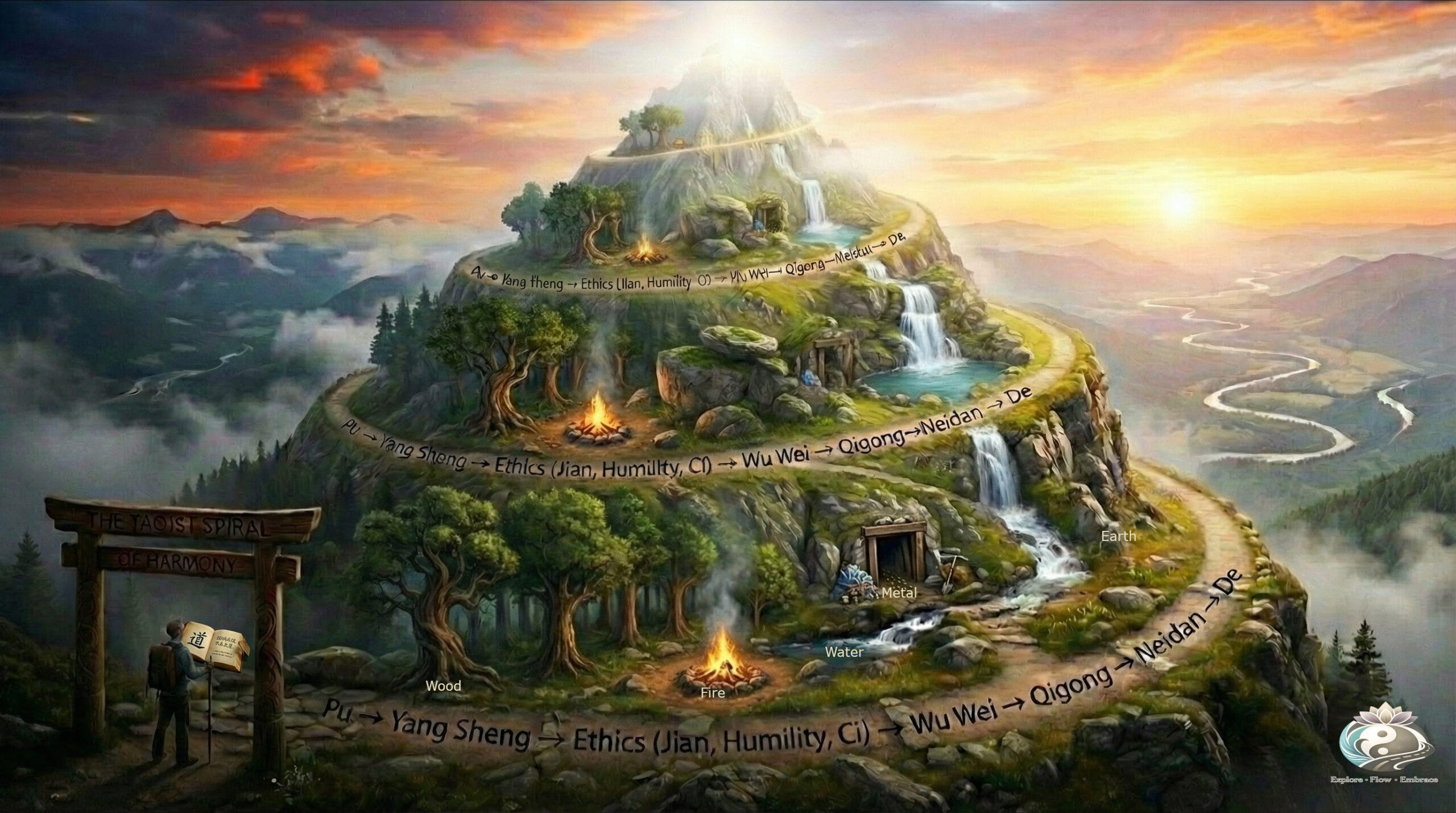
The Taoist Spiral doesn’t exist in a vacuum. It interacts with the Five Elements (Wood, Fire, Earth, Metal, Water)—the fundamental rhythms of nature seen in seasons, times of day, and your emotions.
- You practice Yang Sheng differently in the reflective Water of Winter (rest) than in the expansive Wood of Spring (new projects).
- You apply Wu Wei by aligning with the Fire energy of midday (peak activity) and the Metal energy of evening (letting go).
The Five Elements are the “when” and “how” of the spiral. They provide the rhythmic context for every practice.
The Complete Journey: Climbing the Mountain (and Descending into the Valley)
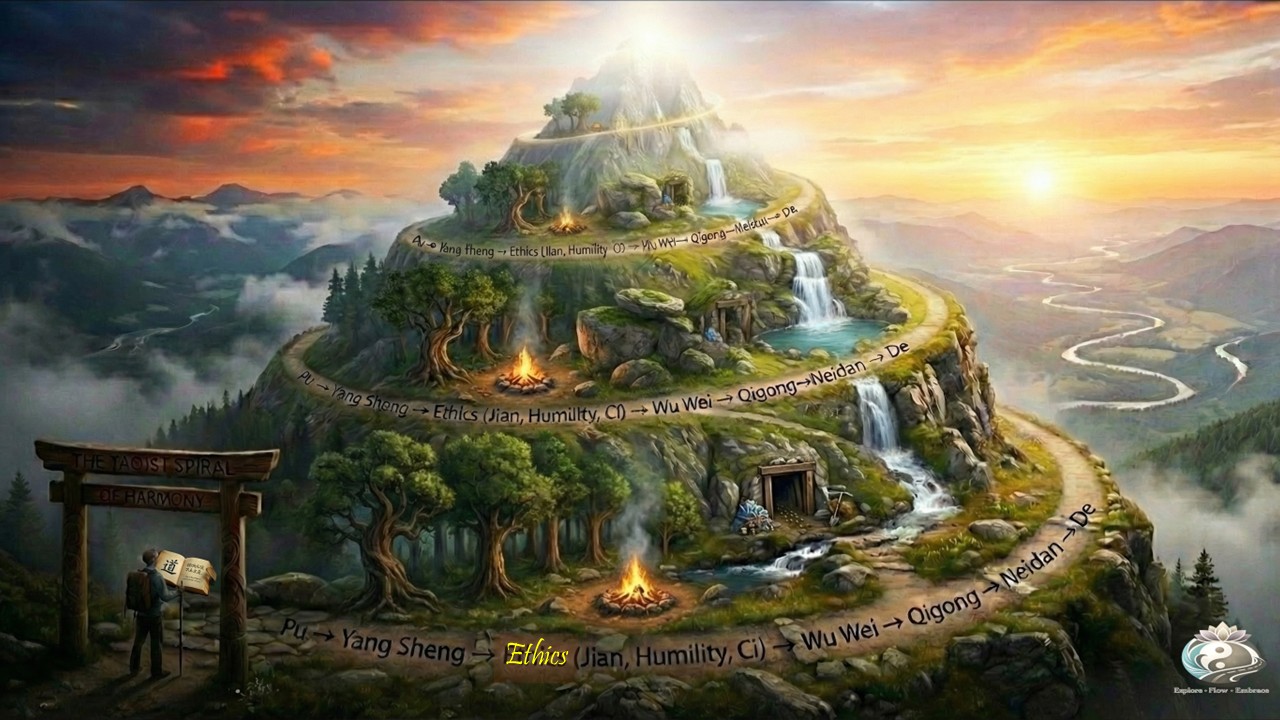
Imagine climbing a mountain on a switchback trail. Each full loop brings you back over the same type of terrain (you practice “Ethics” again, you do “Qigong” again), but you are hundreds of feet higher. The view (your Shen) is broader and clearer with each loop. The climb doesn’t get easier, but you become a more masterful climber.
And yet. The mountain is not the final word. The summit is not a peak you can stand on. It dissolves into the valley, into emptiness, into the Tao. This is why the summit is clouded—so it can never be seen, only approached and returned from.
The spiral does not make you better in the way a ladder does. It makes you more yourself—more empty, more present, more aligned with what is. Mastery on this path is not arriving; it is the ongoing, deepening capacity to return. To let go. To begin again.
This is the Taoist Spiral of Harmony.
- The Tao Te Ching is the Guide Book—the Compass and the Mirror.
- The Brightening Path is your refining Jing, Qi, and Shen, and your return to Emptiness.
- The Looping Trail is your engagement with Pu, Yang Sheng, Ethics, Wu Wei, and Inner Work.
- The Mountain Environment is the ever-present cycle of the Five Elements.
- The Summit isn’t a peak you reach (clouded so it can never be seen), but the endless process of ascending into greater light, simplicity, and effortless harmony—and descending into the empty source from which all arises.
Your Invitation to the Spiral
It is a map for a life not of struggle, but of gentle, intelligent, and radiant becoming. Your task is not to reach the end, but to engage sincerely with the spiral—and watch as your inner light naturally brightens the way.
Ready to begin your first turn? Start with Pu. Tonight, spend five minutes in silence. Let go of the day’s stories. Just be. That simple, uncarved awareness is where the entire spiral—and your most effortless life—begins.
In each of the follow-up posts, we expand on this journey and share ideas on how to practice in your modern, busy life.
The Uncarved Block (PU): How to Find Peace & Potential in Your Already-Busy Life
Yang Sheng: The Ancient Art of “Life Nourishment” (And How to Practice It in Your Modern Life)
Tags: #TaoistSpiral #WuWei #FiveElements #JingQiShen #Qigong #Neidan #YangSheng #Taoism #EffortlessLiving #PersonalGrowth #CyclicalGrowth #SpiritualPractice #InternalAlchemy