The tallest tree snaps in the storm; the bamboo bends and survives. The river that yields to every rock eventually reaches the sea; the dam that stands rigid is eventually broken.
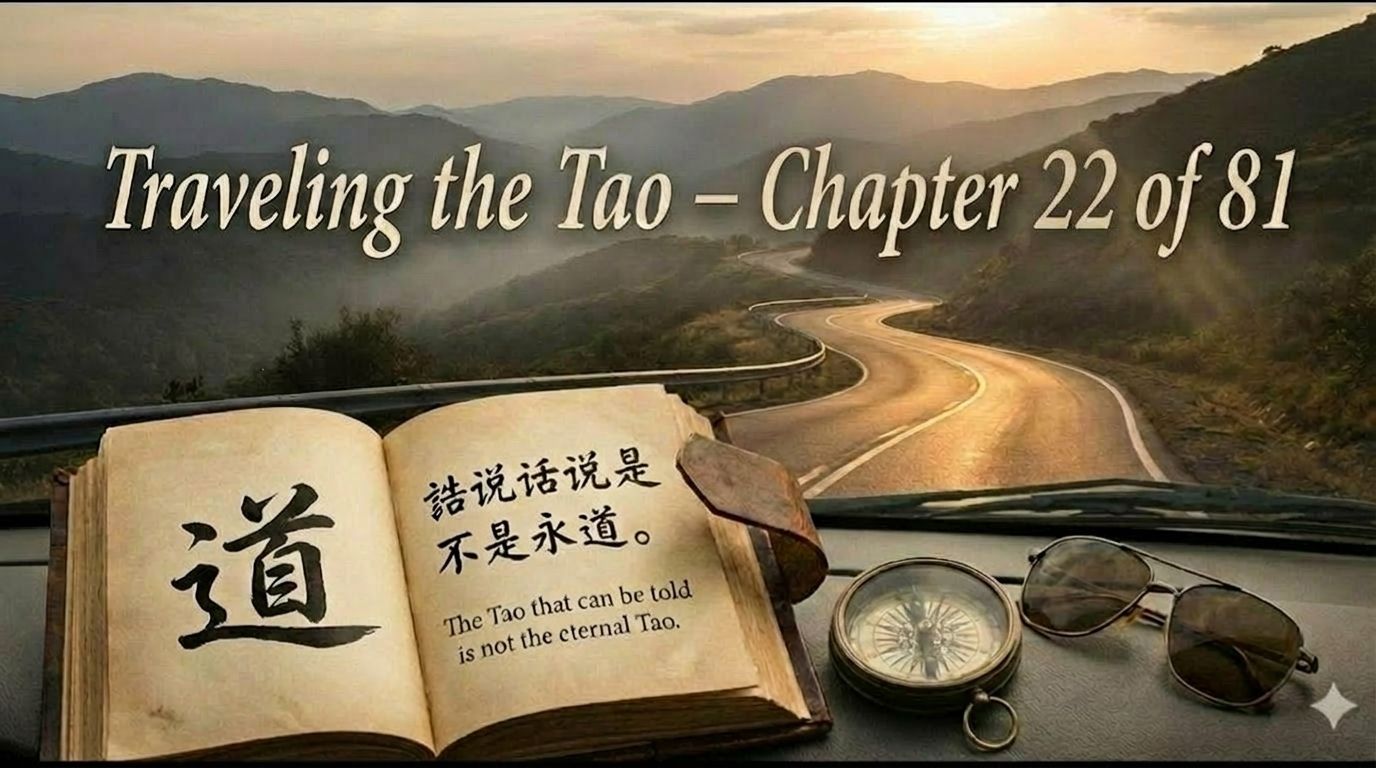
Tao Te Ching Chapter 22 reveals the great paradox of the road: yielding is the path to wholeness, bending is the way to straightness, and the traveler who does not contend can never be opposed.
Executive Summary
Tao Te Ching Chapter 22 teaches the paradox at the heart of the Tao: what bends becomes whole, what yields becomes strong, what empties becomes fulfilled.
This chapter reframes power as flexibility rather than force, showing that those who do not insist on being right, superior, or rigid naturally rise to leadership. By embracing humility, openness, and the willingness to be “unfinished,” the sage becomes complete without striving.
The world trusts those who do not cling to status, and honors those who do not seek honor.
The chapter ultimately reveals that alignment with the Tao comes through softening, not hardening—through becoming the space where harmony can gather.

Chapter 22
Yield and remain whole
Tao te ching 22 Of 81
Bend and remain straight
Be low and become filled
Be worn out and become renewed
Have little and receive
Have much and be confused
Therefore the sages hold to the one as an example for the world
Without flaunting themselves – and so are seen clearly
Without presuming themselves – and so are distinguished
Without praising themselves – and so have merit
Without boasting about themselves – and so are lasting
Because they do not contend the world cannot contend with them
What the ancients called “the one who yields and remains whole”
Were they speaking empty words?
Sincerity becoming whole, and returning to oneself
The Traveler’s Paradox
After learning to follow the indistinct trail of the Tao in Chapter 21, Tao Te Ching Chapter 22 delivers one of the most practical and counterintuitive teachings in the entire text. Lao Tzu presents a series of paradoxes that turn conventional wisdom on its head. The world says: stand firm, push forward, assert yourself. The Tao says: yield, bend, be low, have little. And in that yielding, you find a wholeness that the rigid can never achieve.
For the traveler on life’s road, this chapter is a survival manual for long journeys. It teaches that flexibility, humility, and non‑contention are not weaknesses – they are the very qualities that allow you to endure, to succeed, and to arrive whole.
The Six Paradoxes of the Road
The chapter opens with a cascade of couplets, each presenting a seeming contradiction:
1. Yield and Remain Whole
“Yield and remain whole.”
The Traveler’s Insight: Imagine two hikers caught in a sudden storm. One tries to push through, fighting the wind, refusing to take shelter. The other yields – finds a cave, waits out the worst, then continues. The first may be battered or lost; the second arrives whole. Yielding does not mean giving up; it means knowing when to step aside, to wait, to adapt. The whole traveler is not the one who never bends, but the one who bends and therefore never breaks.
2. Bend and Remain Straight
“Bend and remain straight.”
The Traveler’s Insight: A bow that cannot bend cannot shoot an arrow. A road that has no curves cannot cross a mountain. On a journey, the ability to bend – to change plans, to accept detours, to revise expectations – is what keeps you moving straight toward your true destination. The rigid traveler, clinging to a straight line on the map, often ends up lost. The bending traveler, flexible and adaptive, arrives exactly where they need to be.
3. Be Low and Become Filled
“Be low and become filled.”
The Traveler’s Insight: Water seeks the lowest place – and there it gathers, deep and abundant. The traveler who acts like a valley, receptive and humble, receives knowledge, help, and hospitality from others. The proud traveler, standing on their high horse, is avoided. The low traveler is filled – with stories, with connections, with the richness of the journey.
4. Be Worn Out and Become Renewed
“Be worn out and become renewed.”
The Traveler’s Insight: Every long journey wears down the traveler – tired feet, exhausted mind, depleted resources. But that very exhaustion is the prelude to renewal. The night’s rest after a hard day’s walk is sweeter than any idle afternoon. The worn‑out trail eventually leads to a hot meal and a soft bed. By accepting the wearing out, you open yourself to the renewal that follows.
5. Have Little and Receive
“Have little and receive.”
The Traveler’s Insight: The traveler with a small backpack is grateful for every small gift – a cup of tea, a shared meal, a ride from a stranger. The traveler with too much luggage is too busy protecting their possessions to receive anything new. Having little creates space for receiving. The empty cup can be filled; the full cup overflows.
6. Have Much and Be Confused
“Have much and be confused.”
The Traveler’s Insight: The traveler with too many options – too many guidebooks, too many gadgets, too many itineraries – is paralyzed. They are confused by abundance. The sage traveler keeps only what is essential, and with that clarity, moves without hesitation.
The Sage’s Way: Holding to the One
“Therefore the sages hold to the one as an example for the world.”
The Traveler’s Insight: The “one” is the Tao itself – the single, unifying principle beneath all paradoxes. The sage does not get lost in the many (the ten thousand things). They hold to the one: the simple, yielding, humble way that underlies all success.
The Four Not‑Doings That Lead to Lasting
The chapter then lists four things the sage does not do – and the rewards that follow:
“Without flaunting themselves – and so are seen clearly. Without presuming themselves – and so are distinguished. Without praising themselves – and so have merit. Without boasting about themselves – and so are lasting.”
The Traveler’s Insight: On the road, the traveler who constantly announces their achievements – “I’ve climbed that,” “I know this place,” “Let me tell you about my adventures” – eventually becomes invisible. People stop listening. But the quiet traveler, who does not flaunt, is noticed precisely because they don’t demand attention. Their presence speaks.
The one who does not presume to know the way may be asked for directions because they listen first. The one who does not praise themselves receives praise from others – and it is genuine. The one who does not boast builds a reputation that lasts, because it is built on substance, not noise.
“Because they do not contend, the world cannot contend with them.”
The Traveler’s Insight: This is the ultimate protection. If you refuse to play the game of competition – who is first, who is best, who has the most – no one can defeat you. You are not in the race. You are walking your own path, at your own pace. The world’s contention simply passes you by, like wind around a stone.
The Final Question: Were These Empty Words?
“What the ancients called ‘the one who yields and remains whole’ – were they speaking empty words? Sincerity becoming whole, and returning to oneself.”
The Traveler’s Insight: Lao Tzu answers his own question. This is not empty philosophy. It is the most practical advice imaginable. When you sincerely practice yielding, you become whole – not fractured by resistance, not broken by rigidity. And you return to yourself – your true self, the one that was there before you learned to fight, to flaunt, to contend.
The journey of yielding is the journey home.
Your Roadmap: Practicing the Paradoxes on the Road
How do you apply Chapter 22 to your daily travels?
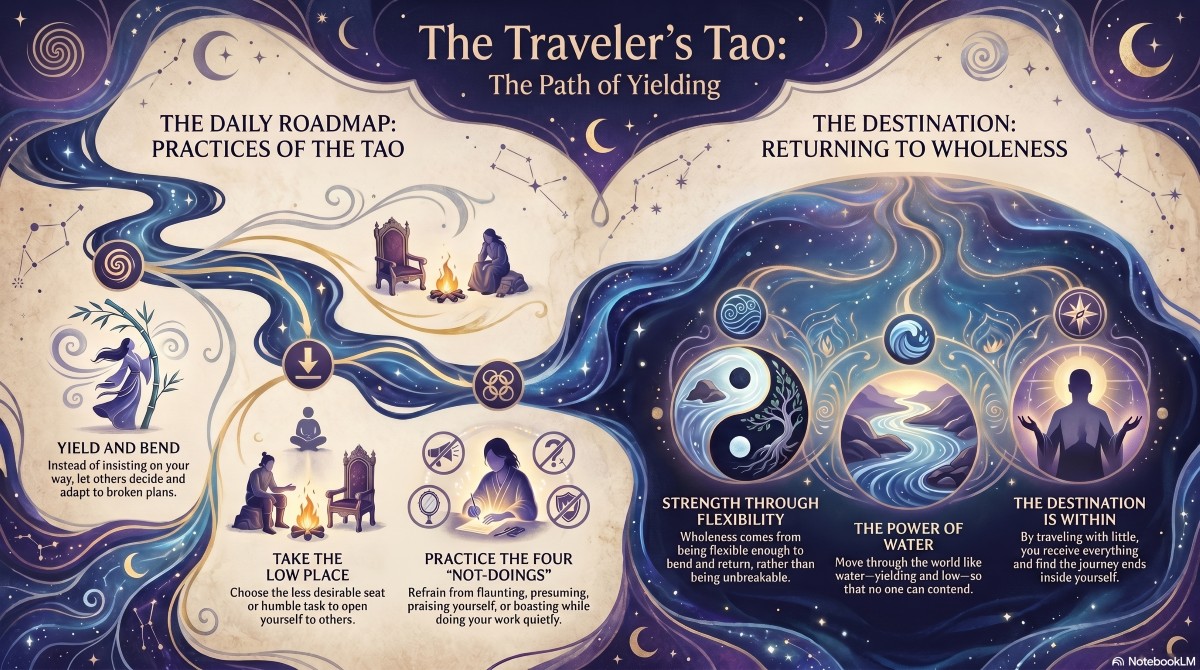
- Yield to One Small Thing Today: Instead of insisting on your way – a restaurant choice, a driving route, a decision – yield. Let someone else decide. Notice that you are still whole. Nothing was lost.
- Bend Instead of Breaking: When a plan falls through, instead of getting angry, say, “Let me bend.” Find the alternative route, the new plan. Watch how bending keeps you moving straight.
- Take the Low Place: In a group, consciously take the less desirable seat, the last turn, the humble task. Notice how being low opens others to you. You may receive unexpected kindness.
- Embrace Being Worn Out: After a hard day, don’t fight your exhaustion. Accept it. Rest deeply. Trust that renewal will come. It always does.
- Travel with Little: Before your next trip, remove one thing you thought you “needed.” See if you miss it. Notice the freedom of having less.
- Practice the Four Not‑Doings: For one day, refrain from flaunting, presuming, praising yourself, and boasting. Just do your work quietly. Notice how others respond – and how you feel.
The Destination: Whole by Yielding
Tao Te Ching Chapter 22 turns the traveler’s world right‑side up. Success is not about pushing harder; it is about yielding at the right time. Wholeness is not about being unbreakable; it is about being flexible enough to bend and return. Recognition comes not from announcing yourself, but from being so present that others cannot help but see.
The traveler who learns these paradoxes moves through the world like water – yielding, bending, low, and therefore whole. They do not contend, so no one can contend with them. They have little, so they receive everything.
This is not the way of the world. But it is the way of the Tao. And it is the path to a journey that never truly ends, because the traveler has become whole, returned to themselves, and found that the destination was within them all along.
Continue Your Journey: Having mastered the art of yielding, Chapter 23 explores speaking sparingly and accepting the natural consequences of our actions – how the wind does not last all morning, and the rain does not last all day.
For the foundational maps of this philosophy, explore our Foundations of the Tao series.