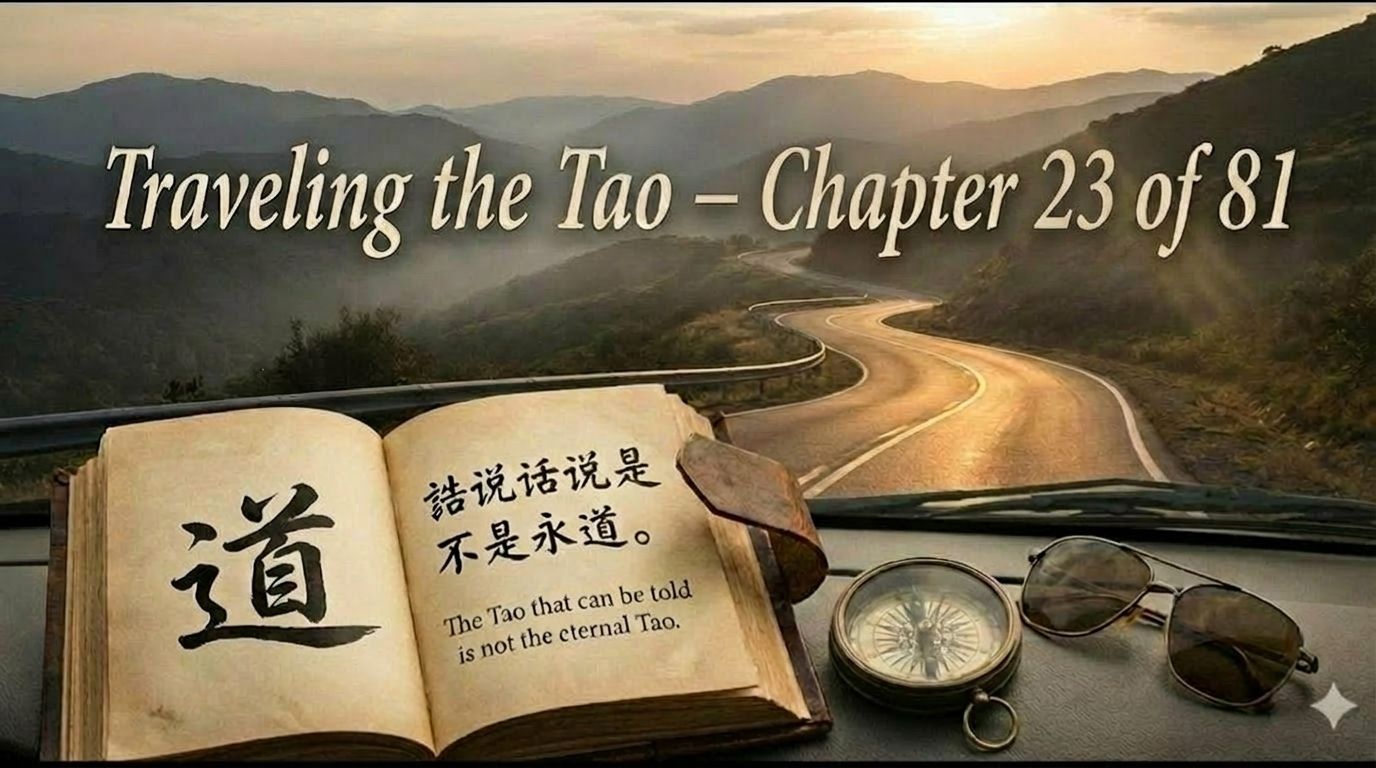
The most violent storm passes quickly. The hardest rain rarely lasts all day. Even Heaven and Earth cannot sustain extreme conditions for long – so why do we try to force our own unnatural intensity?
Tao Te Ching Chapter 23 teaches the traveler to speak little, act naturally, and accept that all extremes eventually return to balance.
Executive Summary
Tao Te Ching Chapter 23 teaches the power of saying less and aligning our actions with the natural rhythms of the Tao.
When we speak sparingly and act without forcing outcomes, we conserve energy and move in harmony with how things actually unfold. Weather changes, seasons shift, and circumstances rise and fall—each follows its own pattern. Humans are no different.
When we align with the Tao, our intentions and actions gain a quiet effectiveness; when we resist, we exhaust ourselves.
The chapter ultimately reminds us that trust—trust in the Tao, trust in timing, trust in the unfolding—is what allows our lives to move with clarity and ease.
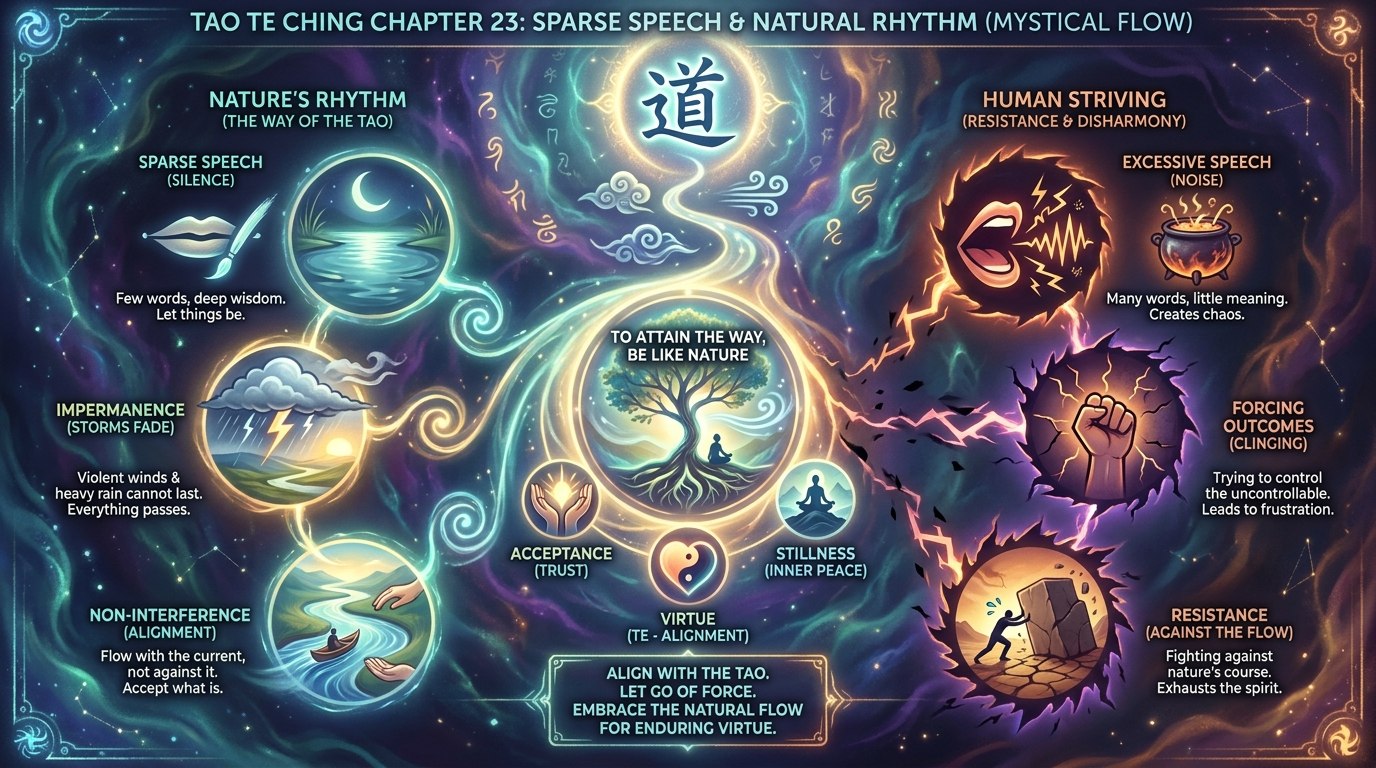
Chapter 23
Sparse speech is natural
Tao te ching 23 Of 81
Thus strong wind does not last all morning
Sudden rain does not last all day
What makes this so?
Heaven and Earth
Even Heaven and Earth cannot make it last
How can humans?
Thus for those who follow the Tao:
Those of the Tao are with the Tao
Those of virtue are with virtue
Those of loss are with loss
Those who are with the Tao
the Tao is also pleased to have them
Those who are with virtue
virtue is also pleased to have them
Those who are with loss
loss is also please to have them
Those who do not trust sufficiently, others have no trust in them
The Traveler Who Talks Too Much
Having learned the art of yielding in Chapter 22, Tao Te Ching Chapter 23 offers a lesson in natural rhythm. Lao Tzu begins with a simple observation about speech – “sparse speech is natural” – then extends it to the very fabric of existence. The fiercest wind lasts only a morning; the heaviest rain lasts only a day. If even Heaven and Earth cannot sustain extremes, what makes us think we can?
For the traveler on life’s road, this chapter is a reminder to stop forcing, stop over‑explaining, and stop expecting intensity to last. The sustainable journey is the one that flows with nature’s own pace – sometimes active, sometimes still, but never strained.
Sparse Speech Is Natural
“Sparse speech is natural.”
The Traveler’s Insight: In the quiet of a forest, no bird sings constantly. In the hum of a city, the most trusted voices are those that speak rarely and meaningfully. The traveler who talks too much – narrating every turn, complaining about every delay, offering unsolicited advice – exhausts themselves and everyone around them. “Sparse speech” means saying only what needs to be said, then falling silent. It is natural, like the wind that gusts then rests.
On a group journey, the quiet traveler is often the one most listened to when they finally speak. Their words carry weight because they are not wasted.
Why Extremes Cannot Last
“Thus strong wind does not last all morning; sudden rain does not last all day. What makes this so? Heaven and Earth. Even Heaven and Earth cannot make it last. How can humans?”
The Traveler’s Insight: Think of the most dramatic moments on any trip – the frantic rush to catch a flight, the furious argument, the wild celebration. None of these last. The human body cannot sustain high adrenaline for long. Relationships cannot survive constant conflict. Even nature itself – vast and powerful as Heaven and Earth – cannot keep a storm going indefinitely.
This is not a flaw; it is a relief. The traveler who understands this stops trying to make the good times last forever and stops fearing that the bad times will never end. The storm will pass. The sun will return. The rhythm of change is the only constant.
Three Kinds of Travelers
The chapter then describes how different people align with reality:
“Thus for those who follow the Tao: Those of the Tao are with the Tao. Those of virtue are with virtue. Those of loss are with loss.”
The Traveler’s Insight: You get what you align with. The traveler who lives simply, flexibly, and without forcing – that is, who “follows the Tao” – finds that the Tao supports them. Doors open; problems resolve; the road provides. This is not magic – it is the natural consequence of moving in harmony with how things work.
Similarly, the traveler who focuses on virtue – genuine, unforced goodness – finds that virtue arises around them. People are kind; help appears; the journey becomes ethical and rewarding.
But the traveler who is “of loss” – who expects failure, who focuses on what is missing, who aligns with negativity – finds that loss multiplies. Their expectations become self‑fulfilling prophecies.
“Those who are with the Tao, the Tao is also pleased to have them. Those who are with virtue, virtue is also pleased to have them. Those who are with loss, loss is also pleased to have them.”
The Traveler’s Insight: This is the law of resonance. Like attracts like. If you approach the road with trust, the road becomes trustworthy. If you approach with fear, you find reasons to fear. The Tao does not punish or reward; it simply reflects your own alignment back to you.
The Final Warning About Trust
“Those who do not trust sufficiently, others have no trust in them.”
The Traveler’s Insight: Trust is a circle. The distrustful traveler – suspicious of locals, paranoid about theft, cynical about kindness – sends out signals that others read. They are met with guardedness, distance, or even deception. The traveler who trusts first – wisely but genuinely – finds that most people rise to meet that trust.
On the road, this is not naive. It is practical: when you assume good intentions, you create the conditions for good interactions. When you assume betrayal, you often provoke it.
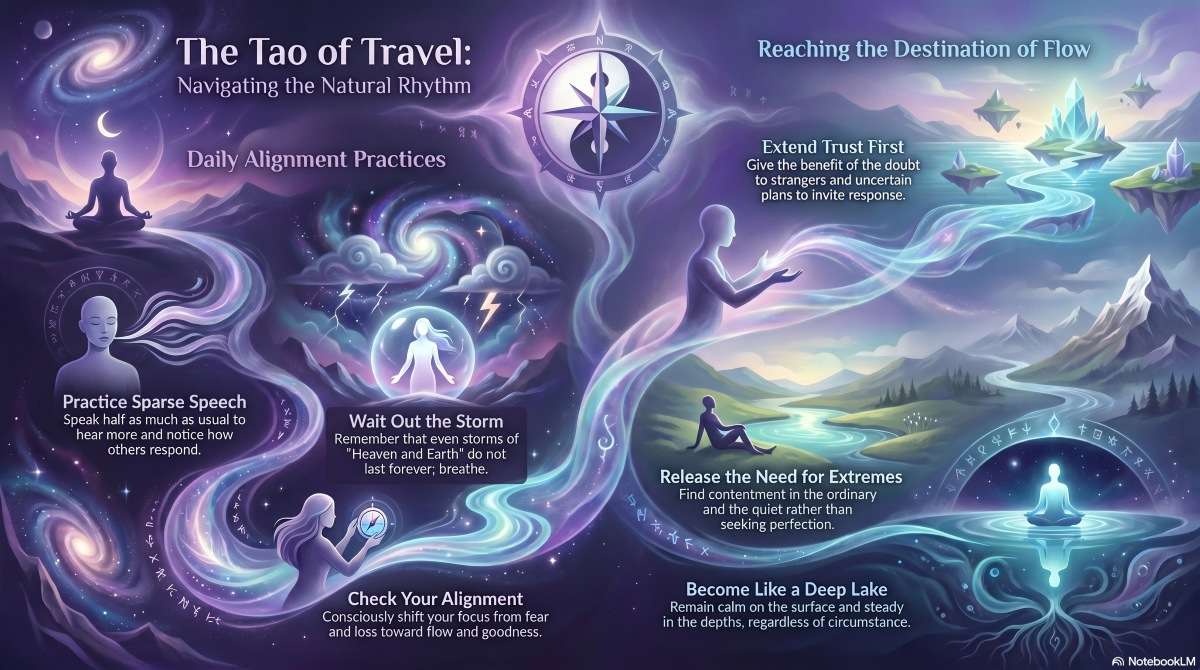
Your Roadmap: Traveling with Natural Rhythm
How do you apply Chapter 23 to your daily journeys?
- Practice Sparse Speech: For one day, speak only half as much as usual. Let silence do its work. Notice how others respond – and how much more you hear.
- Wait Out the Storm: When something difficult arises – a delay, a conflict, a disappointment – remind yourself: “This will not last. Even Heaven and Earth cannot make storms endure.” Breathe. Let time pass.
- Check Your Alignment: Ask yourself: “Am I aligning with the Tao (flow), with virtue (goodness), or with loss (fear and lack)?” Gently shift toward the first two.
- Extend Trust First: In a new situation – a stranger, a new road, an uncertain plan – consciously give the benefit of the doubt. Say, “I trust this.” Notice how the situation responds.
- Release the Need for Extremes: Let go of the idea that a journey must be either perfect or terrible. Accept the ordinary, the medium, the quiet. Find contentment in the natural rhythm.
The Destination: Flowing with Heaven and Earth
Tao Te Ching Chapter 23 offers a profound relief: you do not need to force anything to last. The storm will pass. The rain will stop. The wind will settle. By speaking sparsely, aligning naturally, and trusting sufficiently, you move with the very rhythm of Heaven and Earth.
The traveler who lives this way is not blown about by every gust of circumstance. They are like a deep lake – calm on the surface, steady in the depths, receiving whatever comes and letting it go.
Sparse speech. Natural action. Trust that reflects trust. This is the way of the Tao – and the path to a journey that never exhausts, because it never fights.
Continue Your Journey: Having learned the rhythm of nature, Chapter 24 warns against standing on tiptoes – those who flaunt themselves do not shine, and the traveler who tries to advance too far will soon have to retreat.
For the foundational maps of this philosophy, explore our Foundations of the Tao series.