Introduction
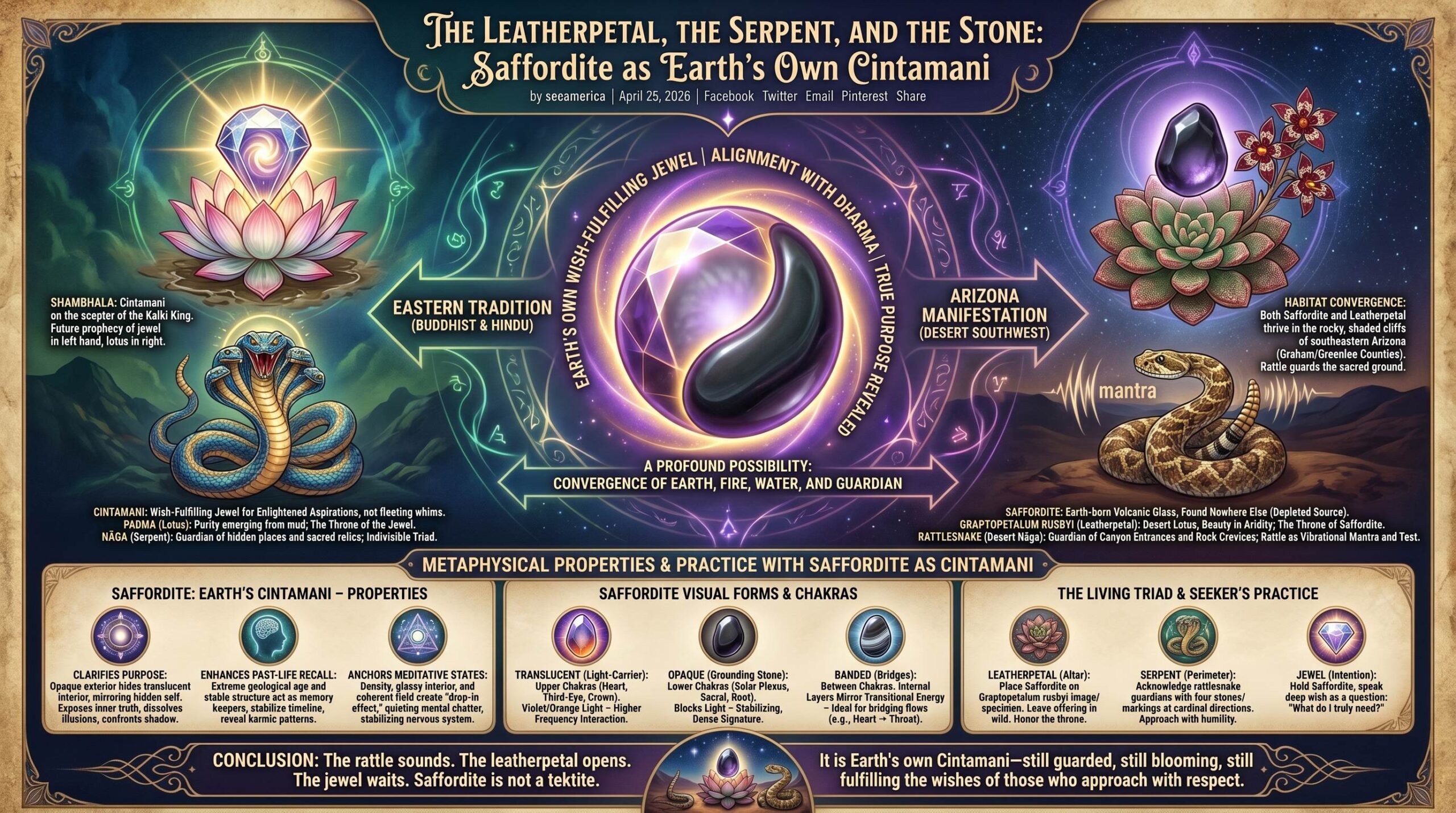
In the sacred texts of the Hindu and Buddhist traditions, three symbols often appear together: the wish-fulfilling jewel (Cintamani), the serpent guardian (nāga), and the lotus (padma). The jewel rests in the lotus. The serpent guards the lotus. And the seeker must approach all three with humility.
For centuries, this triad seemed confined to Asia—to the paintings of Tibet, the temples of India, the gardens of China.
But the desert of southern Arizona holds a striking parallel. Here, the Cintamani appears as Saffordite (a volcanic glass found nowhere else). The nāga appears as the rattlesnake (guardian of hidden places). And the lotus appears as Graptopetalum rusbyi—known commonly as the San Francisco River Leatherpetal, a rare succulent whose botanical rosette mirrors the sacred padma and whose habitat overlaps exactly with the stone it guards.
This article explores a profound possibility:
- What if the complete Cintamani triad—jewel, serpent, lotus—is not confined to the Eastern hemisphere?
- What if it manifests wherever earth, fire, water, and guardian converge?
- What if that convergence is alive and flourishing in the canyons and cliffs of southeastern Arizona?
Part I: The Cintamani in Scripture
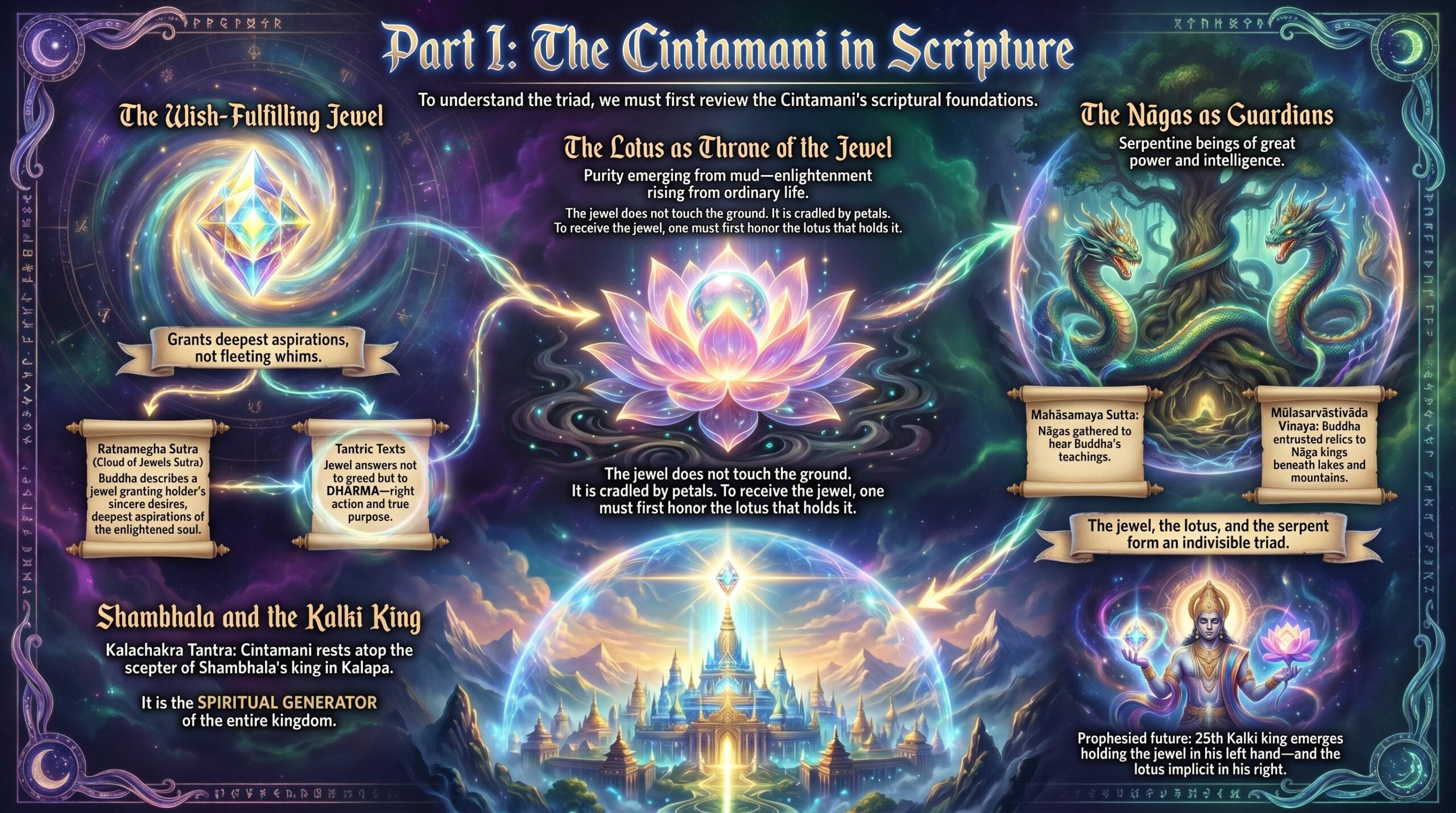
To understand the triad, we must first review the Cintamani’s scriptural foundations.
The Wish-Fulfilling Jewel
The most common epithet for the Cintamani is precisely that: wish-fulfilling. In the Ratnamegha Sutra (Cloud of Jewels Sutra), the Buddha describes a jewel that grants whatever its holder sincerely desires—not fleeting whims, but the deepest aspirations of the enlightened soul. Later tantric texts clarify that the jewel answers not to greed but to dharma—right action and true purpose.
The Lotus as Throne of the Jewel
In Buddhist and Hindu iconography, the Cintamani is almost always depicted resting upon an open lotus flower (padmasana). The lotus signifies purity emerging from mud—enlightenment rising from the messy substratum of ordinary life. The jewel does not touch the ground. It is cradled by petals. To receive the jewel, one must first honor the lotus that holds it.
The Nāgas as Guardians
Both the jewel and the lotus are protected by nāgas—serpentine beings of great power and intelligence. The Mahāsamaya Sutta describes nāgas gathering to hear the Buddha’s teachings, and the Mūlasarvāstivāda Vinaya recounts how the Buddha entrusted relics to nāga kings beneath lakes and mountains. The jewel, the lotus, and the serpent form an indivisible triad.
Shambhala and the Kalki King
The Kalachakra Tantra provides the most detailed account. The Cintamani rests atop the scepter of Shambhala’s king, housed in the capital city of Kalapa. It is the spiritual generator of the entire kingdom. In the prophesied future, the 25th Kalki king will emerge holding the jewel in his left hand—and the lotus implicit in his right.
Part II: Graptopetalum rusbyi — The Leatherpetal as Desert Lotus
Botanical Truth
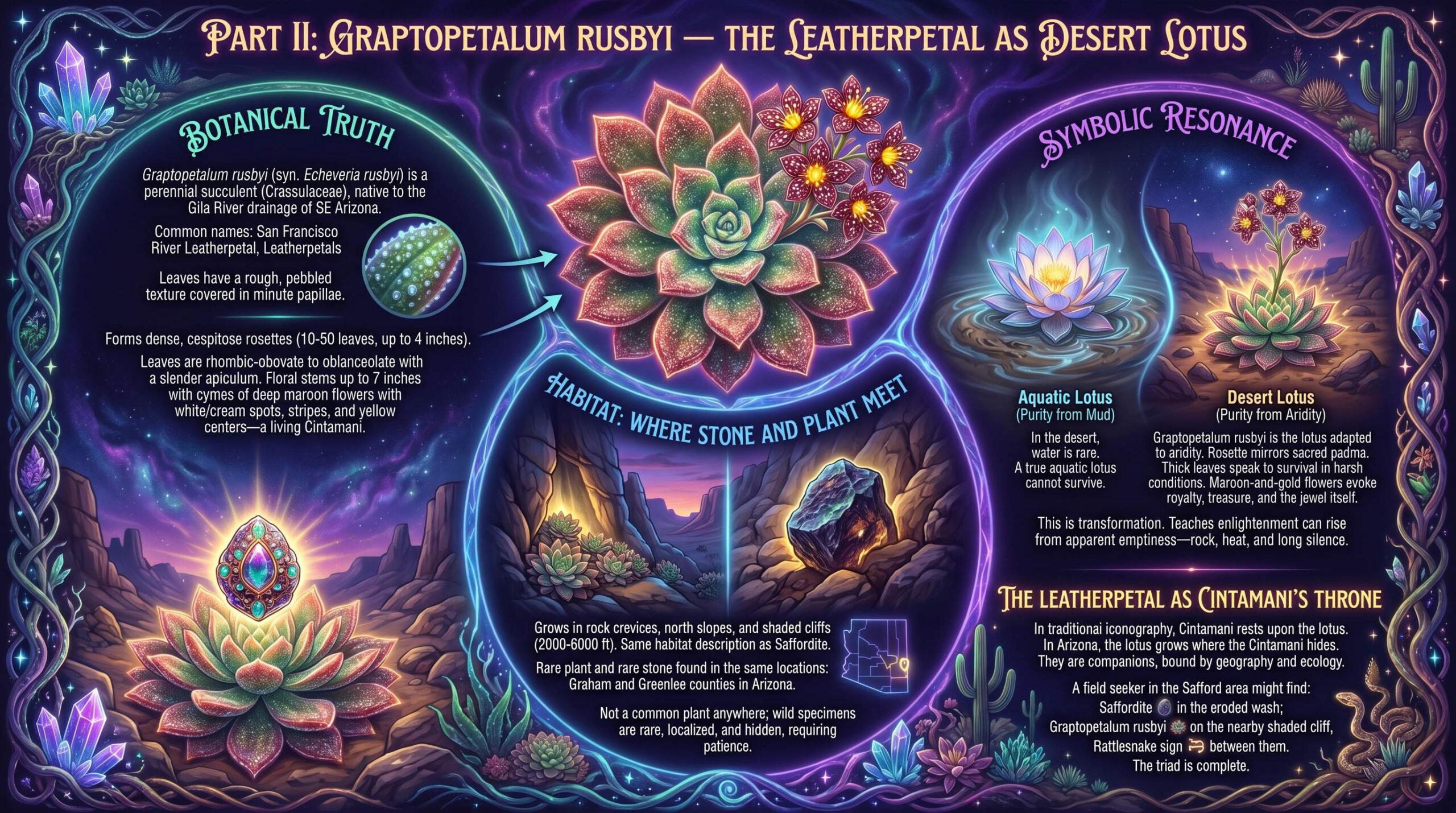
Graptopetalum rusbyi (syn. Echeveria rusbyi) is a perennial succulent in the stonecrop family (Crassulaceae), native exclusively to the Gila River drainage of southeastern Arizona. Its common names—San Francisco River Leatherpetal, or simply Leatherpetals—speak to the rough, pebbled texture of its leaves, which are covered in minute papillae.

Graptopetalum rusbyi Photo by: © Plantemania
The plant forms dense, cespitose rosettes of 10 to 50 leaves, each rosette measuring up to 4 inches in diameter. The leaves are rhombic-obovate to oblanceolate, colored green or reddish, with a slender apiculum at the apex. In late spring, the plant sends up floral stems up to 7 inches tall, bearing flat cymes of remarkable flowers: deep maroon with white or cream-colored spots and stripes, and yellow centers. The effect is that of a jewel set within the rosette—a living Cintamani.
Habitat: Where Stone and Plant Meet
The critical detail for our inquiry is this: Graptopetalum rusbyi grows in rock crevices, especially on north slopes and on shaded cliffs, at elevations between 2000 and 6000 feet. This is precisely the same habitat description given for Saffordite. The rare plant and the rare stone are found in the same locations: Graham and Greenlee counties in Arizona.
The New Mexico Rare Plants database notes that the species is “not a common plant anywhere,” and wild specimens are seldom seen. Like Saffordite, Graptopetalum rusbyi is rare, localized, and hidden in plain sight—requiring patience and respect to find.
Symbolic Resonance
In the desert, water is rare. A true aquatic lotus cannot survive. And yet, the form persists. Graptopetalum rusbyi is the lotus adapted to aridity—purity without the pond, beauty without the mud. Its rosette shape mirrors the sacred padma with uncanny precision. Its thick, water-storing leaves speak to survival in the harshest conditions. Its maroon-and-gold flowers evoke the colors of royalty, of treasure, of the jewel itself.
This is not a diminishment. It is a transformation. The aquatic lotus teaches that enlightenment rises from the messy depths. The desert lotus teaches that enlightenment can also rise from apparent emptiness—from rock, from heat, from the long silence between rains.
The Leatherpetal as Cintamani’s Throne
In traditional iconography, the Cintamani rests upon the lotus. In Arizona, one could say: the lotus grows where the Cintamani hides. Saffordite is found in rocky desert terrain—precisely the kind of ground where Graptopetalum rusbyi thrives. The two are not merely adjacent. They are companions, bound by geography and ecology.
A field seeker in the Safford area might find:
- Saffordite in the eroded wash
- Graptopetalum rusbyi on the shaded north face of a nearby cliff, its maroon-spotted flowers nodding in the breeze
- Rattlesnake sign (shed skin, tracks, or the animal itself) between them
The triad is complete.
Part III: The Rattlesnakes as Nāgas of the Desert
The Serpent Archetype
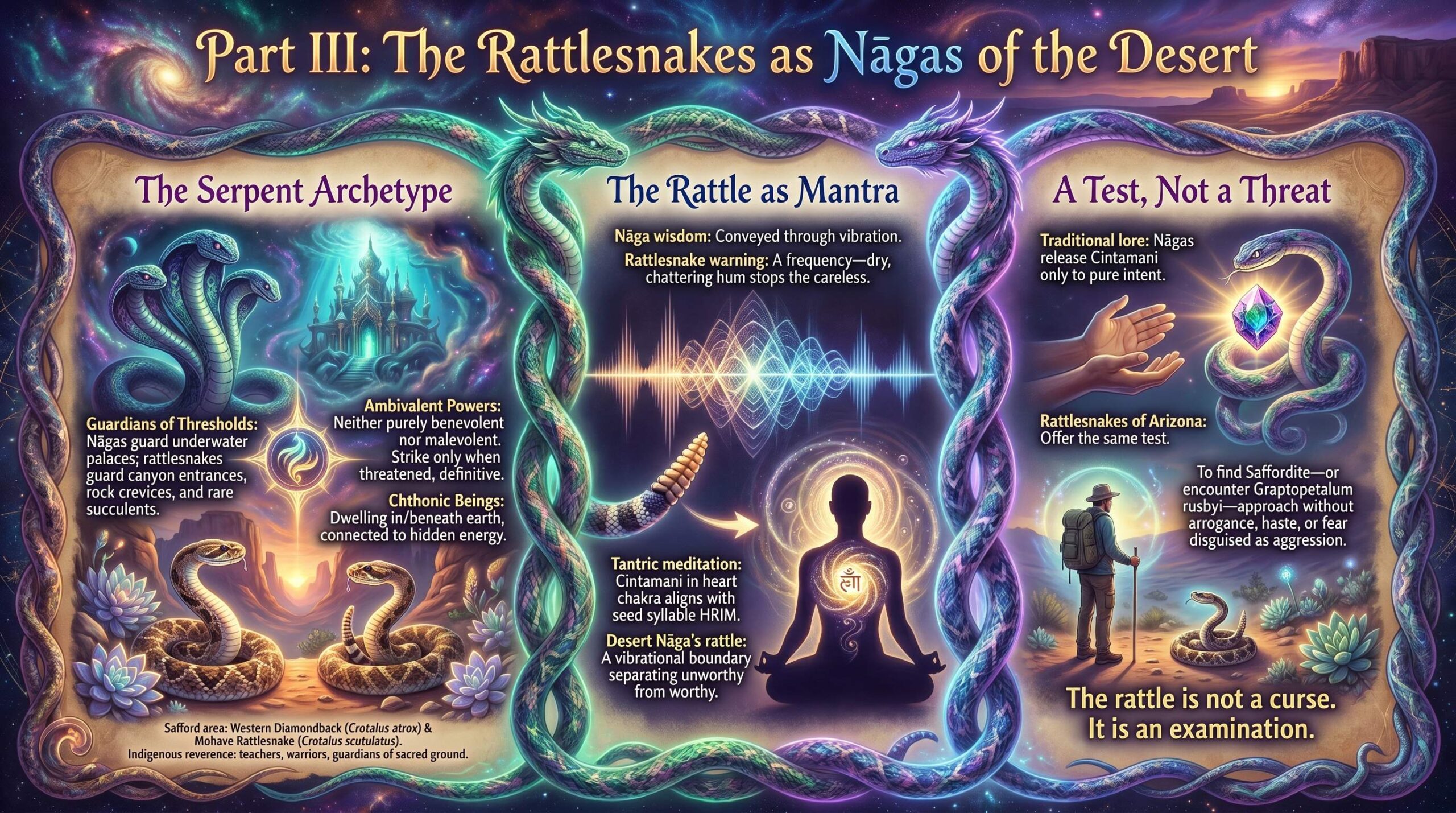
In the Arizona desert, the rattlesnake (Crotalus species) holds a place remarkably similar to the nāga of Eastern tradition. Both are:
- Guardians of thresholds – nāgas guard underwater palaces; rattlesnakes guard canyon entrances, rock crevices, and the base of rare succulents.
- Ambivalent powers – neither purely benevolent nor malevolent. They strike only when threatened, but their strike is definitive.
- Chthonic beings – dwelling in or beneath the earth, connected to hidden sources of energy.
The Safford area is home to the Western Diamondback (Crotalus atrox) and the Mohave Rattlesnake (Crotalus scutulatus). For Indigenous peoples of the Sonoran Desert, rattlesnakes were regarded with a mixture of fear and reverence—as teachers, as warriors, and as guardians of sacred ground, including the places where Graptopetalum rusbyi grows.
The Rattle as Mantra
The nāga does not speak in human language. Its wisdom is conveyed through vibration. Similarly, the rattlesnake’s warning is a frequency—a dry, chattering hum that stops the careless hunter mid-stride.
In tantric meditation, the Cintamani is often visualized within the heart chakra, its vibration aligning with the seed syllable HRIM (pronounced hreem). The rattle of the desert nāga can be understood as the same principle: a vibrational boundary separating the unworthy from the worthy.
A Test, Not a Threat
Traditional lore holds that the nāgas will only release the Cintamani to someone of pure intent. The rattlesnakes of Arizona offer the same test. To find Saffordite—or to encounter Graptopetalum rusbyi in its native habitat—one must approach without arrogance, without haste, and without fear disguised as aggression.
The rattle is not a curse. It is an examination.
Part IV: Saffordite as Earth’s Cintamani
Geological Truth
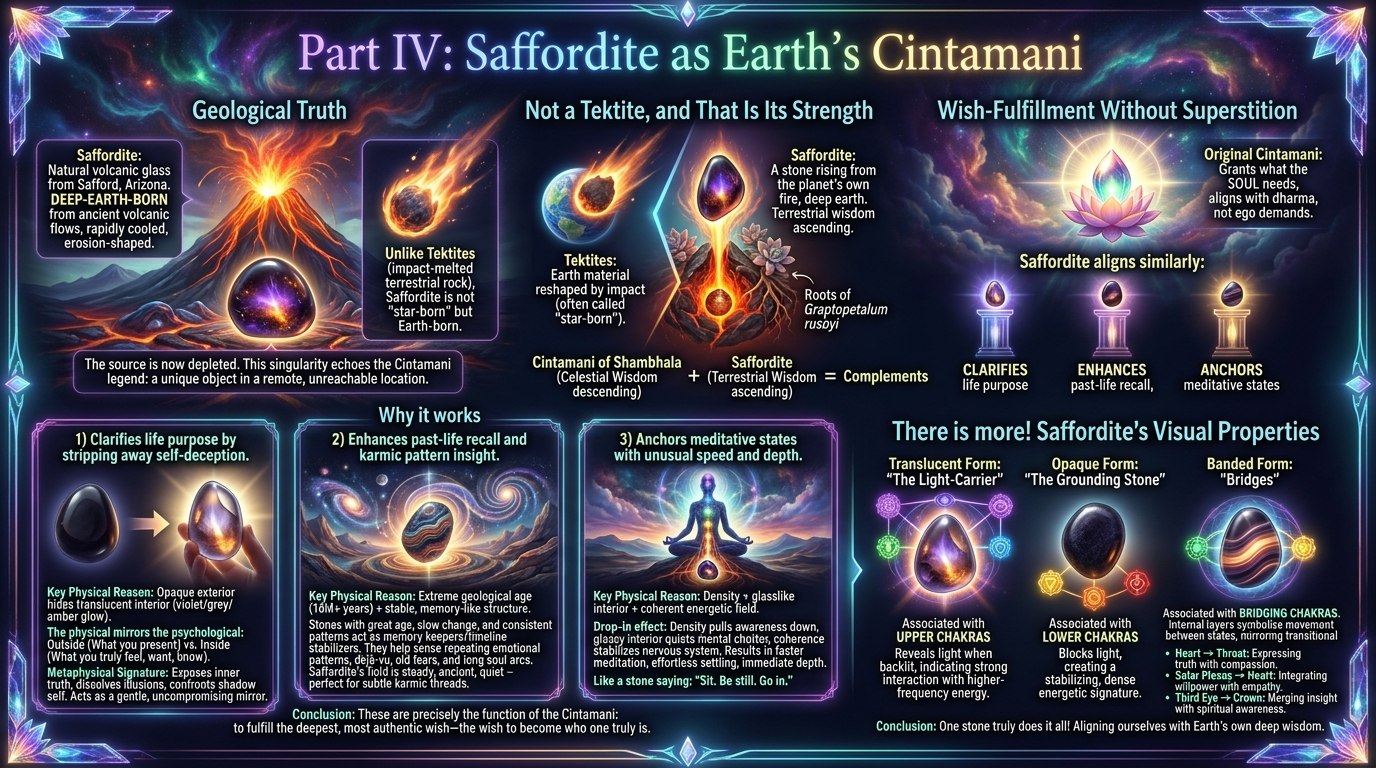
Saffordite is a natural volcanic glass found exclusively near Safford, Arizona. Unlike tektites—which are terrestrial rocks melted by meteorite impacts—Saffordite is deep-Earth-born. It formed from ancient volcanic flows, somehow cooled rapidly without crystallizing, and was shaped over millennia by erosion.
The source is now depleted. No more Saffordite will ever be found in its original location. This singularity echoes the Cintamani legend of a unique object hidden in a remote, almost unreachable location.
Not a Tektite, and That Is Its Strength
Tektites are often marketed as “star-born,” but this is poetic license. They are Earth material reshaped by impact. Saffordite makes no such claim. It offers something arguably more mysterious: a stone that rose from the planet’s own fire, from the same deep earth that feeds the roots of Graptopetalum rusbyi.
If the Cintamani of Shambhala represents celestial wisdom descending to Earth, Saffordite represents terrestrial wisdom ascending to meet it. The two are complements.
Wish-Fulfillment Without Superstition
The original Cintamani grants what the soul truly needs, not what the ego demands. In Buddhist terms, it aligns the holder with their dharma.
Saffordite, in metaphysical practice, is described similarly:
- Clarifies life purpose by stripping away self-deception
- Enhances past-life recall, helping to resolve karmic patterns
- Anchors meditative states with unusual speed and depth
1) Why it “clarifies life purpose by stripping away self‑deception.”
Key physical reason: the opaque exterior hides a translucent interior
Saffordite looks like a solid black stone… until you hold it to the light and discover the hidden violet‑grey glow inside. Note – amber, grey, and even subtle olive-green hues are also found.
That physical pattern mirrors a psychological one:
- Outside: what you present to the world
- Inside: what you actually feel, want, or know
This “hidden interior revealed only under light” creates a metaphysical signature of:
- exposing inner truth
- dissolving illusions
- confronting the parts of yourself you normally keep in shadow
It’s not symbolic only — the stone’s field actually behaves like a “truth‑revealer.” People feel it as a gentle but uncompromising mirror.
This is why it cuts through self‑deception and clarifies purpose.
2) Why it “enhances past‑life recall and karmic pattern insight”
Key physical reason: extreme geological age + stable, memory‑like structure
Saffordite is ancient — 18 million plus years old — and its structure is unusually stable. Metaphysically, stones with:
- great age
- slow geological change
- consistent internal patterning
…tend to act like memory keepers or timeline stabilizers.
This doesn’t mean they “show you past lives” literally. It means they help you sense:
- repeating emotional patterns
- déjà‑vu relationships
- old fears that feel older than this lifetime
- long arcs of your soul’s development
Saffordite’s field is steady, ancient, and quiet — perfect conditions for noticing subtle karmic threads.
This is why it supports past‑life recall and karmic resolution.
3) Why it “anchors meditative states with unusual speed and depth”
Key physical reason: density + glasslike interior + coherent energetic field
Saffordite has a rare combination:
- dense, grounding mass
- smooth, glassy interior that conducts energy cleanly
- a naturally coherent, stable energetic field
Together, these create a “drop‑in effect”:
- the density pulls your awareness downward
- the glassy interior quiets mental chatter
- the coherence stabilizes your nervous system
This is why people feel:
- meditation starts faster
- the mind settles without effort
- the depth feels immediate rather than gradual
It’s like a stone that says, “Sit. Be still. Go in.”
This is why it anchors meditation so quickly and deeply.
Conclusion: These are precisely the function of the Cintamani: to fulfill the deepest, most authentic wish—the wish to become who one truly is.
There is more! Saffordite’s Visual Properties
Saffordite presents its core in 3 visible forms: Translucent, Opaque, and Banded.
We generally associate the translucent form, “the light-carrier”, with the upper Chakras – Heart, Third-eye, and Crown – because it reveals violet or orange/amber light when backlit, indicating a strong interaction with higher‑frequency energy.
We’ve been experimenting with the opaque form, “the grounding stone”, when working with the lower Chakras – Solar Plexus, Sacral, and Root – because it blocks light entirely, creating a stabilizing, dense energetic signature.
Most recently, we started working with the banded form as “bridges” – because the internal layers, when backlit, symbolize movement between states. The banding visually mirrors transitional energy, making it ideal for bridging chakras.
For example, to harmonize flow, we place banded Saffordite between Chakras:
- Heart → Throat: expressing truth with compassion
- Solar Plexus → Heart: integrating willpower with empathy
- Third Eye → Crown: merging insight with spiritual awareness
Conclusion: One stone truly does it all! Aligning ourselves with the corresponding energies accelerates our transformation to enlightenment, and Saffordite is the perfect earth tool.
Part V: The Living Triad — How the Three Work Together
In the desert, the three elements are not separate. They are woven into the same cliffs, the same north-facing slopes, the same secret places where water lingers and guardians coil.
| Element | Eastern Symbol | Arizona Manifestation |
|---|---|---|
| Lotus | Padma | Graptopetalum rusbyi (San Francisco River Leatherpetal) |
| Serpent | Nāga | Rattlesnake (Western Diamondback / Mohave) |
| Jewel | Cintamani | Saffordite (volcanic glass, single source, depleted) |
The Unique Power of the Leatherpetal
Unlike the more common Echeveria cultivars found in garden centers, Graptopetalum rusbyi is a true native, adapted over millennia to the same volcanic slopes that produced Saffordite. Its leaves are not glaucous (waxy) but rough with papillae—a texture that suggests ancientness, weathering, survival. Its flowers, with their maroon, cream, and gold coloration, mirror the colors of royalty and hidden treasure.
One source notes that the flowers have a “distinctive evil smell”. This is not a flaw but a feature: in the logic of guardian plants, unpleasant odors deter the unwary, preserving the plant—and, by extension, the stone it grows alongside—for those who can tolerate discomfort in service of a higher goal.
A Practice for the Seeker
To practice with Saffordite as a Cintamani stone, one can honor the full triad:
- The Leatherpetal as Altar – Place the Saffordite upon an image or dried specimen of Graptopetalum rusbyi. If you are fortunate enough to encounter the living plant in its habitat, leave an offering (water, a small stone, a whispered thanks) before taking your leave. The leatherpetal holds the jewel.
- The Serpent as Perimeter – Set four small stones or markings at the cardinal directions to acknowledge the rattlesnake guardians. Enter the space slowly. Speak aloud: “I come with empty hands and a full heart.”
- The Jewel as Intention – Hold the Saffordite and speak your deepest wish—not as a demand, but as a question: “What do I truly need?”
The rattle sounds. The leatherpetal blooms. The jewel responds.
Conclusion
Perhaps ancient traders told stories of an elusive, black stone that glows, resting amongst serpents and desert flowers. Stories became folklore, adapted to suit the audience while the mystery grew.
The search for the Cintamani has led pilgrims through Himalayan passes, into meditation caves, and across the pages of tantric manuscripts.
Even modern-day leaders have attempted to solve the riddle. Vice President Henry Wallace, who served under Franklin D. Roosevelt, became deeply interested in Cintamani philosophy and provided secret government support for an expedition to the Far East.
But perhaps the serpent-guarded jewel was never confined to one continent. Perhaps the wish-fulfilling stone appears wherever earth, fire, guardian, and plant converge in a sacred tetrad.
In southeastern Arizona, that convergence is complete.
- The fire: ancient volcanic flows, now cooled, that gave birth to Saffordite.
- The earth: a single depleted site, never to be repeated.
- The guardian: the rattlesnake, whose rattle is the oldest mantra on the continent.
- The plant: Graptopetalum rusbyi—the San Francisco River Leatherpetal, blooming from the same cliffs where the stone hides, its maroon-and-gold flowers a testament to beauty in aridity.
Saffordite is not a tektite. It is not a fallen star. It is Earth’s own Cintamani—still guarded, still mysterious, still fulfilling the wishes of those who approach with respect.
Graptopetalum rusbyi is a true child of the desert, rare and wild, found where Saffordite rests. Together, they form a bond that transcends mere coincidence.
The rattle sounds.
The leatherpetal opens.
The jewel waits.
Author’s note: This writing is a mythological and metaphysical exploration, not a botanical or geological claim.
Saffordite is a natural volcanic glass from Arizona. Graptopetalum rusbyi is a rare succulent native to the same region.
Their alignment with the Cintamani triad is poetic—but poetry, as the tantras remind us, is sometimes the truest vehicle for truth.
As such, we believe the following:
Eben & Melinda
Cintamani, the treasure of enlightenment, is hidden in the depths of one’s own mind, guarded by the forces one must face and integrate. Earth tools, such as Saffordite, exist to assist with this journey.
Data compiled from Flora of North America, vPlants, SERNEC, and New Mexico Rare Plants
Where to find or buy Saffordite
Adventure seekers can plan a trip to Safford, Arizona, where Saffordites are found on public land. This effort requires detailed planning because the desert is dangerous for the unprepared. Please read our Guide to Finding Saffordites in Arizona.
An easier option is to buy our hand-mined Saffordites on Etsy.