Executive Summary
Moldavite and Saffordite are often grouped in metaphysical circles, but their value is easier to understand when stripped to their fundamentals.
They are both made of natural glass.
They are both born from heat.
But they represent two completely different processes:
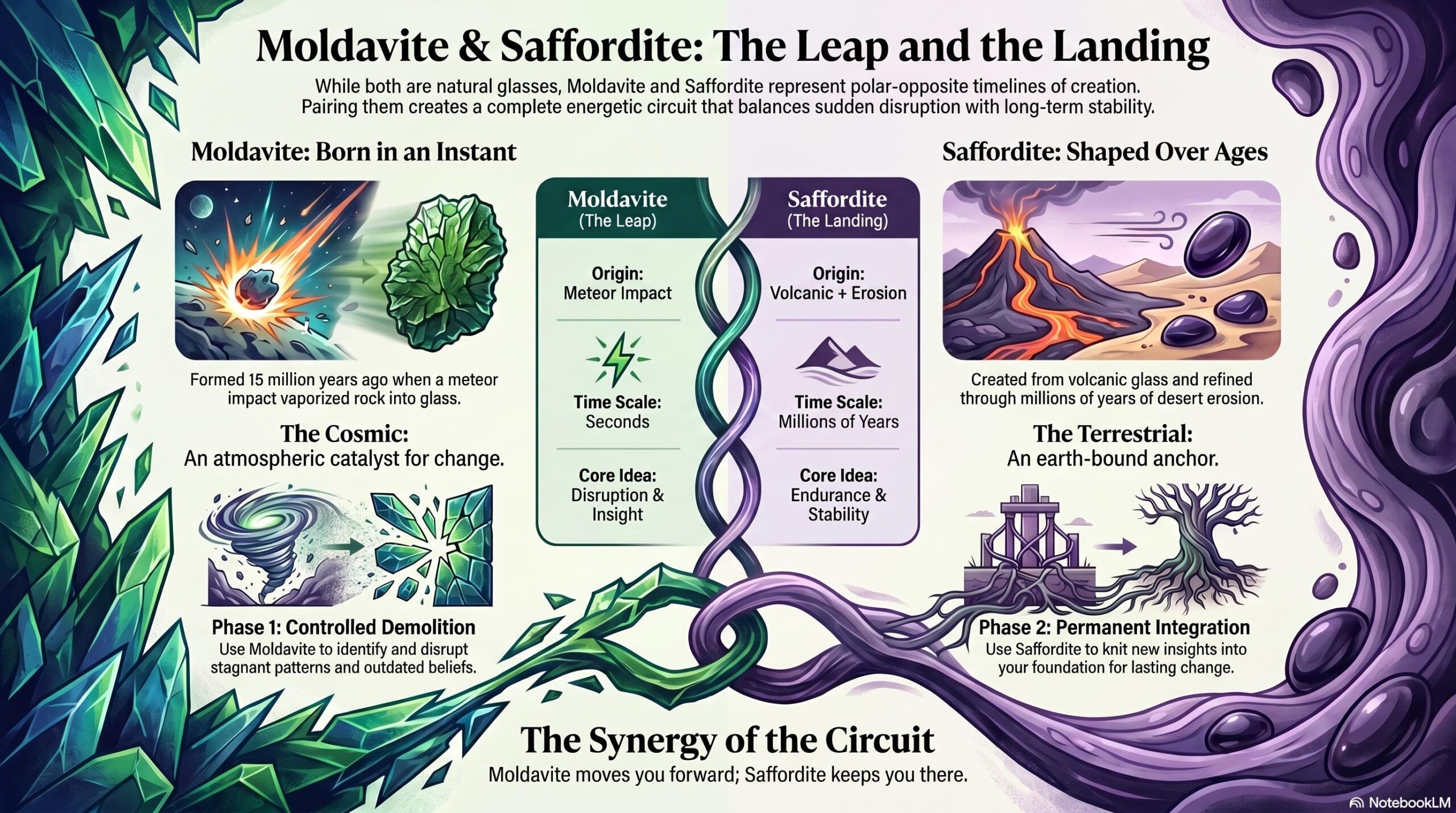
- Moldavite → formed in seconds from a meteor impact
- Saffordite → shaped over millions of years through erosion
That difference is the entire story.
One represents sudden change.
The other represents long-term stability.
If you’re navigating transformation—whether through travel, personal growth, or major life shifts—you need both.
Creation: A Tale of Two Timelines
Moldavite — Born in an Instant
Moldavite traces back to a meteor impact roughly 15 million years ago, centered around the Nördlinger Ries crater in Germany.
Here’s what happened in plain terms:
- A meteor struck Earth at extreme speed
- The impact vaporized and melted the surrounding rock
- Molten material was blasted into the atmosphere
- It cooled mid-flight and fell back down as glass, primarily in the Czech Republic
This entire process happened in a matter of moments.
What that means:
- No time for structure or stability
- No gradual formation
- Just heat, pressure, and rapid transformation
Simple analogy:
Moldavite is what happens when change hits all at once—no warning, no preparation.
Saffordite — Shaped Over Ages
Saffordite comes from the desert regions near Safford. Its origin (about 18 million years ago) is far less dramatic, but far more enduring:
- Lava cools into volcanic glass (obsidian)
- Pieces break off over time
- Water and sediment tumble them smooth
- Desert soils chemically etch their surfaces
This takes millions of years.
What that means:
- Gradual refinement instead of shock
- Stability built through pressure and time
- A structure that survives erosion
Simple analogy:
Saffordite is what remains after everything unnecessary has been worn away.
Saffordite is not just Obsidian
Several unique geological factors contributed to the exceptional purity of Saffordite:
- A Pure “Core”: Saffordite is a type of marekanite, which is a nodule of pure obsidian glass that forms as a core within a larger mass of hydrated volcanic glass called perlite. This formation process naturally separates the pure glass from the more impure material around it, leading to a higher quality, cleaner stone.
- A Perfect Chemical Recipe: The source magma for Saffordite contained a highly unusual and balanced mix of trace elements, particularly manganese and iron. This specific “geochemical recipe” acts as a natural filter, absorbing other wavelengths of light and allowing the ethereal lavender and violet hues to pass through, which is a signature of high-quality Saffordite.
- Rapid Cooling: Like all obsidian, Saffordite’s source lava cooled extremely quickly, which prevented the formation of a crystalline structure, resulting in an amorphous glass. However, in the case of Saffordite, this rapid cooling occurred without trapping the large number of crystallites and impurities that plague common obsidian.
In essence, while common obsidian is typically a “dirty” glass full of microscopic crystals that block light, Saffordite is a rare, pure volcanic glass, whose unique formation as a marekanite nodule from a specific geochemical source resulted in a remarkably translucent material.
This rarity and unique beauty are what make Saffordite a highly sought-after stone.
Why We Pair Moldavite and Saffordite
At a glance, they look similar—they’re both dark, glassy stones. But scientifically and symbolically, they sit on opposite ends of a spectrum.
| Trait | Moldavite | Saffordite |
|---|---|---|
| Formation | Meteor impact | Volcanic + erosion |
| Time scale | Seconds | Millions of years |
| Texture | Sharp, sculpted | Smooth, rounded |
| Environment | Atmospheric flight | Desert weathering |
| Core idea | Disruption | Endurance |
This contrast is why people link them.
Not because they’re the same—but because they complete a cycle.
The Science (Without the Noise)
Both stones are mostly silica (glass), but their internal signatures reveal their origins.
Moldavite
- Extremely low water content
- Contains high-pressure silica features
- Chemically distinct from typical Earth rocks
Translation: formed under extreme, unusual conditions.
Saffordite
- Contains more water (typical of volcanic glass)
- Matches Earth’s crust chemistry
- Structurally uniform
Translation: formed through normal Earth processes over time.
What the “Cosmic vs Terrestrial” Idea Actually Means
You don’t need metaphysics to understand this pairing. It maps directly onto a real pattern:
Moldavite = The Catalyst
Represents:
- Sudden insight
- Rapid change
- Disruption of routine
Real-world examples:
- A trip that changes your perspective
- A major decision made quickly
- Exposure to something completely new
Saffordite = The Anchor
Represents:
- Stability
- Integration
- Long-term grounding
Real-world examples:
- Daily routines
- Systems and planning
- Staying consistent after change
The Real Insight: Change Has Two Phases
The article’s “macro-lattice” idea becomes much clearer when simplified:
Transformation is not one event. It is a two-step process.
- Disruption (something changes)
- Integration (the change becomes stable)
Most people focus only on step one. That’s the problem.
The Leap and the Landing
A useful way to think about this:
- Moldavite = the leap
- Saffordite = the landing
Example from travel:
- You see an inspiring destination (the spark)
- You build the route, timing, and logistics (the system)
Without the second step, nothing actually happens.
Why “Grounding” Matters (In Plain Terms)
When people talk about grounding, they’re usually describing:
- Reduced mental noise
- Stronger connection to the present moment
- A sense of control and stability
This doesn’t require belief—it’s a function of attention and environment.
Grounding comes from:
- Repetition
- Physical awareness
- Familiar structure
Saffordite simply becomes a symbol of that process.
A Practical Way to Use This Pair
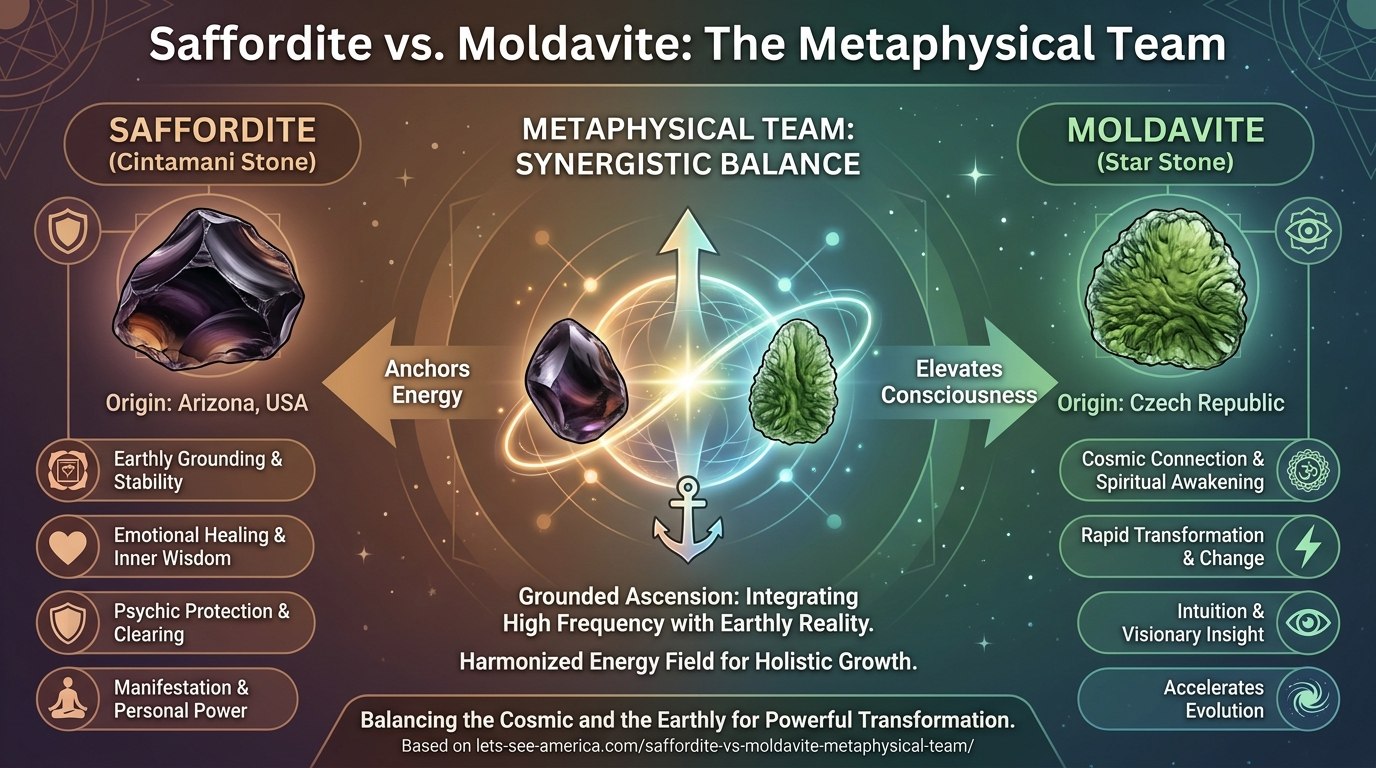
To create a balanced spiritual practice, one must manage the interplay between expansion and stability. Using a high-frequency tektite like Moldavite alongside a grounded “pseudotektite” like Saffordite creates a complete energetic circuit, allowing for growth without losing one’s center.
Here is how to use these two distinct stones as a team for meditation and long-term personal transformation.
1. Meditation: The “Circuit and Ground” Protocol
When meditating with stones of such polar-opposite origins, the goal is to create a balanced flow of energy through the body.
- The Saffordite (The Grounding Wire): Hold the Saffordite in your dominant hand. In energy work, this hand is responsible for “releasing.” Because Saffordite is a terrestrial volcanic glass, it acts as a sink for excess mental “static” and nervous system tension. It anchors your physical presence to the Earth’s steady frequency.
- The Moldavite (The Antenna): Place the Moldavite on the Heart or Brow (Third Eye). As a stone born of a cosmic impact, its vibration is fast and “upward.” It acts as a catalyst, opening the receptive channels of the mind to new insights and broader perspectives.
The Result: This configuration prevents the “spacey” or unmoored feeling often associated with Moldavite. You are grounded enough to stay present, but open enough to receive insight.

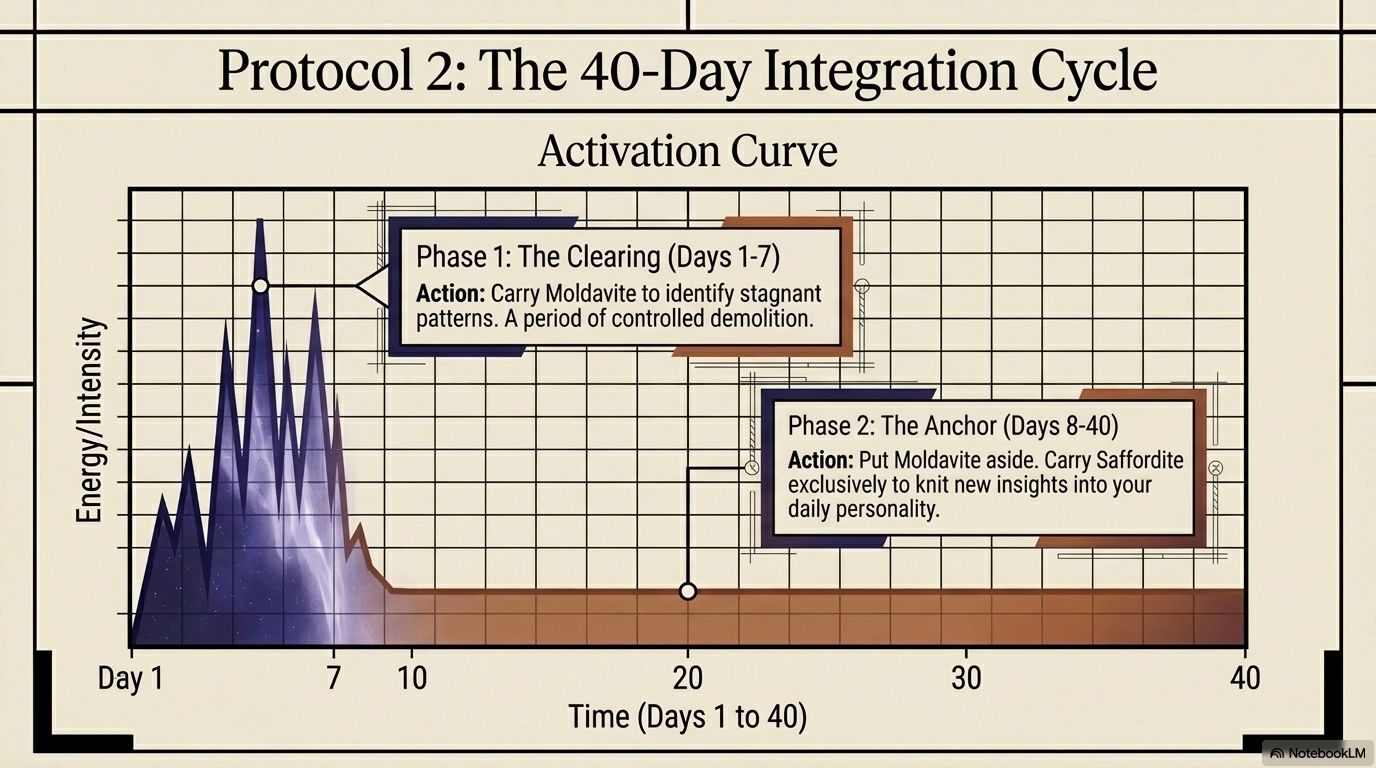
2. Transformation: The 40-Day Integration Cycle
Real change requires two phases: the “shaking up” of old habits and the “settling in” of new ones. This 40-day cycle uses the unique “creation stories” of these stones to facilitate that shift.
Phase 1: The Clearing (Days 1–7)
- Stone: Moldavite
- Action: Carry or wear Moldavite during the first week of a new project or life change.
- Purpose: Much like its violent impact origin, Moldavite is used to “clear the site.” It is designed to identify and disrupt stagnant patterns, outdated beliefs, and emotional blockages. It is a period of “controlled demolition” to make room for something new.
Phase 2: The Anchor (Days 8–40)
- Stone: Saffordite
- Action: Put the Moldavite aside and carry Saffordite exclusively for the remainder of the 40 days.
- Purpose: After the disruption phase, the spirit needs to stabilize. Saffordite—a stone that survived millions of years of desert weathering—provides the energy of endurance. It helps you “knit” your new insights into your daily personality, ensuring the change becomes a permanent part of your foundation rather than a fleeting moment of inspiration.
3. Summary of Synergy
While they are often grouped together, their roles are fundamentally different:
| Goal | Moldavite (The Sky) | Saffordite (The Earth) |
| Energetic Role | The Catalyst | The Anchor |
| Primary Action | Shattering the Old | Strengthening the New |
| Best Used For | Breakthroughs & Visions | Integration & Stillness |
Practical Tip: If you ever feel “over-charged” by the intense energy of a tektite like Moldavite, immediately switch to holding a Saffordite. The transition from the “impact” frequency back to the “terrestrial” frequency helps reset the nervous system and brings your focus back to the present moment.
Final Takeaway
Moldavite gets attention because it’s dramatic.
Saffordite matters because it lasts.
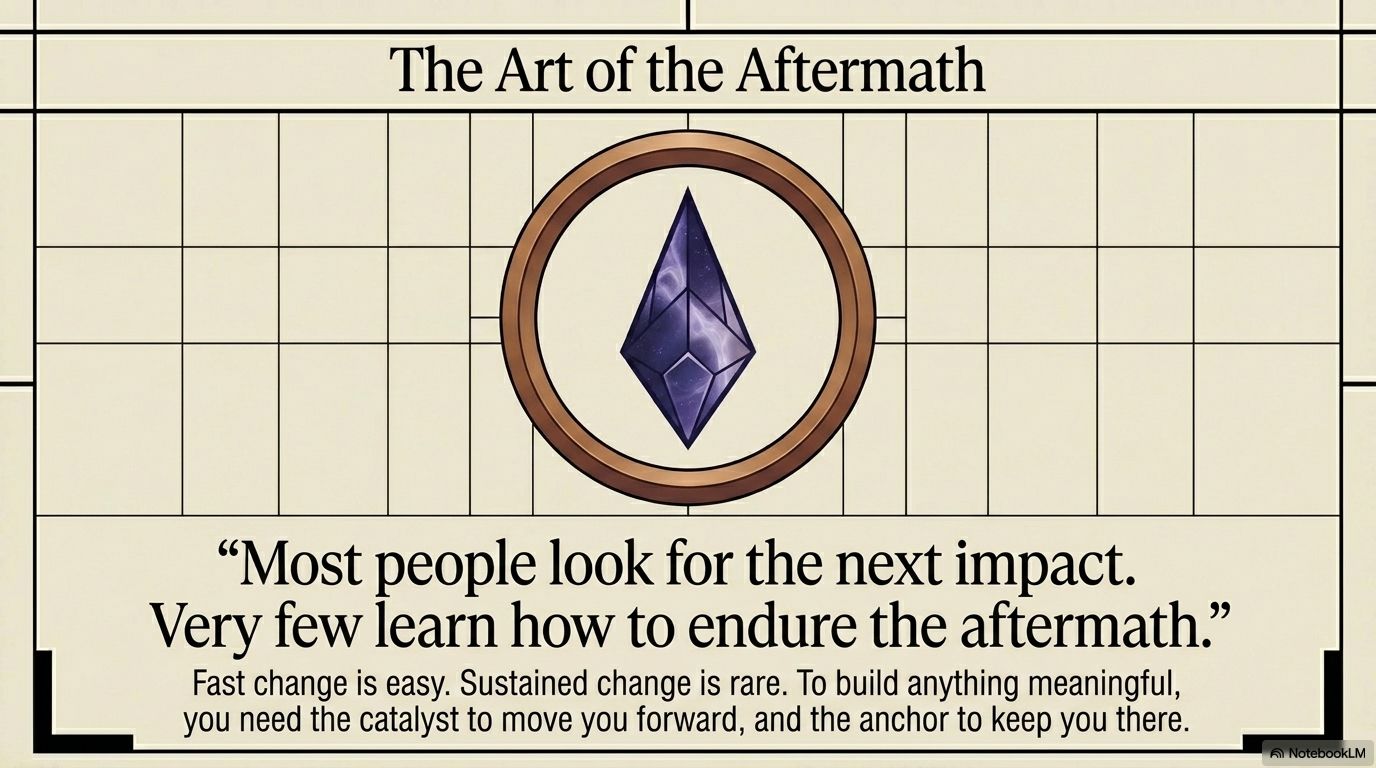
Fast change is easy.
Sustained change is rare.
If you’re building anything meaningful—travel systems, personal growth, or creative work—you need both:
- Something that moves you forward
- Something that keeps you there
Most people look for the next impact. Very few learn how to endure the aftermath.
That’s the difference.
Experience the Light of the Desert
Ready to experience the high-frequency energy of the desert for yourself? Browse our hand-selected, authentic collection of Arizona Saffordites. Every stone is unique, ethically sourced from the Safford region, and waiting to find its keeper.