The best trails in the wilderness are often unmarked – a subtle indentation in the grass, a bent branch, a feeling in the bones. You cannot see the trail clearly, yet it is there.
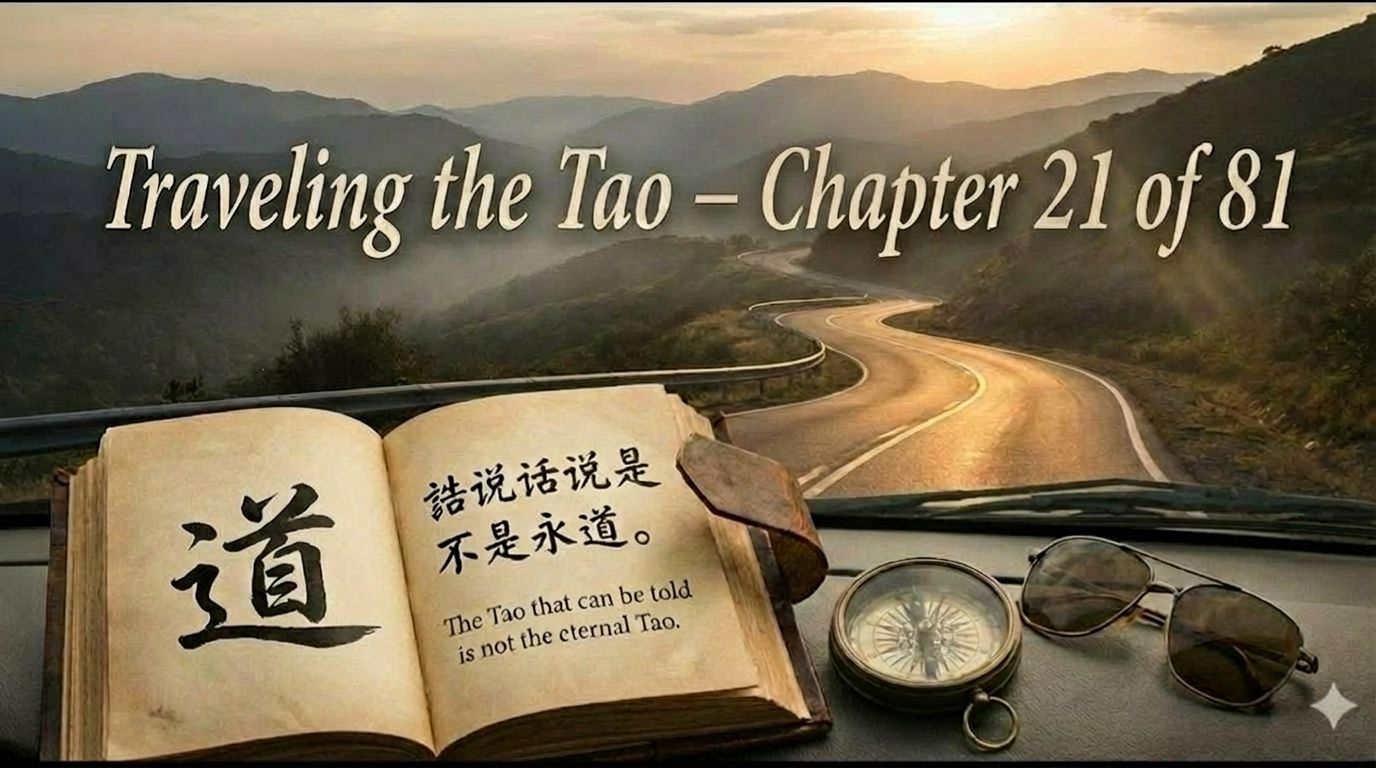
Tao Te Ching Chapter 21 reveals that great virtue follows the Tao, and the Tao, though indistinct and unclear, contains image, substance, essence, and unshakable faith. The traveler who learns to read these invisible signs finds the source of all things.
Executive Summary
Tao Te Ching Chapter 21 describes the nature of the Tao as both utterly mysterious and completely reliable.
This chapter emphasizes that all true power, clarity, and guidance arise from aligning with this formless source. Though the Tao cannot be seen, named, or grasped, its presence can be felt in the quiet, subtle way it shapes everything.
The sage follows this invisible pattern with humility and trust, moving in harmony with what cannot be described but can always be depended on.
The chapter ultimately teaches that the deepest truth leaves no trace, yet guides all things.
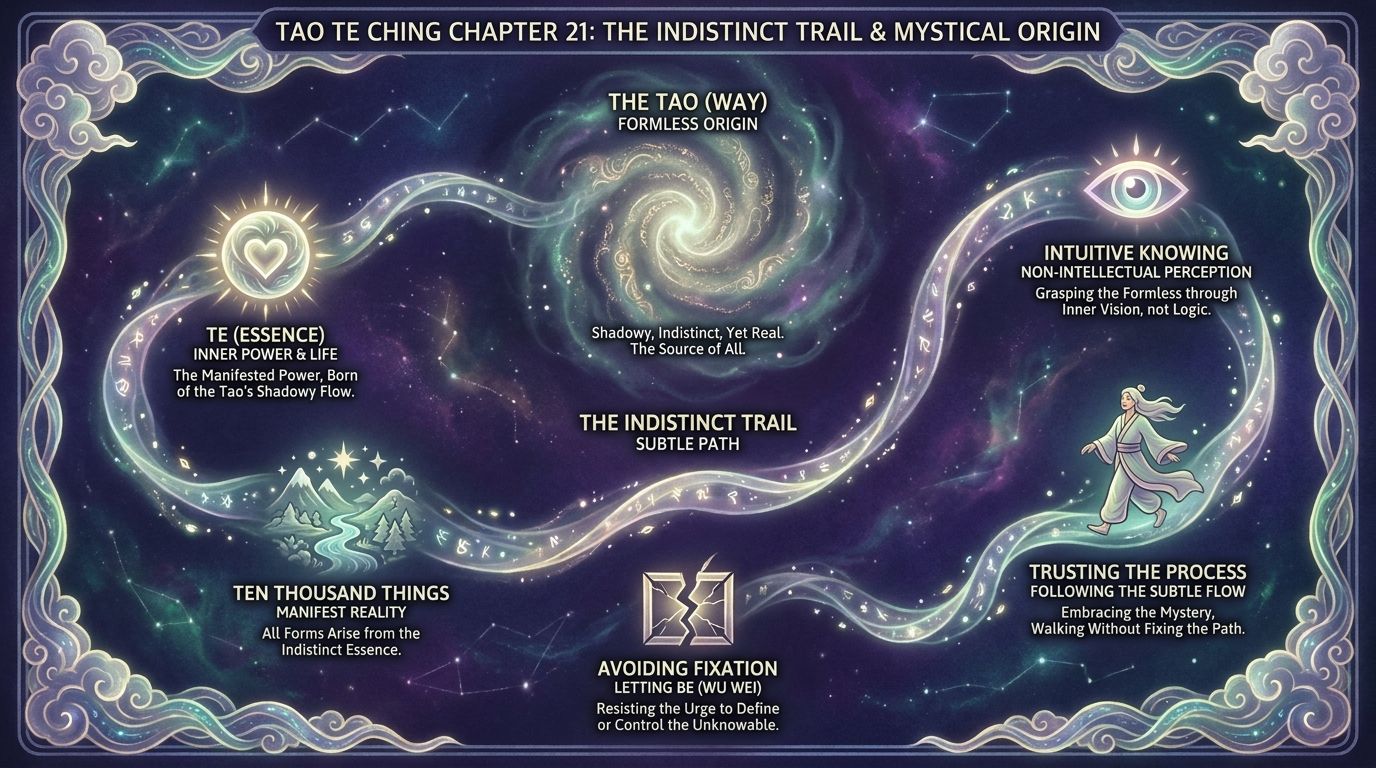
Chapter 21
The appearance of great virtue
Tao te ching 21 Of 81
Follows only the Tao
The Tao, as a thing
Seems indistinct, seems unclear
So unclear, so indistinct
Within it there is image
So indistinct, so unclear
Within it there is substance
So deep, so profound
Within it there is essence
Its essence is supremely real
Within it there is faith
From ancient times to the present
Its name never departs
To observe the source of all things
How do I know the nature of the source?
With this
The Trail That Cannot Be Seen
After embracing the fool’s heart in Chapter 20, Tao Te Ching Chapter 21 deepens the mystery of the Tao itself. Lao Tzu acknowledges that the Tao seems vague, shadowy, and impossible to grasp. Yet within that very vagueness, there is real substance. Within the obscurity, there is reliable guidance. This is not a philosophy of confusion – it is an invitation to develop a different kind of vision, one that sees through, not despite, the indistinct.
For the traveler, Chapter 21 is about learning to follow the invisible trail. The obvious path is often paved and crowded. The Tao is the subtle trail that only those with “great virtue” can discern – not because they are special, but because they have learned to trust what is unclear.
Great Virtue Follows Only the Tao
The chapter opens with a foundational statement:
“The appearance of great virtue follows only the Tao.”
The Traveler’s Insight: Virtue (Te) in Taoism is not moral superiority – it is the authentic power that comes from alignment with the Tao. A skilled tracker does not force the forest to reveal its secrets; they simply follow the signs. Great virtue is like that: it doesn’t invent its own way; it follows the way that already exists.
On a journey, the virtuous traveler is not the one who imposes their will on the road, but the one who reads the road and moves accordingly. They don’t fight the terrain; they flow with it. This is the “appearance” – the outward manifestation – of inner alignment.
The Indistinct and Unclear – Yet Full of Substance
Lao Tzu then describes the Tao itself:
“The Tao, as a thing, seems indistinct, seems unclear. So unclear, so indistinct – within it there is image. So indistinct, so unclear – within it there is substance.”
The Traveler’s Insight: Imagine walking through a thick fog. You cannot see more than a few feet ahead. The path is indistinct. Yet within that fog, there is a trail – a subtle difference in the vegetation, a faint depression in the soil. That is the “image.” And if you keep following, you will eventually feel solid ground beneath your feet – that is the “substance.”
The Tao is not nothing. It is not a void of meaninglessness. It is a real, reliable presence that reveals itself not through sharp outlines but through felt sense, intuition, and patient attention. The traveler who demands a clear, bright, well‑marked road will miss the Tao entirely. The traveler who accepts the fog and walks anyway will find that the fog itself contains the way.
“So deep, so profound – within it there is essence. Its essence is supremely real. Within it there is faith.”
The Traveler’s Insight: As you walk deeper into the indistinct, you encounter not confusion but essence – the heart of the matter. This essence is “supremely real,” more real than the solid objects you can see and touch, because it does not change. And within that essence is faith – not religious belief, but a deep, lived trust that the Tao is reliable. The traveler who has walked many miles in the fog knows that the trail will hold. That knowing is faith.
An Unbroken Name from Ancient Times
“From ancient times to the present, its name never departs. To observe the source of all things. How do I know the nature of the source? With this.”
The Traveler’s Insight: The Tao has been called by many names – the Way, the Source, the Uncarved Block. But the name itself is not important. What matters is that the reality behind the name has never disappeared. It was there for the first humans crossing unknown continents, and it is here for you today.
“With this” – Lao Tzu points directly to the experience of the Tao itself. How does he know the nature of the source? Not through books or arguments, but through direct encounter. “This” means the indistinct clarity, the foggy substance, the profound essence that he has just described. You can know it too – not by analyzing these words, but by walking your own foggy trail with patient attention.
Your Roadmap: Following the Indistinct Trail
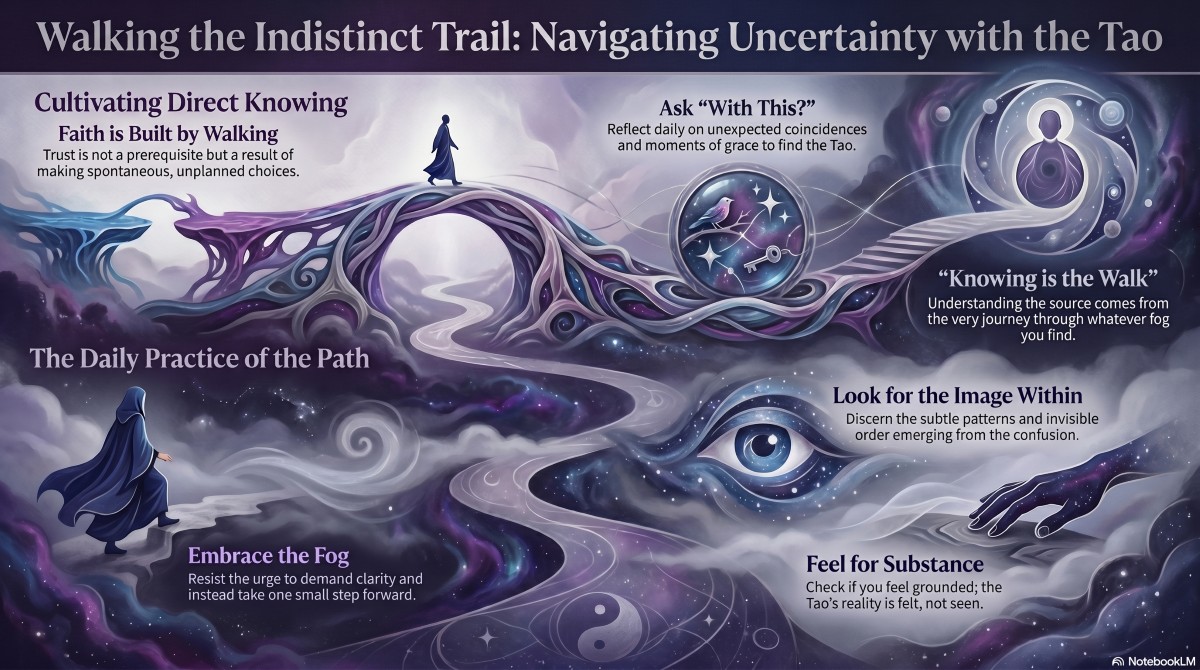
How do you apply Chapter 21 to your daily travels?
- Embrace the Fog: The next time you feel uncertain – about a decision, a direction, a relationship – resist the urge to demand clarity. Accept the indistinct. Say, “The Tao seems unclear, and that is okay.” Then take one small step.
- Look for the Image Within: When things are vague, ask: “What subtle pattern is emerging? What faint image can I discern?” Trust that even in confusion, there is an invisible order.
- Feel for Substance: After following the image for a while, check in with your body and heart. Do you feel more grounded? More solid? That is the substance of the Tao. It may not be visible, but it is real.
- Cultivate Faith Through Practice: Faith is not something you have before you walk; it is something you build by walking. Each time you trust the indistinct and find it reliable, your faith grows. Practice this in small things – a new route, an unplanned conversation, a spontaneous choice.
- Ask “With This?” At the end of each day, reflect not on what you planned, but on what you actually experienced. Where did the Tao show up – in a coincidence, a feeling, a moment of unexpected grace? That “this” is your direct knowing.
The Destination: The Source Observed
Tao Te Ching Chapter 21 offers a radical redefinition of knowledge. Knowing the source of all things is not about mastering facts or achieving certainty. It is about developing the sensitivity to perceive the Tao in its indistinct, profound, supremely real presence.
The traveler who learns this moves through the world with a quiet confidence. They do not need bright signs or clear instructions. They trust the fog. They follow the image. They rest in the substance. And they carry within them a faith that has been reliable from ancient times to the present.
How do you know the nature of the source? With this – with the very walk you are taking right now, through whatever fog you find yourself in. The trail is there. Take the next step.
Continue Your Journey: Having learned to see the invisible trail, Chapter 22 explores the paradox of yielding – how being bent is preserved, being hollow is filled, and the ancient sage does not show themselves and so shines forth.
For the foundational maps of this philosophy, explore our Foundations of the Tao series.