At the festival, everyone rushes toward the bright lights, the music, the feast. But the sage slips away to a quiet hill, sits alone, and watches the stars. Tao Te Ching Chapter 20 is the portrait of this solitary traveler – the one who looks foolish to the crowd, who seems muddled and lost, yet who alone has found the nourishing mother of all things.
Executive Summary
Tao Te Ching Chapter 20 is a rupture point—a moment where Lao Tzu steps out of the swirl of social values and declares his independence from the world’s anxieties.
This chapter contrasts the frantic concerns of society—status, opinions, cleverness, comparison—with the quiet, grounded presence of someone aligned with the Tao.
While others chase knowledge, praise, and belonging, the sage feels like an outsider: calm, empty, childlike, and content with simplicity. This “difference” is not alienation but freedom.
By refusing to be pulled into collective agitation, the sage discovers a deeper nourishment—an inner steadiness that comes from living close to the source rather than the noise.
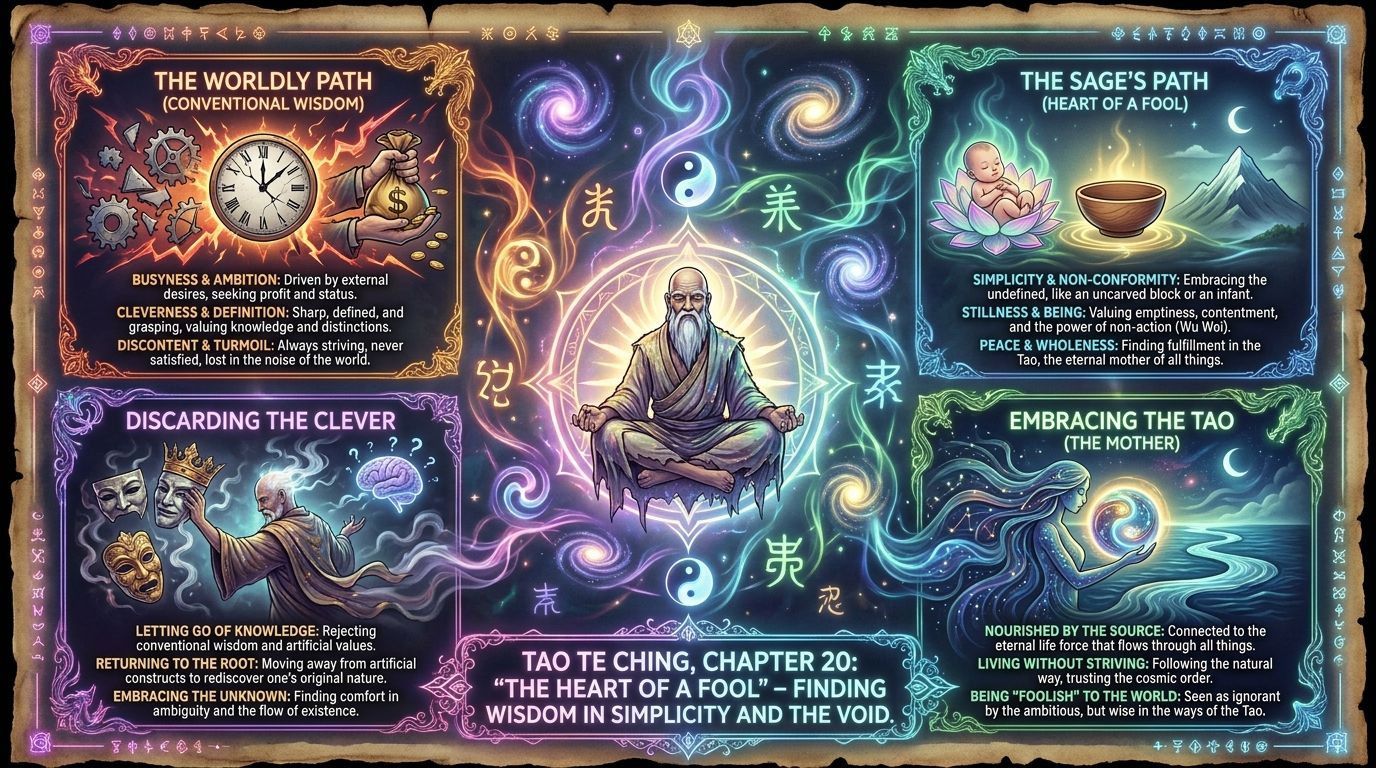
Chapter 20
Cease learning, no more worries
Tao te ching 20 Of 81
Respectful response and scornful response
How much is the difference?
Goodness and evil
How much do they differ?
What the people fear, I cannot be unafraid
So desolate!
How limitless it is!
The people are excited
As if enjoying a great feast
As if climbing up to the terrace in spring
I alone am quiet and uninvolved
Like an infant not yet smiling
So weary, like having no place to return
The people all have surplus
While I alone seem lacking
I have the heart of a fool indeed – so ignorant!
Ordinary people are bright
I alone am muddled
Ordinary people are scrutinizing
I alone am obtuse
Such tranquility, like the ocean
Such high wind, as if without limits
The people all have goals
And I alone am stubborn and lowly
I alone am different from them
And value the nourishing mother
The Uncomfortable Traveler
After prescribing the three abandonments in Chapter 19, Tao Te Ching Chapter 20 reveals the emotional and social reality of walking the Tao. This is one of the most personal, vulnerable chapters in the entire text. Lao Tzu describes how he appears to others – dull, stupid, adrift – while everyone else seems bright, purposeful, and successful. Yet he alone knows what truly matters.
For the traveler on life’s road, this chapter offers profound comfort. If you have ever felt out of step with the crowd – too quiet, too slow, too strange – you are in good company. The Tao has always been walked by fools in the eyes of the world.
Cease Learning, No More Worries
The chapter opens with a line that echoes through Taoist history:
“Cease learning, no more worries.”
The Traveler’s Insight: This does not mean stop acquiring useful skills. It means stop accumulating the kind of “learning” that fills the mind with judgments, comparisons, and shoulds – the endless curriculum of how to succeed, impress, and conform. The traveler who ceases this kind of learning drops a heavy burden. No more worrying about being good enough, smart enough, or impressive enough.
On a journey, this is the difference between the tourist who must visit every “must‑see” and the wanderer who simply walks. The first is anxious about missing out; the second misses nothing because they are fully present.
The Thin Line Between Respect and Scorn
“Respectful response and scornful response – how much is the difference? Goodness and evil – how much do they differ?”
The Traveler’s Insight: On the surface, praise and blame seem worlds apart. But to the sage, they are two sides of the same coin – both are judgments from others, both create attachment and fear. The traveler who chases praise will also dread scorn. The one who abandons both is free.
Think of online reviews. One day you are praised as a brilliant guide; the next, criticized as incompetent. If you believe both, you are on a rollercoaster. The sage traveler simply does their work, unmoved by either.
“What the people fear, I cannot be unafraid.”
Lao Tzu here shows humility. He is not a superhuman. He feels fear like everyone else – of death, of loss, of pain. But he does not let that fear drive his choices. He acknowledges it, then returns to the Tao.
The Festival and the Fool
The chapter then paints a vivid contrast between the crowd and the sage:
“The people are excited, as if enjoying a great feast, as if climbing up to the terrace in spring. I alone am quiet and uninvolved, like an infant not yet smiling. So weary, like having no place to return.”
The Traveler’s Insight: Imagine a bustling festival town. Everyone is rushing to the main square, laughing, eating, celebrating. The atmosphere is electric. But one traveler sits on the edge of town, alone. They look tired, aimless, perhaps a little lost. The crowd pities them – or mocks them.
But the sage knows something the crowd does not. The feast will end. The spring terrace will empty. And where will the revelers be? Hungover, exhausted, already planning the next distraction. The sage, by contrast, is at home in the quiet. They do not need the festival because they carry their own peace.
The “infant not yet smiling” is a crucial image. An infant’s smile comes later – first, there is simple, unadorned being. The sage has not yet learned to perform happiness for others. They are raw, genuine, without social polish.
The Heart of a Fool
“The people all have surplus, while I alone seem lacking. I have the heart of a fool indeed – so ignorant!”
The Traveler’s Insight: The crowd has abundance – money, possessions, achievements, connections. The sage appears to have nothing. But “lacking” is only from the outside. Inside, the sage has everything needed. The fool’s heart is not stupid; it is free from the clutter of cleverness.
“Ordinary people are bright; I alone am muddled. Ordinary people are scrutinizing; I alone am obtuse.”
The Traveler’s Insight: The world values sharpness – quick wit, critical thinking, the ability to judge and categorize. The sage is “muddled” – not confused, but seeing without slicing. They do not need to scrutinize every detail because they trust the whole. On a journey, the muddled traveler may not know the name of every bird or the history of every ruin – but they feel the beauty of the forest and the weight of time. That is a deeper knowing.
Tranquil as the Ocean, Wind as Without Limits
“Such tranquility, like the ocean. Such high wind, as if without limits.”
The Traveler’s Insight: The sage’s inner state is vast and calm, like the deep ocean. Yet they are also capable of great movement, like wind that cannot be contained. This is the paradox of Wu Wei: still and active, calm and powerful, all at once. The traveler who embodies this is unshaken by storms yet dances with the breeze.
The One Who Values the Nourishing Mother
“The people all have goals, and I alone am stubborn and lowly. I alone am different from them, and value the nourishing mother.”
The Traveler’s Insight: Everyone else has destinations – careers, achievements, specific outcomes. The sage has no goal except to stay connected to the source, the “nourishing mother” – the Tao itself. This makes them seem stubborn (refusing to follow the crowd) and lowly (unimpressive by worldly standards). But they are the only ones who will never run out of nourishment.
On a journey, the goal‑oriented traveler rushes from point A to point B, always in a hurry. The sage traveler is already home. Every step is the destination because they walk with the mother.
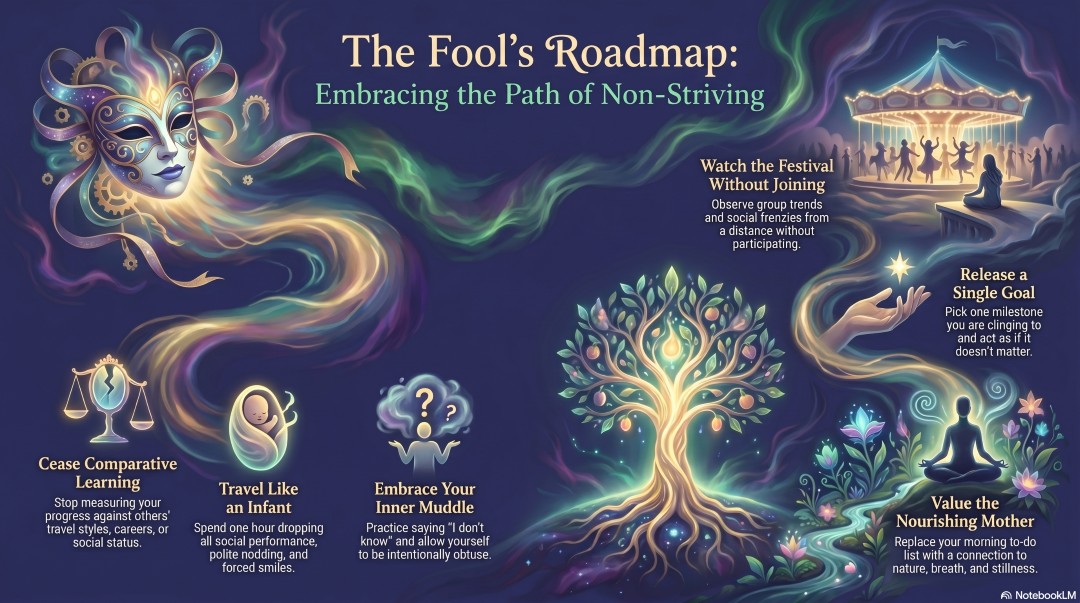
Your Roadmap: Embracing the Fool’s Journey
How do you apply Chapter 20 to your own travels and life?
- Cease One Kind of Learning: Identify an area where you’re constantly comparing yourself to others – travel styles, career progress, social status. Declare a temporary moratorium on that kind of “learning.” Just be, without the scorecard.
- Watch the Festival Without Joining: The next time you feel pressure to participate in a group frenzy – a shopping spree, a social media trend, a competitive race – step back. Sit on the metaphorical hill. Observe without judgment. Notice how it feels to be uninvolved.
- Embrace Your Inner Muddle: When you don’t know the answer, say “I don’t know.” When you can’t make a sharp distinction, admit it. Let yourself be “obtuse” for a day. Notice that the world does not end – in fact, you may feel lighter.
- Release a Goal: Pick one goal you’ve been clinging to – a destination, a milestone, a possession. For today, act as if it doesn’t matter. Do not pursue it. See what arises in the space left behind.
- Value the Nourishing Mother: Each morning, spend a few minutes connecting not to your to‑do list, but to the source – nature, breath, stillness. Let that be your anchor. Then go about your day, carrying the mother with you.
- Travel Like an Infant: For one hour, drop all social performance. Don’t smile to please others, don’t nod to be polite, don’t chatter to fill silence. Simply be – present, quiet, like an infant before the social mask is learned.
The Destination: The Fool Who Knows
Tao Te Ching Chapter 20 is a love letter to all who feel out of place. The sage looks like a fool – muddled, aimless, lacking. But the fool’s heart is the only one that is truly free. While the crowd chases brightness, the sage sits in the dark and sees the stars. While everyone scrutinizes, the sage rests in the whole.
Do not be afraid to be the slow traveler, the quiet one, the one who doesn’t fit the itinerary. You are in excellent company. Lao Tzu himself walked that road.
And at the end of all your wandering, you will discover what the crowd never finds: the nourishing mother, the source of all, the peace that cannot be lost because it was never gained.
Continue Your Journey: Having embraced the fool’s path, Chapter 21 describes the elusive nature of virtue – how the Tao’s presence is known not through form, but through its faithful manifestations.
For the foundational maps of this philosophy, explore our Foundations of the Tao series.