Every overpacked suitcase contains items you were told you “might need” – extra shoes, emergency gadgets, clothes for every weather. The wise traveler knows that most of this baggage is unnecessary. Tao Te Ching Chapter 19 delivers a radical packing list for the soul: abandon sagacity, abandon benevolence, abandon cunning. Strip away the excess, and the journey becomes simple, honest, and free.
Executive Summary
Tao Te Ching Chapter 19 is a sharp, surgical critique of performative morality.
Lao Tzu argues that when societies obsess over wisdom, virtue, and rules, it’s a sign they’ve already lost their natural alignment.
This chapter calls for stripping away the layers—cleverness, moral posturing, rigid righteousness—so people can return to simplicity, honesty, and genuine care. Its core message is that goodness emerges naturally when we stop trying to appear good.
By letting go of artificial ideals, we rediscover the plain, grounded humanity that makes harmony possible.
Chapter 19
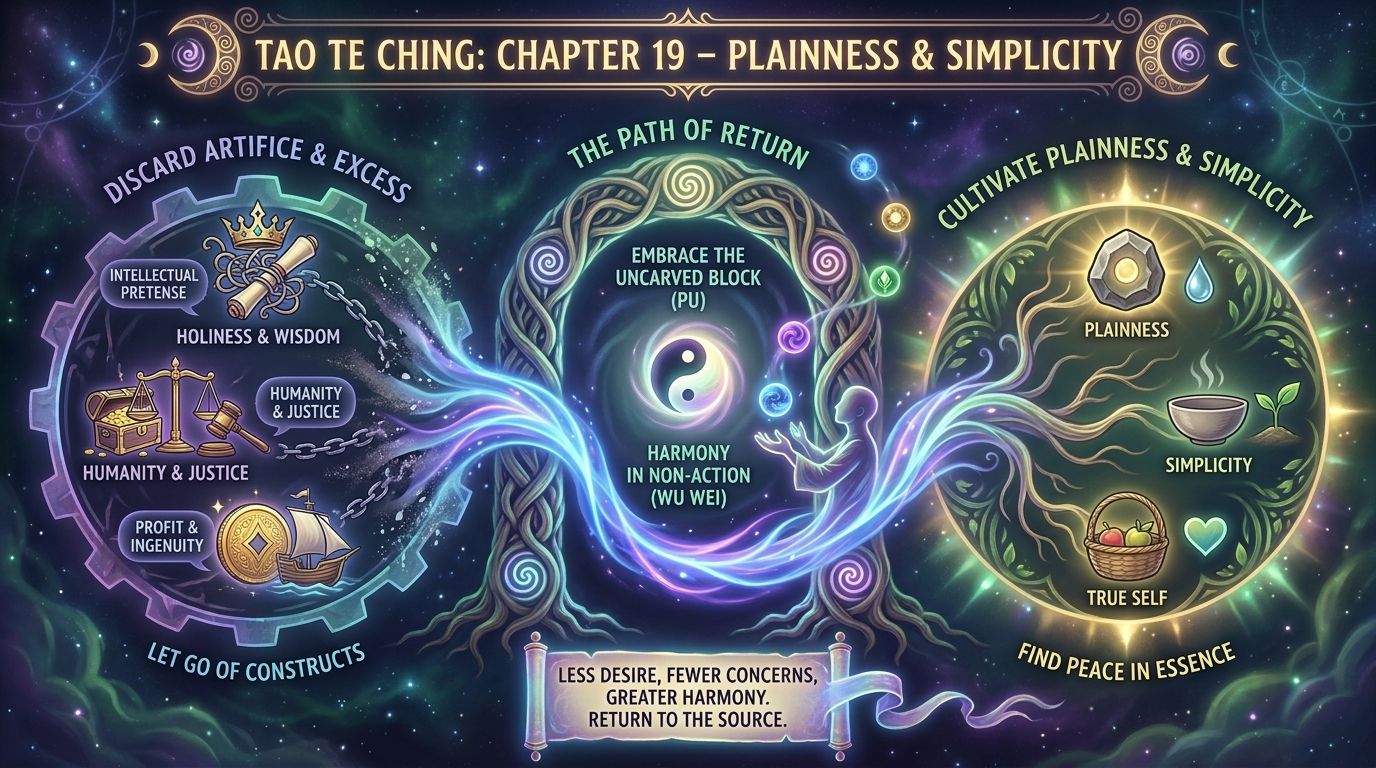
End sagacity; abandon knowledge
Tao te ching 19 Of 81
The people benefit a hundred times
End benevolence; abandon righteousness
The people return to piety and charity
End cunning; discard profit
Bandits and thieves no longer exist
These three things are superficial and insufficient
Thus this teaching has its place:
Show plainness; hold simplicity
Reduce selfishness; decrease desires
The Overburdened Traveler
After diagnosing the loss of Tao in Chapter 18, Tao Te Ching Chapter 19 prescribes the cure. Lao Tzu identifies three artificial constructs that weigh us down: clever knowledge, forced virtue, and the pursuit of profit. These, he says, are “superficial and insufficient.” The real remedy is not more concepts or rules – it is a return to plainness, simplicity, and reduced desire.
For the modern traveler, this chapter is an invitation to unlearn. To stop trying to be so smart, so good, so strategic. To simply be plain, like undyed silk, and let the journey unfold.
The Three Abandonments
The chapter opens with a bold triple declaration:
1. End Sagacity; Abandon Knowledge
“End sagacity; abandon knowledge. The people benefit a hundred times.”
“Sagacity” here means cleverness, expertise, the kind of intelligence that schemes and calculates. “Knowledge” means the accumulation of facts, rules, and distinctions. Lao Tzu claims that letting go of these actually benefits everyone – a hundred times over.
The Traveler’s Insight: Think of the traveler who has read every guidebook, memorized every tip, and planned every hour. They are “sagacious” – but are they happy? Often, they are anxious, rigid, and disappointed when reality doesn’t match the plan. Now consider the traveler who arrives with open eyes and an empty itinerary. They make discoveries, follow local advice, and flow with surprises. Who benefits more? The “ignorant” traveler often has a richer experience because they are present, not buried in knowledge.
Letting go of knowing does not mean becoming stupid. It means trusting direct experience over secondhand information. The map is not the territory – and the territory is infinitely more rewarding.
2. End Benevolence; Abandon Righteousness
“End benevolence; abandon righteousness. The people return to piety and charity.”
This is a shocking statement, following Chapter 18’s point that benevolence and righteousness appear only after the Tao fades. Here, Lao Tzu says: stop preaching these virtues. When you do, people naturally return to genuine kindness and filial affection – not because they are told to, but because it is their nature.
The Traveler’s Insight: On a group trip, nothing kills camaraderie faster than a leader who constantly lectures about “being a team” and “showing respect.” True team spirit arises organically when people feel safe and valued. When you stop enforcing virtue, virtue appears on its own – like grass growing when you stop trampling it.
The “piety and charity” here are not religious concepts; they are the natural, unforced love between family and friends. When you abandon the performance of righteousness, you make room for the real thing.
3. End Cunning; Discard Profit
“End cunning; discard profit. Bandits and thieves no longer exist.”
Cunning is the art of outsmarting others for personal gain. Profit is the obsession with accumulation. Lao Tzu claims that these two are the parents of theft and corruption. When you stop scheming and stop hoarding, the very motivation for stealing disappears.
The Traveler’s Insight: Have you ever been on a trip where someone was constantly looking for an angle – a better deal, a shortcut, a way to get something for nothing? That person creates a climate of suspicion and competition. Others may respond in kind, and soon everyone is watching their back. But when everyone abandons cunning and profit-seeking, trust returns. No one needs to steal because no one is hoarding; no one needs to cheat because there is nothing to gain.
Why These Three Are Superficial
Lao Tzu then critiques his own prescription:
“These three things are superficial and insufficient. Thus this teaching has its place.”
The Traveler’s Insight: The commands to abandon sagacity, benevolence, and cunning are themselves teachings – and therefore, in a sense, still part of the “superficial” world of concepts. They are necessary as medicine, but they are not the ultimate destination. The true teaching is not about rejecting anything; it is about returning to something more fundamental.
So what is that fundamental? The final four lines give the answer.
The Real Remedy: Plainness, Simplicity, Selflessness, Few Desires
“Show plainness; hold simplicity. Reduce selfishness; decrease desires.”
This is the heart of Chapter 19. Four short phrases that constitute a complete guide to the liberated journey.
The Traveler’s Insight:
- Show plainness (su): Be unadorned, like undyed silk. Don’t dress up your words, your actions, or your identity. Let your natural self show through. On the road, the plain traveler is the one who doesn’t need to impress. They are comfortable with a simple meal, a basic room, a quiet conversation.
- Hold simplicity (pu): The uncarved block. Don’t complicate things. Choose the straightforward path, the honest word, the easy solution. The simple traveler doesn’t create unnecessary drama or invent complex plans. They trust that what is simple is often what is true.
- Reduce selfishness (si): Less me, more we. The selfish traveler hordes the window seat, complains about delays, and insists on their preferences. The selfless traveler considers others, shares resources, and finds joy in the group’s success. Reducing selfishness doesn’t mean self-neglect; it means expanding your sense of self to include others.
- Decrease desires (yu): Not all desires – just the excessive, grasping ones. The traveler with few desires doesn’t need luxury, status, or constant stimulation. They are content with a good view, a kind companion, a safe road. Decreased desires mean decreased disappointment and increased appreciation for what is already present.
Your Roadmap: The Three Abandonments in Practice
How do you apply Chapter 19 to your daily travels?
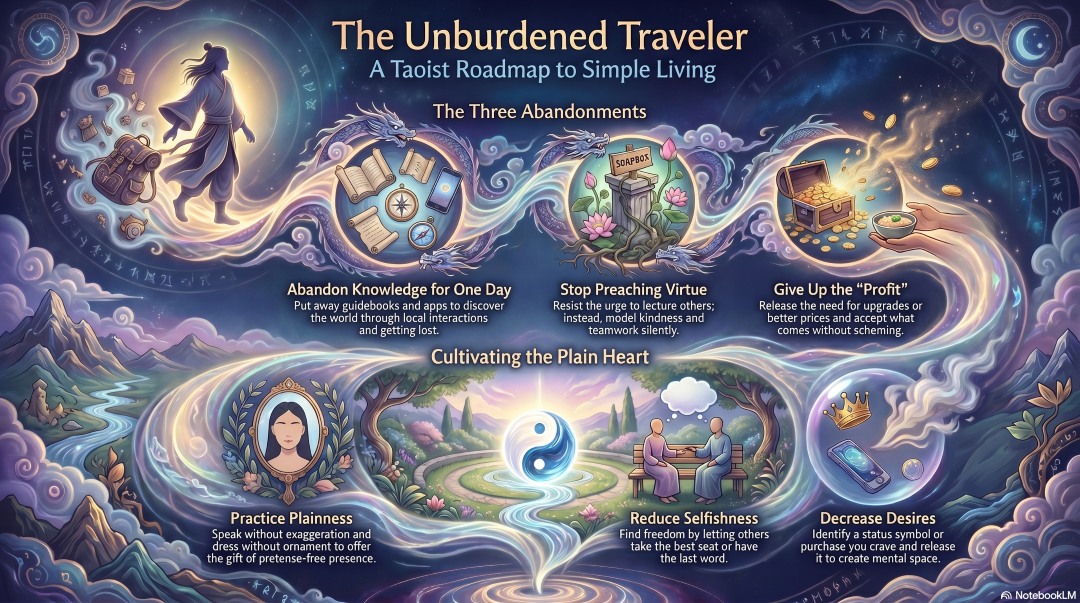
- Abandon Knowledge for One Day: Put away the guidebooks, turn off the travel apps, and don’t research where you’re going. Simply go. Ask locals for recommendations. Get lost. Notice how much you discover without knowing.
- Stop Preaching Virtue: In your family or travel group, resist the urge to lecture about kindness or teamwork. Instead, model it silently. Do the right thing without announcing it. Watch how others naturally follow.
- Give Up a “Profit”: Identify something you’ve been scheming for – a better price, an upgrade, an advantage. Consciously let it go. Accept what comes without trying to get more. Notice the relief.
- Practice Plainness: For one day, speak without exaggeration, dress without ornament, and act without pretense. Let your plainness be a gift to those around you.
- Reduce One Selfishness: Identify a habit of putting yourself first – the best seat, the first choice, the last word. Do the opposite today. Give the seat away, let others choose first, stay silent. Feel the freedom of reduced selfishness.
- Decrease One Desire: Pick a desire you’ve been clinging to – a purchase, a status symbol, an achievement. Say, “I don’t need this.” Release it. Notice how much space appears in your mind.
The Destination: The Unburdened Traveler
Tao Te Ching Chapter 19 is a call to strip down to essentials. Not because essentials are less, but because they are more – more real, more alive, more free. The traveler who abandons knowledge finds wisdom. The one who abandons forced virtue finds genuine kindness. The one who abandons cunning finds trust.
And beneath all abandonments, the simple, plain, selfless, desireless heart discovers that the greatest journey requires nothing but itself.
Show plainness. Hold simplicity. Reduce selfishness. Decrease desires.
Then walk. The road will take care of itself.
Continue Your Journey: Having abandoned the superficial, Chapter 20 explores the vast difference between the sage and the ordinary person – how the sage is like an infant who hasn’t yet learned to smile, while others rush about as if at a great festival.
For the foundational maps of this philosophy, explore our Foundations of the Tao series.