When the highways are well‑marked, and the routes are clear, no one talks about “how to find the way.” But when the great road crumbles, suddenly everyone becomes a navigation expert. Tao Te Ching Chapter 18 reveals a painful irony: the appearance of virtue, loyalty, and filial piety are not signs of health – they are symptoms that the natural Tao has been forgotten.
Executive Summary
Tao Te Ching Chapter 18 describes what happens when a society drifts away from the Tao: artificial virtues rush in to fill the vacuum.
When natural harmony is lost, people start performing goodness, loyalty, righteousness, and moral rules—not because they are aligned, but because alignment has already collapsed.
This chapter is a diagnostic tool: the louder a culture talks about virtue, the further it has strayed from its source. Its teaching is subtle but sharp—true goodness doesn’t announce itself, and true harmony doesn’t need enforcement.
When the Tao is present, life organizes itself; when it is absent, people compensate with appearances
Chapter 18
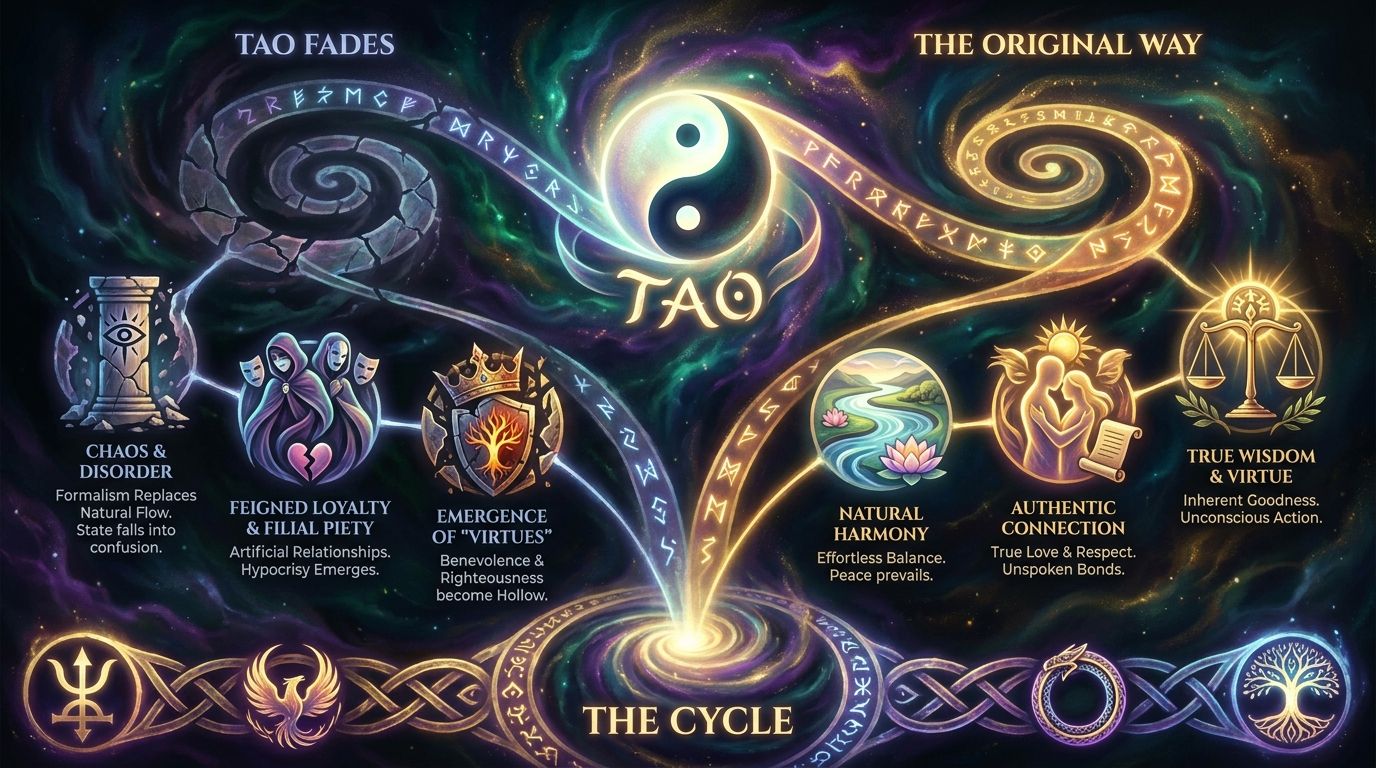
The great Tao fades away
Tao te ching 18 Of 81
There is benevolence and justice
Intelligence comes forth
There is great deception
The six relations are not harmonious
There is filial piety and kind affection
The country is in confused chaos
There are loyal ministers
The Traveler’s Diagnostic Tool
After learning the art of invisible leadership in Chapter 17, Tao Te Ching Chapter 18 offers a sobering diagnosis. Lao Tzu points out that when the great Tao – the natural, effortless way of living – is present, people don’t talk about morality, loyalty, or family duty. They live them. It is only when the Tao fades that these concepts appear as explicit teachings and desperate remedies.
For the traveler on life’s road, this chapter is a mirror. It asks: What “virtues” are you having to preach, enforce, or plead for? Those very preachings may be signs that something deeper has been lost.
The Paradox of Lost Innocence
The chapter opens with a series of paired observations:
“The great Tao fades away; there is benevolence and justice.”
The Traveler’s Insight: Imagine a small, close‑knit traveling group. When everyone naturally looks out for each other, no one needs to give a speech about “being kind” or “sharing.” The kindness just happens. But when that natural harmony breaks down – when someone hoards water or refuses to help – suddenly the leader has to announce: “From now on, we will practice benevolence.”
The rule’s appearance reveals the absence of the spirit. Benevolence and justice are beautiful things – but they only become necessary when the Tao has faded.
“Intelligence comes forth; there is great deception.”
The Traveler’s Insight: On the road, “intelligence” might mean cleverness, strategic thinking, or outsmarting others. But when people start relying on their wits to get ahead, deception follows close behind. The crafty traveler who always finds the best deals may also be the one who cheats the group. The more “intelligence” is celebrated, the more opportunities for deception arise.
True wisdom, by contrast, is simple and does not need to scheme.
“The six relations are not harmonious; there is filial piety and kind affection.”
The “six relations” refer to family bonds: father‑son, elder‑younger brother, husband‑wife. When these relationships are naturally loving, no one lectures about filial piety. But when families are falling apart, parents start demanding “respect” and children are taught “duty” as a lesson.
The Traveler’s Insight: Have you ever seen a travel group where the leader constantly reminds everyone to “be a team”? That very reminder is a sign that the team spirit is already weak. When a group is cohesive, no one needs to say it.
“The country is in confused chaos; there are loyal ministers.”
Finally, when a nation is peaceful and well‑governed, loyal ministers are unremarkable – they simply do their jobs. It is only when chaos reigns that a few upright officials stand out as “loyal.” Their heroism is a symptom of the disease, not the cure.
The Traveler’s Insight: On a disastrous trip – flights cancelled, hotels overbooked, everyone angry – the one person who stays calm and helpful is hailed as a hero. But on a smooth, well‑run tour, that same person would be just another pleasant companion. The crisis creates the hero. The Tao doesn’t need heroes because there are no crises.
What This Means for Your Journey
Chapter 18 is not a rejection of benevolence, justice, filial piety, or loyalty. It is a warning: if you find yourself preaching these virtues, something has already gone wrong. The real work is to restore the Tao – the natural, effortless harmony – so that virtues become lived rather than lectured.
The Traveler’s Insight: On your next group journey, notice the “virtue talk.” Who is telling others to be kind? Who is demanding respect? Who is being praised as a hero? Each of these may be a clue – not about the goodness of the people, but about the absence of the Tao.
When the road is true, no one discusses the road. They simply walk it.
Your Roadmap: Diagnosing and Restoring the Tao
How do you apply Chapter 18 to your travels and life?
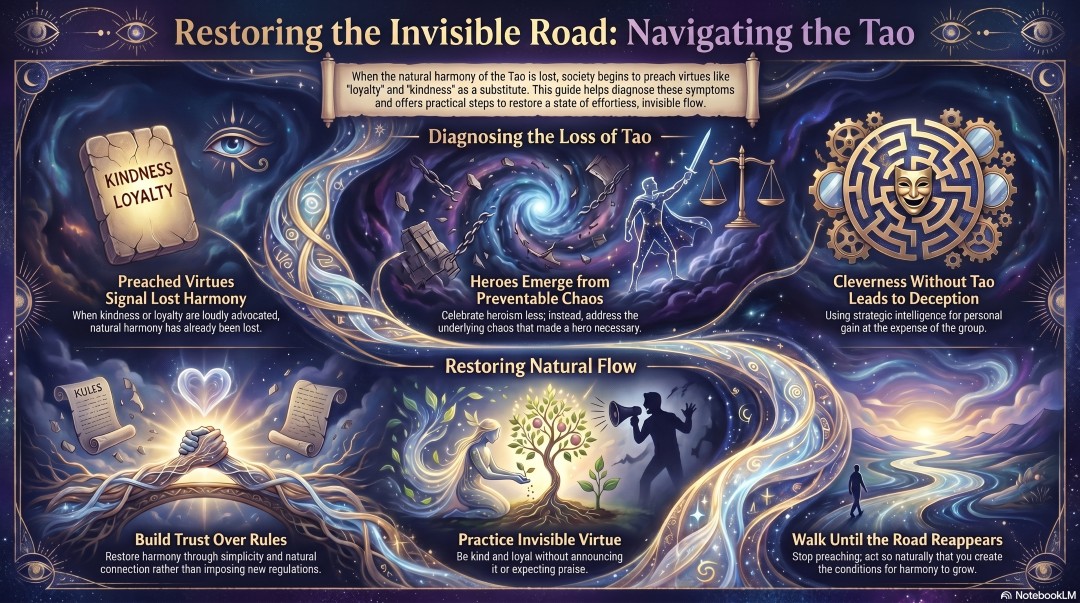
- Look for Preached Virtues: When you hear yourself or others advocating for kindness, teamwork, or loyalty, pause. Ask: “What natural harmony has been lost that makes this preaching necessary?”
- Don’t Celebrate Heroes Too Quickly: When someone is hailed as a hero for staying calm in chaos, recognize that the chaos itself is the real problem. Instead of just praising the hero, ask how the group can prevent such chaos next time.
- Restore the Tao, Not the Rules: Rather than imposing more rules about “being good,” focus on rebuilding trust, simplicity, and natural connection. The Tao is restored not by preaching, but by example and by creating conditions where harmony can grow.
- Check Your Own “Intelligence”: When you find yourself being clever, strategic, or cunning, ask: “Am I using this intelligence to serve the group – or to get ahead at their expense?” Cleverness without Tao leads to deception.
- Travel as If the Tao Is Present: Even in a difficult situation, act as if the natural way is still possible. Be kind without announcing it. Be loyal without expecting praise. Let your virtue be invisible – and you may help bring the Tao back.
The Destination: Before the Virtues Were Named
Tao Te Ching Chapter 18 takes us back to a time before concepts like “benevolence” and “loyalty” were needed – a time when people simply lived in harmony with the Tao, like a well‑functioning ecosystem. That time is not gone; it is always available when we stop forcing and start flowing.
The sage traveler knows that the highest form of virtue leaves no trace. It does not need to be named, praised, or taught. It simply is.
So when you hear a lot of talk about “being good,” look deeper. Somewhere, the great Tao has faded. Your task is not to preach louder – but to walk so naturally that the road reappears beneath your feet.
Continue Your Journey: Having diagnosed the loss of Tao, Chapter 19 offers the remedy: abandon sageliness and discard wisdom, and the people will benefit a hundredfold.
For the foundational maps of this philosophy, explore our Foundations of the Tao series.