Every road, no matter how far it stretches, eventually turns back toward home. Every traveler, no matter how restless, eventually seeks stillness. Tao Te Ching Chapter 16 reveals the great cycle of all journeys: from emptiness to activity, from flourishing to return, from the self to the source.
Executive Summary
Tao Te Ching Chapter 16 teaches that true clarity comes from returning to stillness.
When we quiet the mind and let all things rise and fall without interference, we begin to see the natural rhythm of life: everything returns to its source.
This return is not loss but alignment—an anchoring in the Tao that dissolves confusion and fear.
This chapter emphasizes that those who recognize this cyclical nature become steady, compassionate, and impossible to disturb.
By rooting ourselves in the unchanging center beneath life’s constant motion, we gain perspective, patience, and a deep sense of belonging to the larger unfolding of the world.
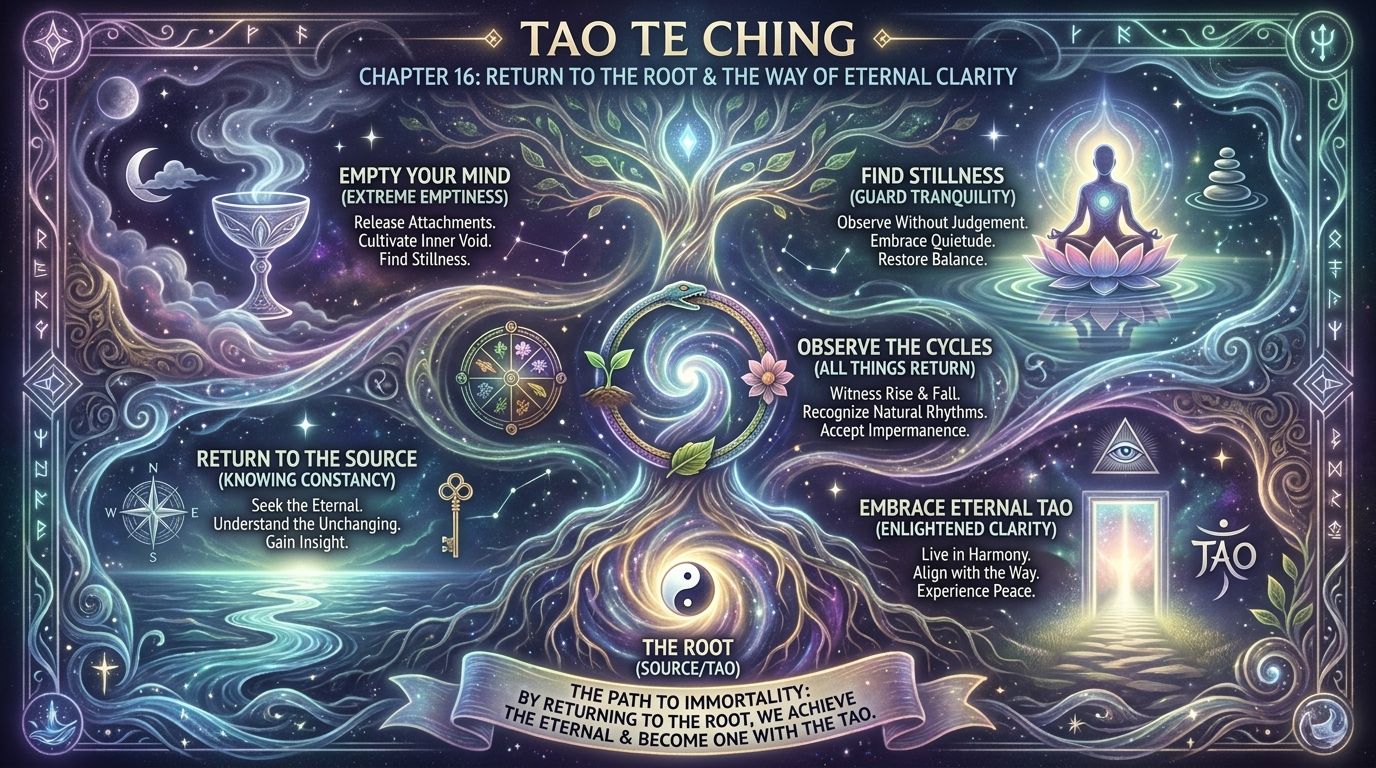
Chapter 16
Attain the ultimate emptiness
Tao te ching 16 Of 81
Hold on to the truest tranquility
The myriad things are all active
I therefore watch their return
Everything flourishes; each returns to its root
Returning to the root is called tranquility
Tranquility is called returning to one’s nature
Returning to one’s nature is called constancy
Knowing constancy is called clarity
Not knowing constancy, one recklessly causes trouble
Knowing constancy is acceptance
Acceptance is impartiality
Impartiality is sovereign
Sovereign is Heaven
Heaven is Tao
Tao is eternal
The self is no more, without danger
The Traveler’s Ultimate Destination
After meeting the ancient masters in Chapter 15, Tao Te Ching Chapter 16 delivers one of the most practical and profound teachings in the entire text: a step-by-step path to inner peace and lasting clarity. This chapter describes the cycle of all things – how everything arises from stillness, flourishes, and then returns. And it offers the traveler a method: attain ultimate emptiness, hold to truest tranquility, and watch the return.
For anyone who has ever felt lost, anxious, or disconnected, Chapter 16 is a homecoming. It reminds us that the goal of the journey is not to accumulate more experiences, but to return to the root – and in that return, discover a peace that no storm can disturb.
The Practice: Ultimate Emptiness, Truest Tranquility
The chapter opens with a direct instruction:
“Attain the ultimate emptiness. Hold on to the truest tranquility.”
The Traveler’s Insight: Before any journey, there is preparation. But here, the preparation is not packing – it is emptying. “Ultimate emptiness” means clearing the mind of all clutter: plans, worries, expectations, memories. It is the mental equivalent of an empty suitcase, ready to receive only what is needed.
“Truest tranquility” is the stillness that comes when the mind stops chattering. On a long drive, have you ever reached a point where the hum of the road fades and you feel completely at peace? That is a glimpse of this tranquility. The practice is to cultivate it deliberately, to hold onto it even amidst motion.
Watching the Return of All Things
Lao Tzu then makes an observation:
“The myriad things are all active; I therefore watch their return.”
The Traveler’s Insight: From the perspective of ultimate emptiness, the sage becomes a witness. They watch the world of ten thousand things – all the busyness, the comings and goings, the births and deaths – without getting swept away. Like a traveler sitting on a hill overlooking a busy highway, they see the cars rush by but remain still.
And what do they see? Every active thing eventually returns. The river flows to the ocean. The day gives way to night. The traveler returns home. Even the most frantic activity has a built-in return to stillness.
“Everything flourishes; each returns to its root.”
Spring blooms, summer ripens, autumn fades, winter rests – and then spring comes again. The “root” is the source, the ground, the stillness from which all activity emerges and to which it returns.
The Sequence of Return: From Tranquility to Eternity
The chapter then unfolds a logical progression that is both philosophical and deeply practical:
1. Returning to the Root is Tranquility
“Returning to the root is called tranquility.”
When you return to your source – the empty, still awareness beneath all thoughts – you find natural peace. Not a forced calm, but the tranquility of a lake that has stopped being stirred.
The Traveler’s Insight: After a long day of sightseeing, when you finally sit down in a quiet place, the busyness settles. That settling is not something you do; it happens on its own when you stop adding motion. Returning to the root is simply ceasing to stir the water.
2. Tranquility is Returning to One’s Nature
“Tranquility is called returning to one’s nature.”
Your true nature is not the restless, wanting self. It is the peaceful, aware presence that was there before you learned to be anxious. When you are tranquil, you come home to who you really are.
The Traveler’s Insight: Have you ever felt most yourself in a quiet moment on the road – watching a sunrise, sitting by a campfire, staring at the ocean? That is not escape; that is return. Your nature is peace. The noise is just temporary.
3. Returning to Nature is Constancy
“Returning to one’s nature is called constancy.”
Constancy means that which does not change. Your moods change, your thoughts change, your circumstances change – but the awareness that witnesses all of this remains constant. When you live from that constancy, you are unshakable.
The Traveler’s Insight: The road is full of changes: flat tires, closed roads, bad weather. The traveler who is rooted in constancy is not thrown by these events. They know that the changing conditions are like clouds passing through a clear sky – the sky itself remains unchanged.
4. Knowing Constancy is Clarity
“Knowing constancy is called clarity.”
Clarity is not intellectual knowledge; it is direct insight. When you know – not just believe, but directly perceive – that your true nature is constant and peaceful, you see clearly. You are no longer confused by the surface turbulence.
The Traveler’s Insight: Clarity is like a windshield wiped clean. You see the road exactly as it is, without the distortions of fear or desire. The traveler with clarity makes better decisions, not because they are smarter, but because they are not blinded by inner fog.
5. Not Knowing Constancy Brings Trouble
“Not knowing constancy, one recklessly causes trouble.”
When you forget your true nature – when you believe you are just the restless, wanting self – you act recklessly. You chase what you don’t need, cling to what you can’t keep, and suffer unnecessarily.
The Traveler’s Insight: The traveler who has forgotten their constancy panics when a flight is delayed, fights with companions over small irritations, and returns home exhausted and disappointed. They cause their own trouble because they have no inner anchor.
The Virtues of Knowing Constancy
The chapter then lists the qualities that arise from this knowing:
“Knowing constancy is acceptance. Acceptance is impartiality. Impartiality is sovereign. Sovereign is Heaven. Heaven is Tao. Tao is eternal.”
The Traveler’s Insight: When you know your constant nature, you naturally accept whatever arises – not with resignation, but with openness. This acceptance becomes impartiality: you no longer favor pleasure over pain, gain over loss. Impartiality is “sovereign” – it rules your inner life with effortless authority, like Heaven itself, which treats all things equally. And Heaven is none other than the Tao – eternal, unchanging, the very ground of being.
The Final Freedom: No Self, No Danger
The chapter ends with the ultimate realization:
“The self is no more, without danger.”
The Traveler’s Insight: This does not mean you become a blank nothing. It means the small, fearful, grasping self – the one that worries about disgrace, chases favor, and clings to life – dissolves. In its place is the vast, constant awareness that was always there. And without that small self to be harmed, there is no danger. Danger exists only for the ego. The Tao cannot be threatened.
The traveler who has returned to the root moves through the world like water: nothing can harm them because there is no separate self to harm. They are not reckless – they are simply fearless. And in that fearlessness, they are safer than any anxious person clutching their belongings.
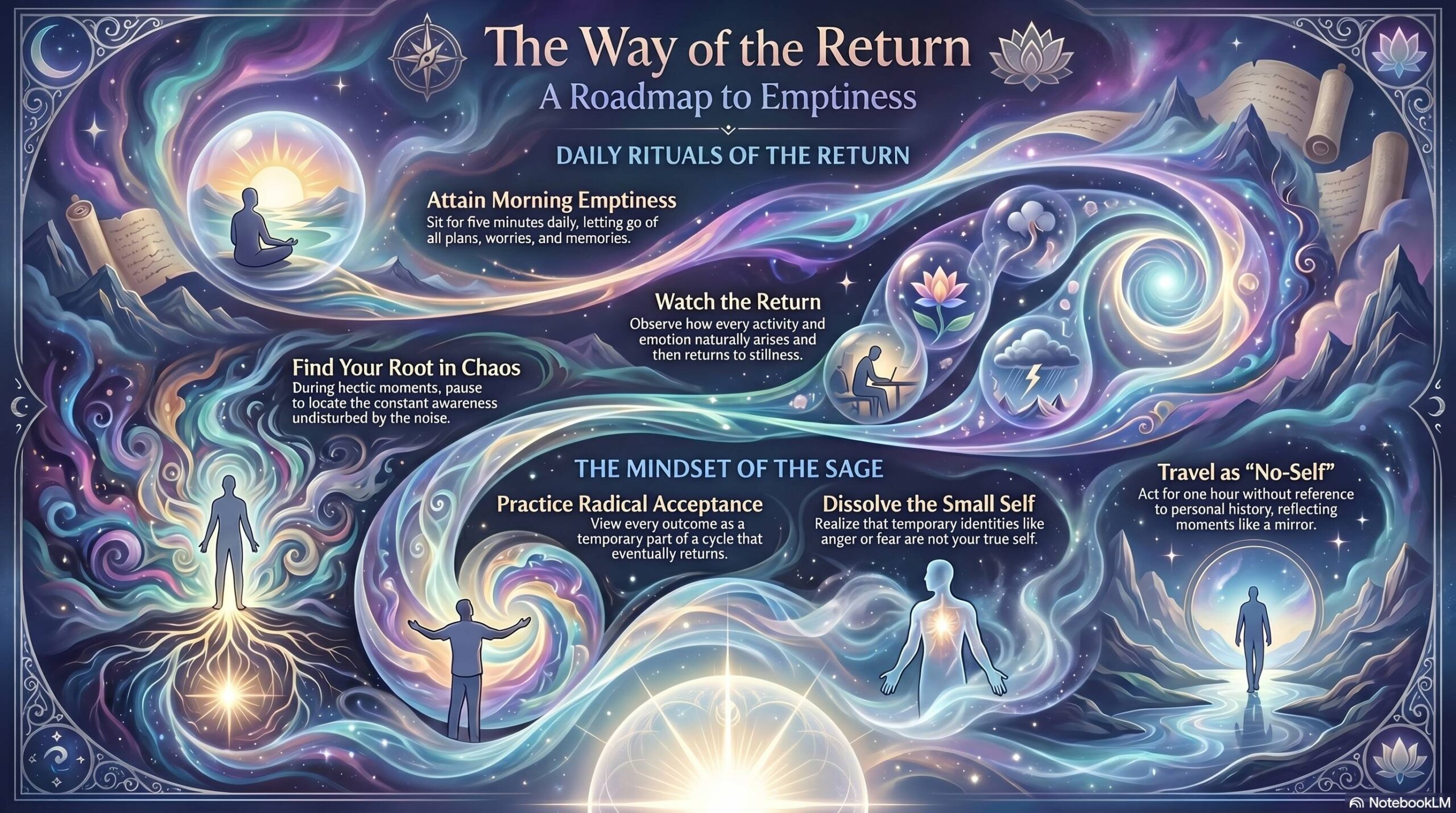
Your Roadmap: Practicing Return on the Journey
How do you apply Chapter 16 to your daily travels?
- Attain Ultimate Emptiness Each Morning: Before you start your day, sit for five minutes. Let go of all plans, worries, and memories. Empty your mind completely. This is your “emptiness practice.”
- Watch the Return: Throughout the day, notice how every activity – every conversation, every task, every emotion – naturally arises and then returns to stillness. Don’t interfere; just watch.
- Find Your Root in Chaos: When things get hectic, pause and ask: “Where is the stillness beneath this noise?” Feel for the constant awareness that is not disturbed.
- Practice Acceptance: When something doesn’t go your way, say to yourself: “This too arises and will return. I accept it as part of the cycle.”
- Recognize the Self That Is No More: In a moment of fear or anger, ask: “Which self is feeling this? Is it the real me, or just a temporary identity?” Let that small self dissolve back into the root.
- Travel as No-Self: For one hour, act without reference to your personal history, preferences, or reputation. Simply respond to each moment as it comes, like a mirror reflecting whatever appears.
The Destination: Home Is Where the Root Is
Tao Te Ching Chapter 16 is a complete manual for inner peace. It teaches that you don’t need to go anywhere special or become anyone different. The journey of a thousand miles begins and ends in the same place: the root of your own being.
Attain emptiness. Hold tranquility. Watch the return. Know constancy. And in that knowing, discover that the self you were so worried about was never really there. Only the Tao remains – eternal, impartial, and utterly safe.
Every traveler eventually comes home. But the sage realizes: you never left.
Continue Your Journey: Having returned to the root, Chapter 17 explores the highest leadership – where the people barely know the leader exists, and when the work is done, they say “we did it ourselves”.
For the foundational maps of this philosophy, explore our Foundations of the Tao series.