The most experienced travelers rarely announce themselves. They move with the hesitance of someone crossing a frozen river, the caution of a stranger in a strange land, the simplicity of undyed silk. Tao Te Ching Chapter 15 paints a portrait of the ancient masters – travelers so deeply aligned with the Tao that their wisdom appears as mystery, their action as hesitation, and their clarity as muddy water waiting to settle.
Executive Summary
Tao Te Ching Chapter 15 describes the ancient masters as subtle, cautious, humble, and paradoxically powerful—moving through the world with the quiet precision of someone crossing winter ice and the openness of a valley.
They embody qualities that seem ordinary on the surface but reveal profound inner clarity and depth. Their wisdom comes not from force or certainty, but from stillness, patience, and the ability to let muddiness settle on its own.
By avoiding self‑importance and refusing to “fill up,” they remain adaptable, renewed, and deeply aligned with the Tao.
The chapter ultimately teaches that true mastery looks understated, moves slowly, and stays empty enough to keep learning.
Chapter 15
The Tao masters of antiquity
Tao te ching 15 Of 81
Subtle wonders through mystery
Depths that cannot be discerned
Because one cannot discern them
Therefore one is forced to describe the appearance
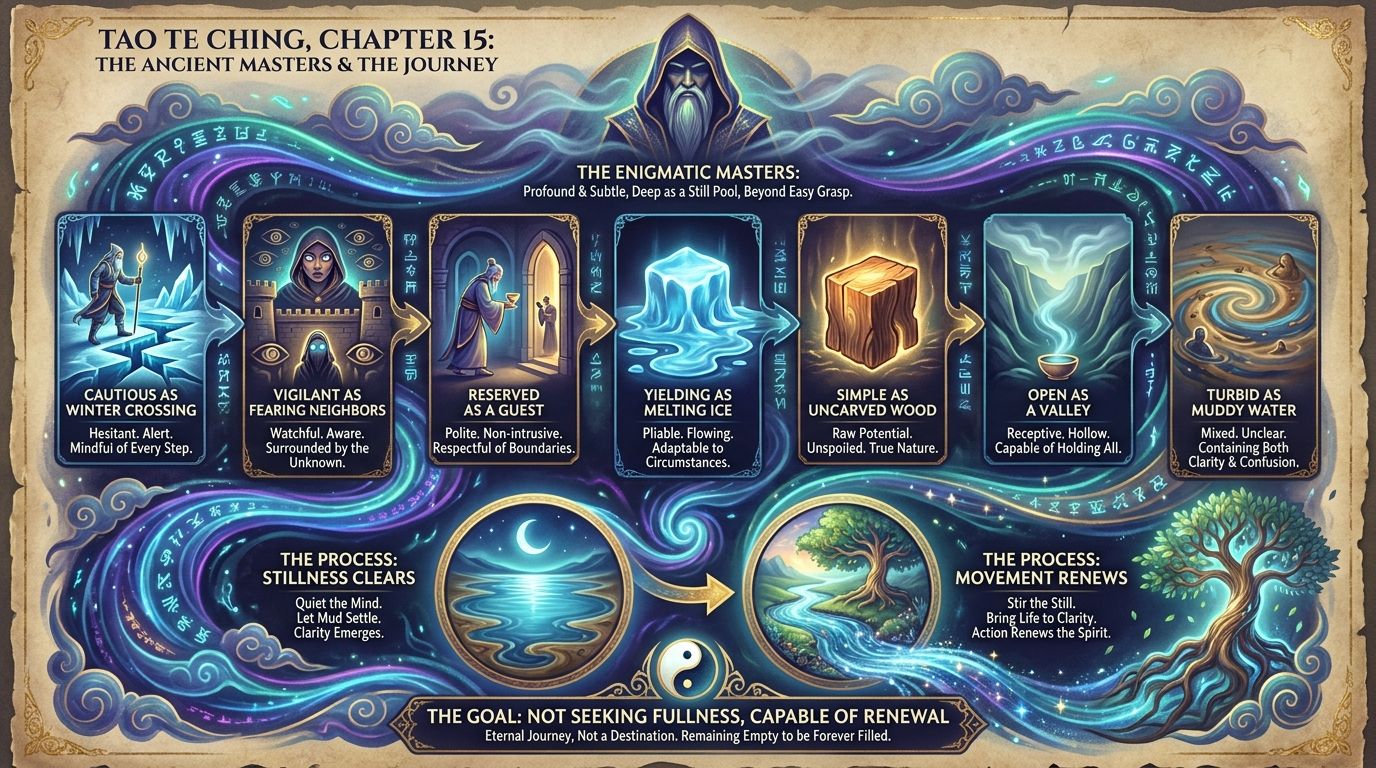
Hesitant, like crossing a wintry river
Cautious, like fearing four neighbors
Solemn, like a guest
Loose, like ice about to melt
Genuine, like plain wood
Open, like a valley
Opaque, like muddy water
Who can be muddled yet desist
In stillness gradually become clear?
Who can be serene yet persist
In motion gradually come alive?
One who holds this Tao does not wish to be overfilled
Because one is not overfilled
Therefore one can preserve and not create anew
The Undiscernible Traveler
After exploring the invisible Tao in Chapter 14, Tao Te Ching Chapter 15 describes those who have embodied that mystery: the Tao masters of antiquity. Lao Tzu admits from the start that these masters cannot be fully understood. Their depth is unfathomable. Yet because we cannot grasp them directly, we are forced to describe them through images – similes drawn from nature and daily life.
For the modern traveler, these images offer a mirror. They invite us to ask: Do I move through the world with this kind of subtle, grounded presence? Or do I rush, announce myself, demand clarity before I’ve allowed the mud to settle?
Seven Portraits of the Master Traveler
The chapter presents seven vivid similes, each revealing a different facet of the sage’s way.
1. Hesitant, Like Crossing a Winter River
“Hesitant, like crossing a wintry river.”
Imagine standing at the edge of a river in deep winter. The ice may hold – or it may not. The master traveler does not charge ahead. They test each step, feeling for solidity, ready to retreat.
The Traveler’s Insight: On a journey, rushing into the unknown is not courage; it is recklessness. The wise traveler approaches new terrain – a new culture, a difficult conversation, an uncertain decision – with hesitation born of respect. They do not assume the ice will hold. They proceed with care, and in that care, they rarely break through.
2. Cautious, Like Fearing Four Neighbors
“Cautious, like fearing four neighbors.”
In ancient China, neighbors could be allies or threats. The cautious person is aware of their surroundings – not paranoid, but attentive. On a journey, this means being present to the people and forces around you.
The Traveler’s Insight: The master traveler does not blunder into a situation oblivious to others. They read the room, sense the mood, and move with respect for those sharing the road. This is not fear – it is situational awareness, the mark of one who has traveled long enough to know that every environment has its own rules.
3. Solemn, Like a Guest
“Solemn, like a guest.”
A guest does not act as if they own the house. They are respectful, grateful, and restrained. They do not demand or dominate.
The Traveler’s Insight: Every place you visit is someone’s home – even a national park, a city street, a museum. The sage traveler moves as a guest, not a conqueror. They leave no trace, take only memories, and honor the hosts – human and natural – who make the journey possible.
4. Loose, Like Ice About to Melt
“Loose, like ice about to melt.”
Ice is rigid; melting ice becomes fluid. The master traveler holds their plans, opinions, and identity loosely – ready to adapt, to flow, to change form as conditions shift.
The Traveler’s Insight: The traveler who clings to a rigid itinerary, who cannot accept a detour or a delay, suffers constantly. The traveler who is “loose” – flexible, open, willing to melt into the new situation – finds that the road offers gifts the rigid never see.
5. Genuine, Like Plain Wood
“Genuine, like plain wood.”
Uncarved wood (Pu in Taoism) is simple, unadorned, authentic. It has not been shaped into a “useful” object that loses its natural integrity.
The Traveler’s Insight: The master traveler does not perform. They do not try to impress with stories, gear, or knowledge. They are simply themselves – plain, genuine, without pretense. In a world of curated travel personas, this authenticity is rare and deeply refreshing.
6. Open, Like a Valley
“Open, like a valley.”
A valley is receptive. It receives rain, wind, seeds, and travelers. It does not block or resist; it holds.
The Traveler’s Insight: The open traveler receives what comes – new ideas, unexpected encounters, unfamiliar customs. They do not close themselves off with prejudice or fear. Their openness becomes a valley where experiences gather and are enriched.
7. Opaque, Like Muddy Water
“Opaque, like muddy water.”
This is the most paradoxical image. Muddy water is not clear – yet the master is described as opaque. Why? Because wisdom does not always present itself as crystal clarity. Sometimes it is murky, confusing, unclear – and that is exactly as it should be.
The Traveler’s Insight: Have you ever arrived in a new place and felt utterly lost? The language, the customs, the layout – all muddled. The novice traveler panics and demands clarity. The master traveler accepts the muddiness, knowing that stillness will eventually let the sediment settle, revealing clear water beneath.
The Two Great Questions: Stillness and Motion
The chapter then poses two profound questions:
“Who can be muddled yet desist? In stillness gradually become clear. Who can be serene yet persist? In motion gradually come alive.”
The Traveler’s Insight: The first question addresses confusion. When you are muddled – lost in a foreign city, overwhelmed by choices, uncertain of the path – the natural impulse is to rush, to force clarity. The Tao asks you to do the opposite: desist. Stop. Be still. In that stillness, the mud settles on its own. Clarity arises without struggle.
The second question addresses serenity. When you are peaceful, still, calm – the natural impulse is to stay there, to cling to the stillness. But the Tao asks you to persist – to move, to act, to engage. In that motion, you “come alive.” Life is not static peace; it is dynamic harmony. The master traveler can be serene and in motion, like a dancer who is completely relaxed yet moving with precision.
The Secret of Not Overfilling
The chapter concludes:
“One who holds this Tao does not wish to be overfilled. Because one is not overfilled, therefore one can preserve and not create anew.”
The Traveler’s Insight: “Overfilled” means full of oneself – full of opinions, plans, certainties, ego. The master traveler keeps a space of emptiness inside. They do not cram their mind with rigid expectations or their bags with unnecessary gear. Because they are not overfilled, they can preserve what is essential – their energy, their openness, their connection to the Tao – without needing to constantly “create anew” through effort and strain.
On a journey, this is the difference between the traveler who returns exhausted (overfilled, spent) and the traveler who returns refreshed (preserved, whole). The sage does less, yet accomplishes more – because they never exceed their natural capacity.
Your Roadmap: Traveling as an Ancient Master
How do you embody these seven qualities on the road?
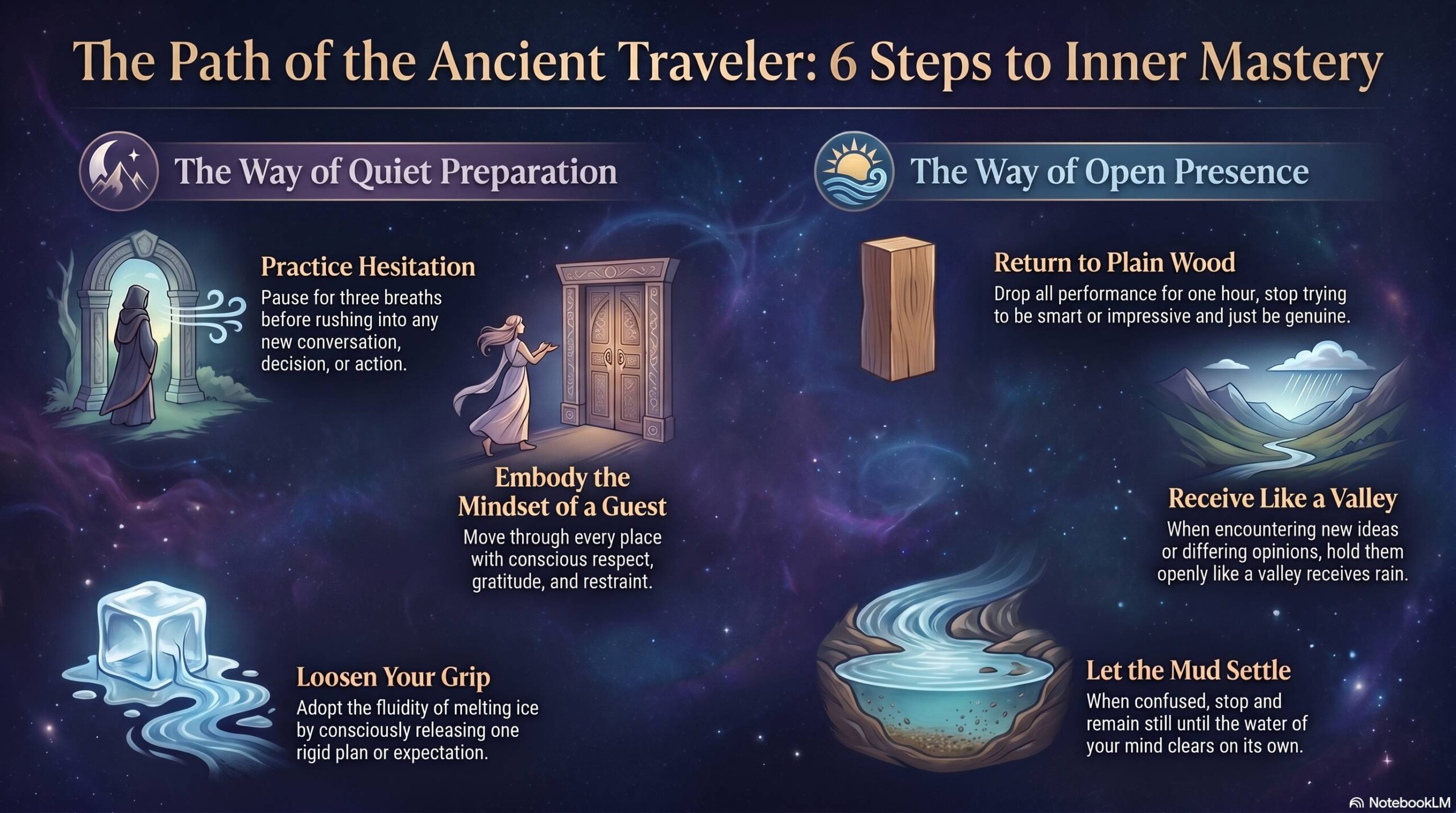
- Practice Hesitation: Before rushing into a new situation – a conversation, a decision, a turn – pause for three breaths. Let the hesitation of crossing the winter river guide you.
- Be a Guest: In every place you visit today, consciously adopt the mindset of a guest. Be respectful, grateful, and restrained. Notice how this changes your experience.
- Loosen Your Grip: Identify one plan or expectation you are holding tightly. Consciously loosen it. Say, “I am like melting ice. I will adapt.”
- Return to Plain Wood: For one hour, drop all performance. Don’t try to be interesting, smart, or impressive. Just be plain, genuine, yourself.
- Become a Valley: When someone offers a different opinion or a new idea, receive it like a valley receives rain. Don’t block; just hold it.
- Let Mud Settle: When confused, do not demand immediate clarity. Stop. Be still. Trust that stillness will clear the water.
- Stay Underfilled: At the end of the day, notice where you feel “overfilled” – too much input, too many plans. Choose one thing to release. Preserve your essence.
The Destination: The Master Traveler Within
Tao Te Ching Chapter 15 shows us that wisdom looks like hesitation, caution, solemnity, looseness, genuineness, openness, and even muddiness. It does not look like the confident, loud, always-certain traveler we are taught to admire. It looks like someone crossing a winter river – one careful step at a time.
The good news: this master traveler is not some ancient figure from a distant land. It is the way you already know how to move when you are most present, most humble, most open. The seven images are not achievements to earn – they are invitations to remember.
Walk hesitantly, and you will not fall through the ice. Be a guest, and you will be welcomed. Remain underfilled, and you will never run dry.
This is the way of the ancient traveler. And it is your way, too.
Continue Your Journey: Having met the ancient masters, Chapter 16 teaches the practice of emptying the mind and returning to the root – how stillness reveals the cycle of all things.
For the foundational maps of this philosophy, explore our Foundations of the Tao series.