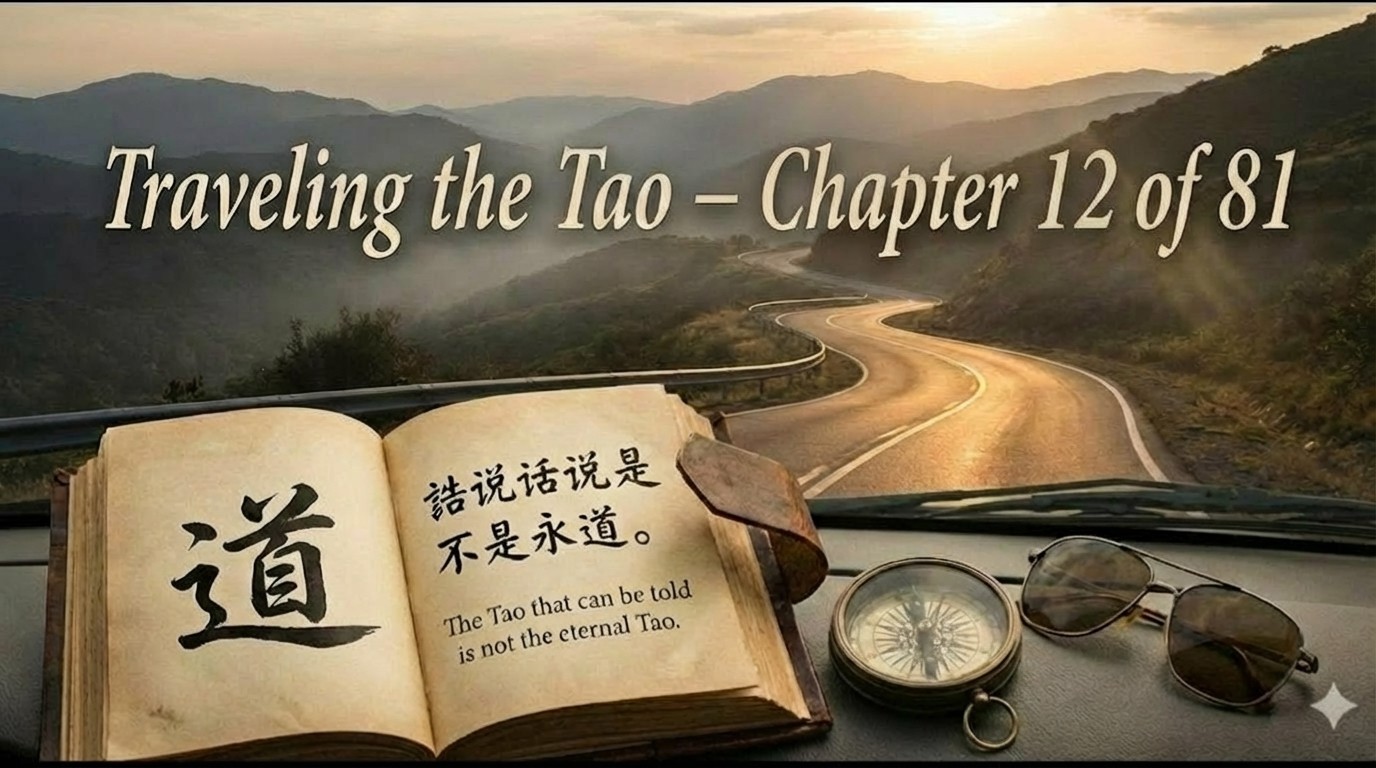
The road is full of dazzling sights: neon signs promising adventure, guidebooks shouting “must-see,” souvenir markets tempting with rare treasures. Yet the traveler who chases every sensation arrives home empty—blinded by color, deafened by noise, and starving for the one thing they never tasted: presence. Tao Te Ching Chapter 12 warns that sensory overload is not enrichment, but impoverishment.
Executive Summary
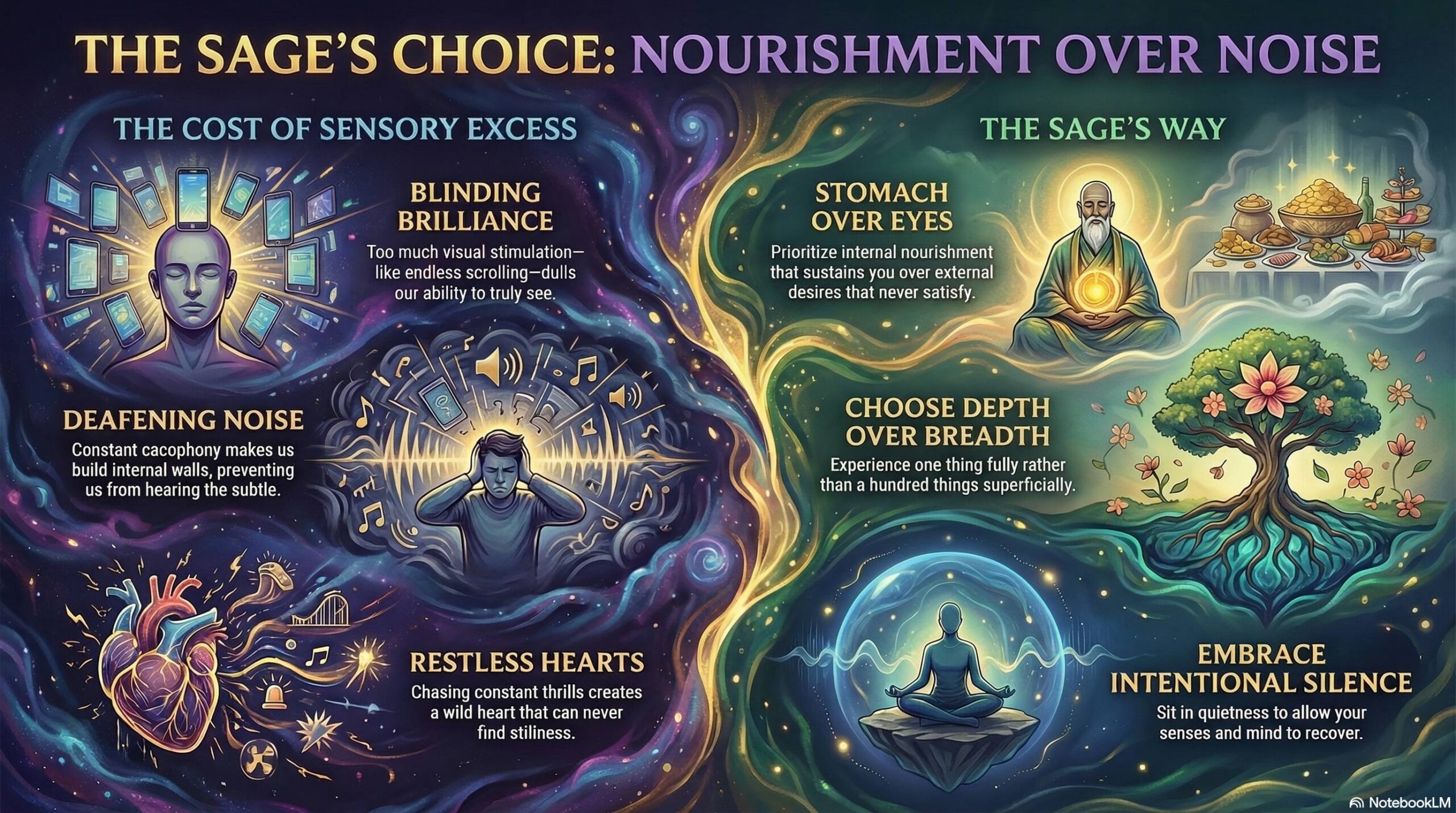
Tao Te Ching Chapter 12 warns that an overstimulated life is not a richer one—it is a numbed one.
When we flood our senses with constant input—endless images, noise, flavors, thrills, and the pursuit of rare or exclusive experiences—we lose the ability to perceive anything deeply. Excess doesn’t heighten awareness; it erodes it.
Lao Tzu’s teaching invites a shift from chasing stimulation to choosing nourishment. The “eyes” symbolize the restless appetite for novelty, while the “stomach” represents what truly sustains: simplicity, presence, and experiences we can actually digest.
Applied to modern life, this means limiting sensory overload, seeking quiet, simplifying pleasures, doing fewer things with more depth, and questioning pursuits driven by hype rather than genuine value.
By caring for what nourishes rather than what dazzles, we recover clarity, satisfaction, and the capacity to be fully present. In choosing less, life becomes more vivid, meaningful, and whole.
Chapter 12
The five colors make one blind in the eyes
Tao te ching 12 Of 81
The five sounds make one deaf in the ears
The five flavors make one tasteless in the mouth
Racing and hunting make one wild in the heart
Goods that are difficult to acquire make one cause damage
Therefore the sages care for the stomach and not the eyes
That is why they discard the other and take this
The Overstimulated Traveler: A Modern Epidemic
After exploring the function of emptiness in Chapter 11, Tao Te Ching Chapter 12 addresses a problem as old as humanity but magnified a thousandfold in our age: the addiction to sensation. Lao Tzu observes that too much stimulation doesn’t sharpen the senses—it dulls them. The traveler who tries to see everything ends up seeing nothing. The one who chases every experience loses the capacity to experience anything deeply.
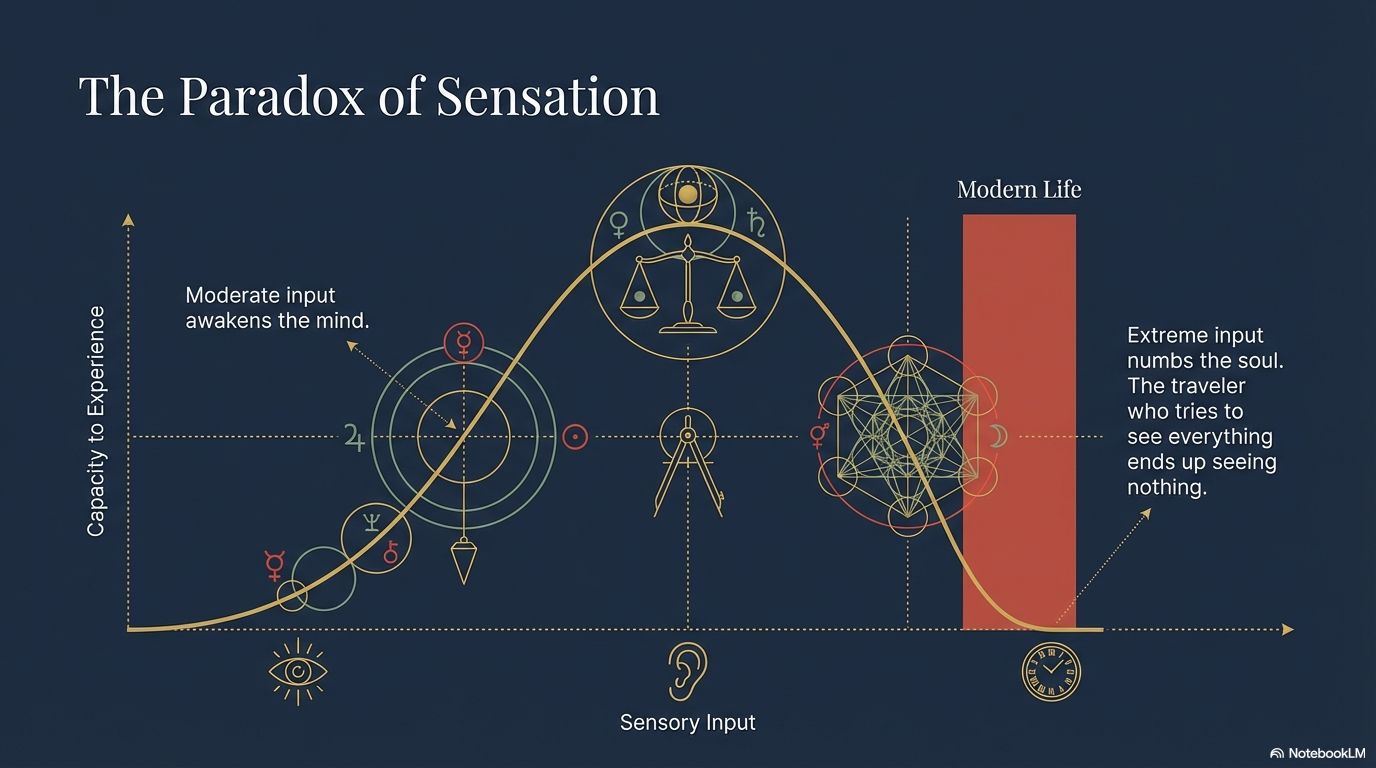
For the modern traveler, this chapter is essential medicine. We live in an era of bucket lists, Instagram walls, and the constant pressure to “make the most” of every moment. Chapter 12 offers a countercultural wisdom: true richness lies not in consuming more, but in attending to what truly nourishes.
The Five Sins of Sensory Excess
The chapter opens with a series of parallel warnings:
“The five colors make one blind in the eyes.”
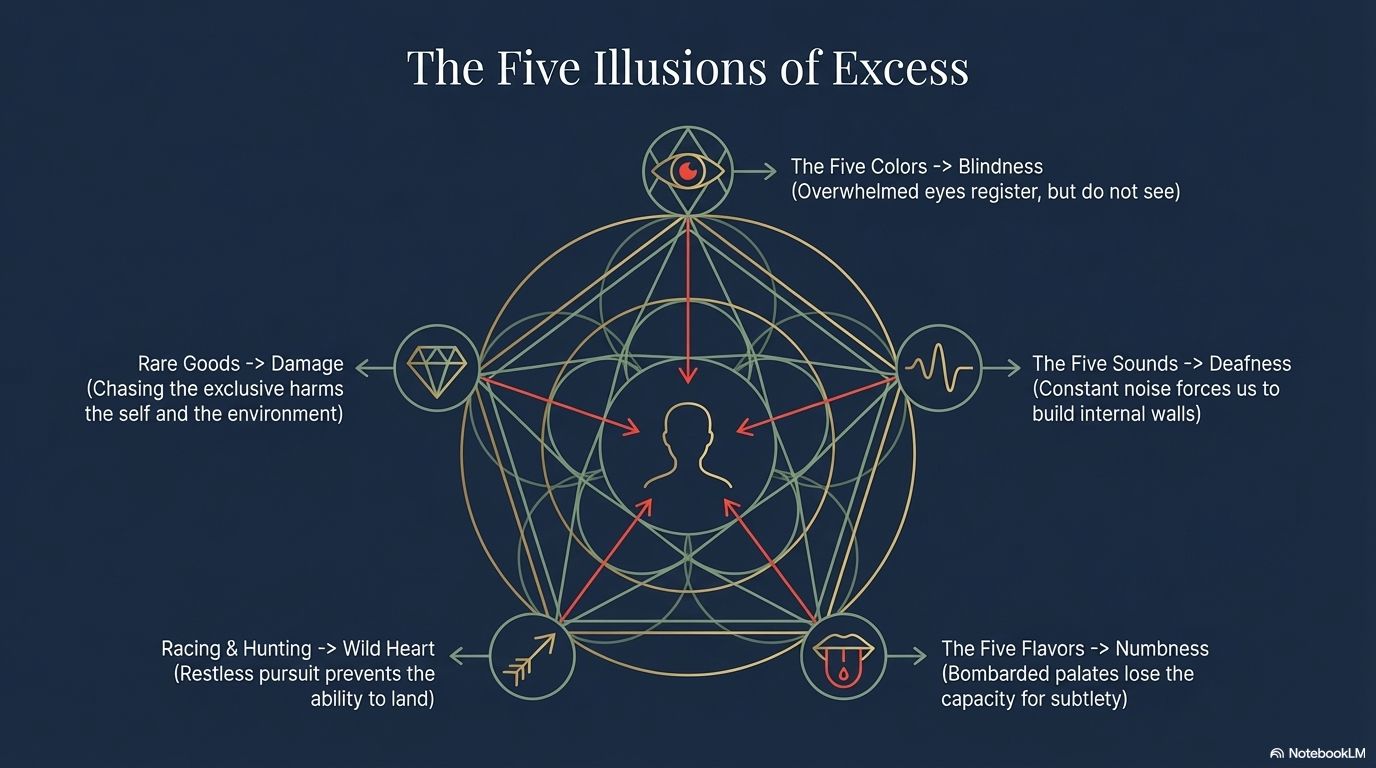
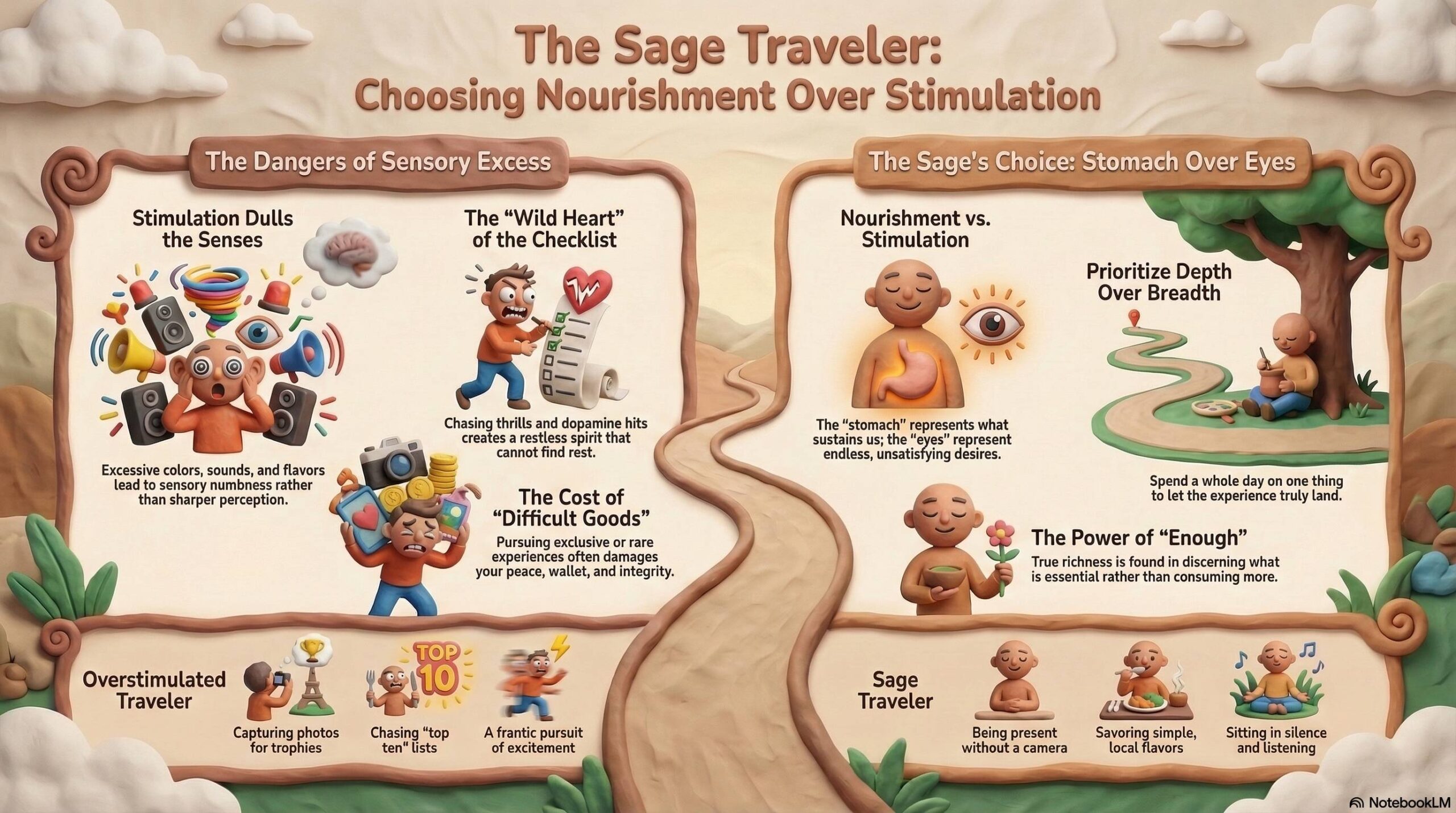
In ancient China, “five colors” referred to the full spectrum of visual stimulation. Today, think of the neon chaos of Times Square, the endless scroll of travel photos, the visual assault of crowded markets. When you try to take in too much visual information, your eyes—and your mind—become overwhelmed. You stop really seeing. You simply register.
The Traveler’s Insight: Have you ever returned from a trip with a thousand photos but no memory of actually being anywhere? You saw so much that you saw nothing. The eyes became cameras, not organs of presence.
“The five sounds make one deaf in the ears.”
The cacophony of a busy city, the constant background music in shops, the chatter of crowds, the roar of engines—when sound never ceases, we stop listening. We build internal walls just to survive the noise.
The Traveler’s Insight: The traveler who seeks silence finds more than peace. They find the ability to truly hear—the wind in the canyon, the subtle accent of a local, the unspoken rhythm of a place. The overstimulated ear catches only the loudest surface.
“The five flavors make one tasteless in the mouth.”
Buffets, street food tours, endless novelty—when the palate is constantly bombarded, it loses discernment. You can’t taste the subtlety of a simple, well-prepared dish because your tongue has been beaten into numbness.
The Traveler’s Insight: The most memorable meals on the road are often the simplest: fresh bread, a local cheese, a bowl of noodles eaten slowly in a quiet corner. The gourmand who must taste everything ends up tasting nothing.
“Racing and hunting make one wild in the heart.”
This line describes the frantic pursuit of excitement—chasing thrills, checking off adventures, constantly seeking the next dopamine hit. The heart becomes “wild” not in a free, natural way, but in a restless, ungrounded way, always needing more and never satisfied.
The Traveler’s Insight: The traveler who treats the road as a checklist—climb this mountain, ride that zipline, attend that festival—returns home with a racing heart that cannot rest. They were never still enough to let any experience truly land.
“Goods that are difficult to acquire make one cause damage.”
Rare treasures, exclusive experiences, luxury goods—the pursuit of what is hard to get creates harm. It harms the traveler (through stress, debt, or moral compromise) and often harms the places visited (through exploitation, overtourism, or environmental damage).
The Traveler’s Insight: The “difficult to acquire” might be that elusive hotel reservation, that overhyped restaurant, that souvenir only available in one shop. The chase itself becomes the trip, and the damage—to your peace, your wallet, your integrity—is the only lasting result.
The Sage’s Choice: Stomach Over Eyes
The chapter concludes with its essential teaching:
“Therefore the sages care for the stomach and not the eyes. That is why they discard the other and take this.”
This is not a rejection of beauty or enjoyment. It is a prioritization of what truly nourishes over what merely stimulates. The stomach represents what sustains—the essential, the foundational, the truly needful. The eyes represent the endless parade of desires, the “look at this” culture that keeps us always wanting but never satisfied.
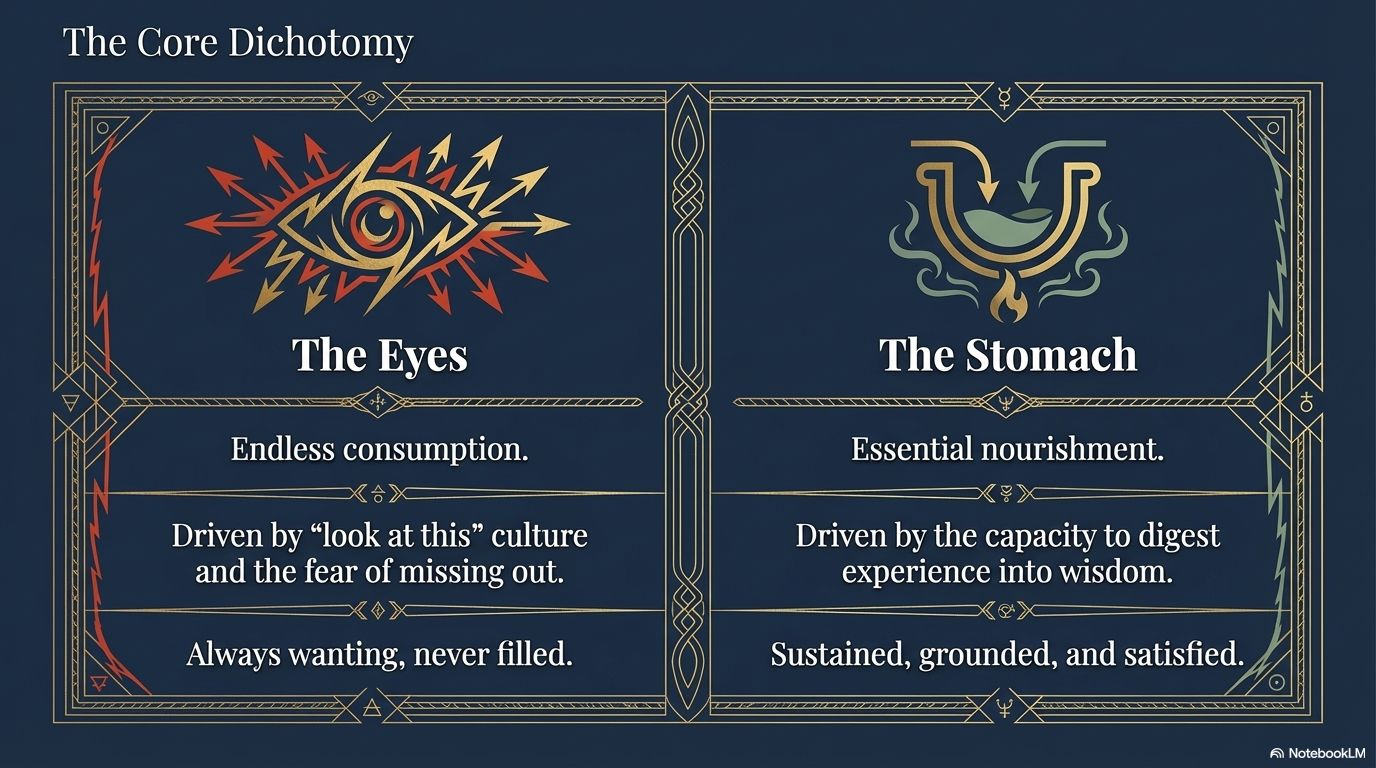
The Traveler’s Insight: The sage traveler makes a deliberate choice. They let go of the pressure to “see it all,” to collect experiences like trophies. Instead, they focus on what truly nourishes: a few meaningful encounters, a simple meal shared, a landscape sat with long enough to feel its soul. They care for their inner “stomach”—their capacity to digest experience into wisdom—rather than their “eyes,” which would consume endlessly without ever being filled.
Your Roadmap: Traveling with the Sage’s Priorities
How do you apply Chapter 12’s wisdom on the road and in life?
- Limit Visual Input: For one day of your next trip, put the camera away. No photos, no video. Simply look with your eyes—not to capture, but to be present. Notice what you see when you aren’t trying to frame the perfect shot.
- Seek Silence: Intentionally find a place without background music, announcements, or crowds. Sit in silence for twenty minutes. Let your ears recover. Listen to what you’ve been missing.
- Simplify Your Meals: Instead of chasing the “top ten restaurants,” eat simply for a day. Fresh bread, local fruit, water from a spring. Notice how your taste awakens to subtle flavors when not overwhelmed.
- One Thing, Deeply: Instead of a whirlwind tour, spend a whole day doing one thing—walking one trail, sitting in one square, having a single conversation. Let depth replace breadth.
- Question the “Must-See”: When you feel the urge to pursue something because it’s “rare” or “famous,” pause. Ask: Is this truly nourishing, or just stimulating? Is the chase worth the cost?
- Care for Your Stomach: At the end of each travel day, reflect: What actually fed me today? What was simply noise? Let this guide tomorrow’s choices.
The Destination: Less is More
Tao Te Ching Chapter 12 doesn’t tell you to become a hermit or reject beauty. It invites you to become discerning. In a world that screams “more,” it whispers: “enough.”
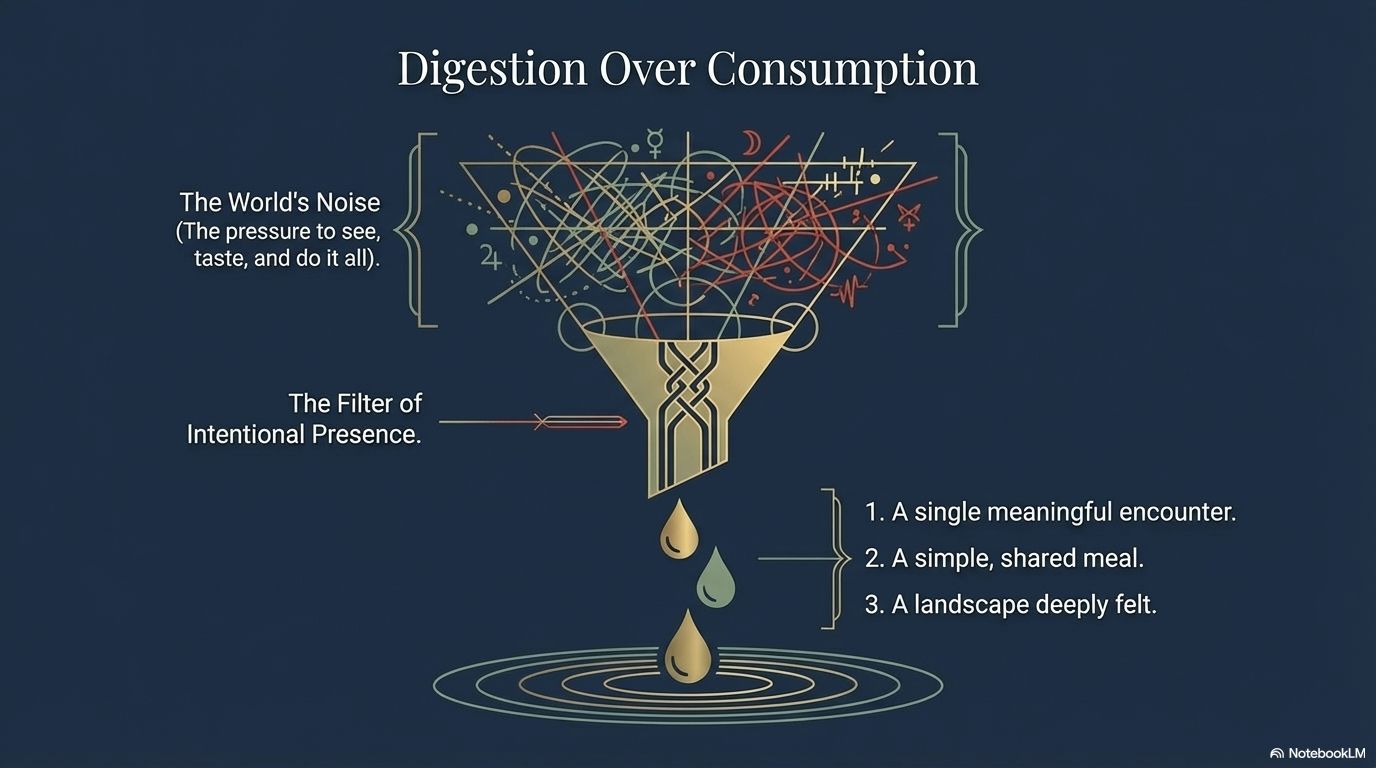
The traveler who heeds this wisdom moves differently. They aren’t chasing the next sensation, so they are present for the one they’re in. They don’t need to collect every sight, so the sights they do see enter deeply. They don’t race to the next destination, so the journey itself becomes the destination.
They care for the stomach—the capacity to absorb, digest, and be nourished—rather than the eyes, which can never be satisfied.
And in that choice, they discover a richness no amount of sensory overload could ever provide.
Continue Your Journey: Having learned to see beyond the noise, Chapter 13 explores the paradox of honor and disgrace—how treating both with equanimity frees the traveler from fear.
For the foundational maps of this philosophy, explore our Foundations of the Tao series.