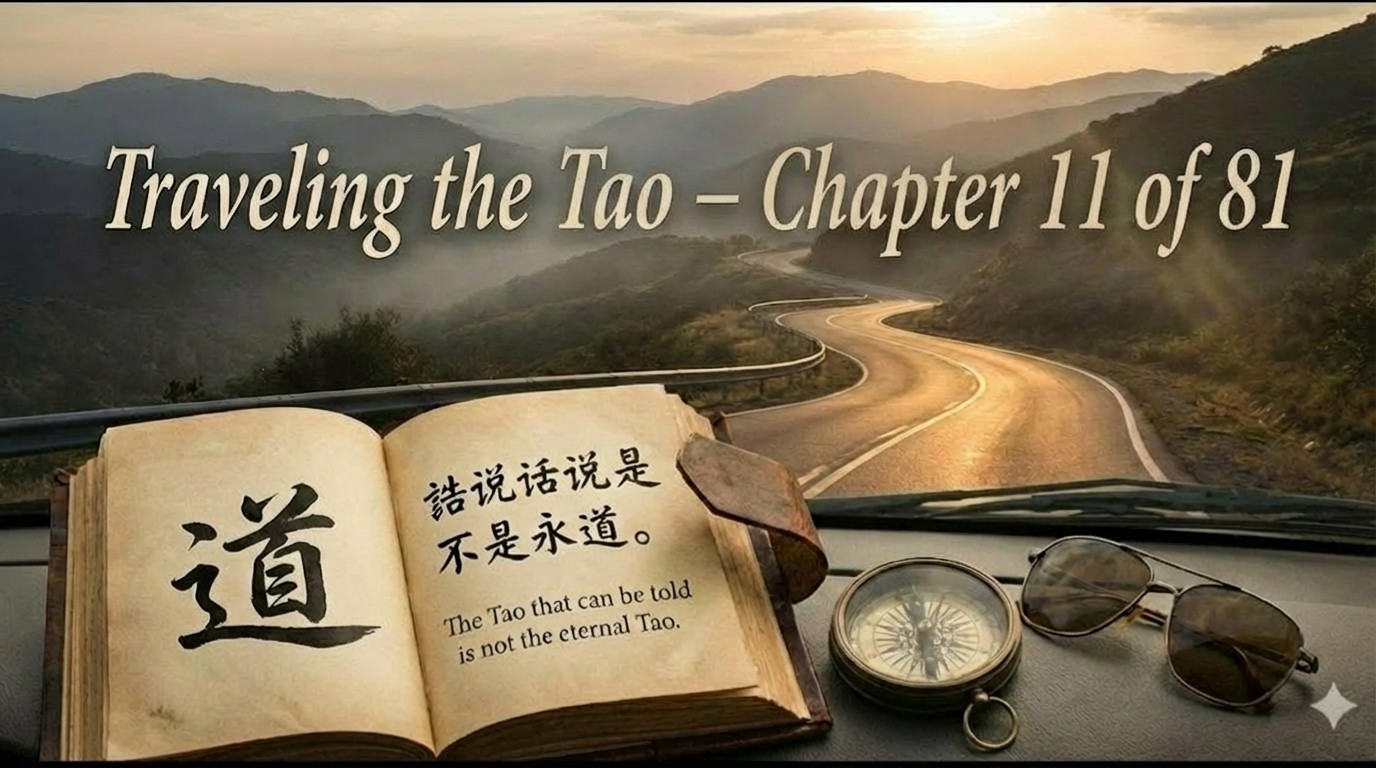
The hub of a wheel is just empty space—yet without it, the wagon cannot roll. The hollow of a cup is nothing but absence—yet without it, the cup cannot hold water. Tao Te Ching Chapter 11 reveals one of the most counterintuitive truths of the path: what makes any journey possible is not what you can see, but what you cannot.
Executive Summary
Tao Te Ching Chapter 11 uses three simple images—the wheel, the vessel, and the room—to show that the most important functions in life arise from emptiness, not from the solid forms we usually focus on.
A wheel turns because of the open hub, a cup holds because of its hollow center, and a room shelters because of the space within its walls. Lao Tzu’s point is that structure and emptiness are partners: what exists provides shape, but what’s empty provides possibility.
Applied to everyday life, this teaching encourages creating space in our minds, schedules, relationships, and goals.
Openness allows creativity, rest, connection, and unexpected opportunities to emerge. A life packed too tightly—emotionally, materially, or mentally—loses its ability to function well.
By honoring both form and spaciousness, we cultivate a life that can move, hold, and evolve.
Chapter 11
Thirty spokes join in one hub
Tao te ching 11 Of 81
In its emptiness, there is the function of a vehicle
Mix clay to create a container
In its emptiness, there is the function of a container
Cut open doors and windows to create a room
In its emptiness, there is the function of a room
Therefore, that which exists is used to create benefit
That which is empty is used to create functionality
The Traveler’s Greatest Discovery
After exploring the inner integration of Chapter 10, Tao Te Ching Chapter 11 turns outward to examine the physical world—and delivers a profound lesson about emptiness. Using three simple, everyday objects, Lao Tzu demonstrates that usefulness comes not from what exists, but from what doesn’t.
For the traveler on life’s road, this chapter is a revelation. It asks us to look at our vehicles, our containers, our destinations—and see them anew. It invites us to recognize that the most important elements of any journey are the empty spaces we usually overlook.
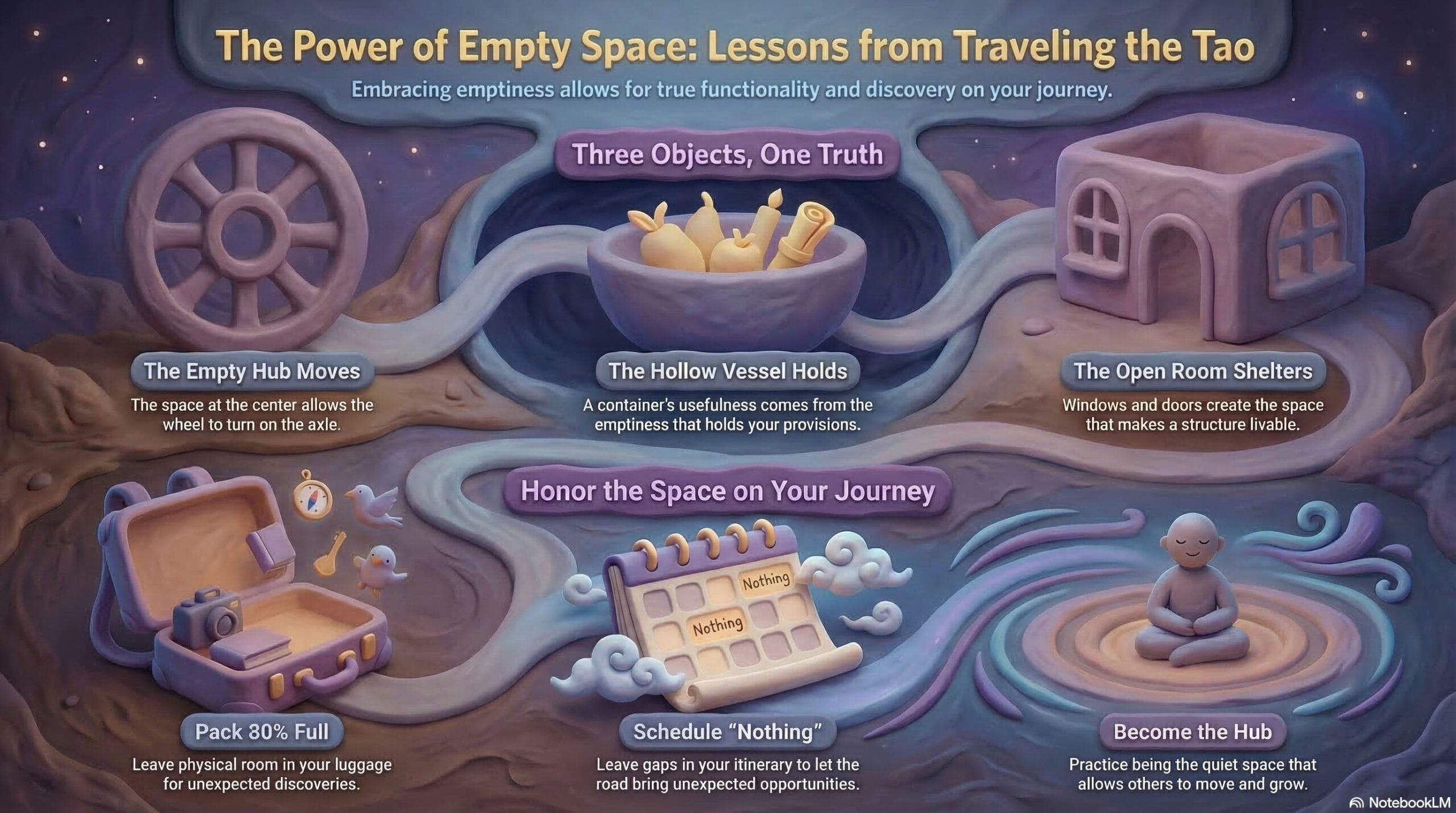
Three Objects, One Truth
The chapter presents three vivid images, each building toward the same insight.
The Wheel: Emptiness That Moves
“Thirty spokes join in one hub. In its emptiness, there is the function of a vehicle.”
Picture a wagon wheel. The spokes are solid, strong, essential. But they don’t make the wheel functional. The hub—the empty space at the center—is what allows the wheel to turn on the axle. Without that emptiness, the spokes would be merely a static circle, useless for movement.
The Traveler’s Insight: Your vehicle—whether a car, an RV, or simply your own two feet—depends on empty spaces. The hollow cylinders of the engine, the empty space in the gas tank, the air in the tires. Without emptiness, nothing moves. The traveler who understands this looks at their vehicle differently. They appreciate not just the solid parts they can see, but the essential emptiness they cannot.
The Vessel: Emptiness That Holds
“Mix clay to create a container. In its emptiness, there is the function of a container.”
A potter shapes clay into a bowl or cup. The clay walls are necessary—they give the vessel its form. But the vessel’s function—to hold water, to carry provisions, to store memories—depends entirely on the empty space inside. A solid clay block holds nothing.
The Traveler’s Insight: Every traveler carries containers. Water bottles, backpacks, suitcases, coolers. We focus on their durability, their material, their appearance. But their true function is the empty space within. The traveler who packs wisely honors this emptiness—leaving room for souvenirs, for unexpected finds, for the simple freedom of not being completely full.
The Room: Emptiness That Shelters
“Cut open doors and windows to create a room. In its emptiness, there is the function of a room.”
Build four solid walls, and you have a block. Cut a door to enter, windows to see through, and suddenly you have a room—a space that can shelter, comfort, hold life. The walls matter, but the room’s function is the emptiness they enclose.
The Traveler’s Insight: Think of the places you stay on your journeys—tents, hotel rooms, borrowed couches. Their value isn’t in their walls but in the empty space that becomes your temporary home. That emptiness holds your rest, your dreams, your refuge from the road. The traveler who appreciates this honors the space itself, not just the structure that contains it.
The Core Teaching: Existence and Emptiness Work Together
The chapter concludes with its essential teaching:
“Therefore, that which exists is used to create benefit; that which is empty is used to create functionality.”
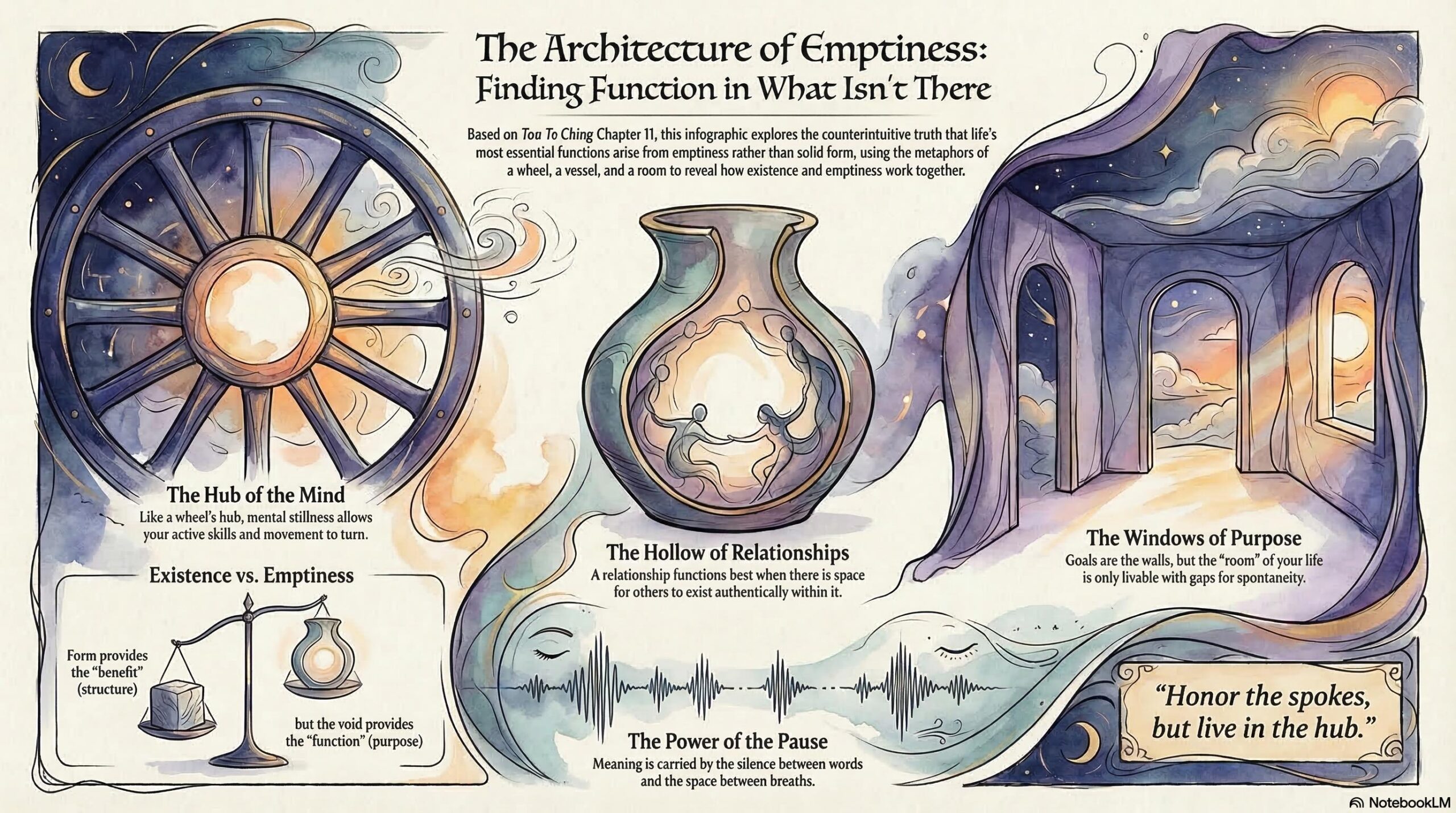
This is not a rejection of the solid world. The spokes, the clay, the walls—these “existences” are necessary. They provide benefit, structure, form. But they cannot function alone. They require their partners: the empty hub, the hollow interior, the open space. Existence and emptiness are not opposites; they are co-creators of every useful thing.
The Traveler’s Insight: The wise traveler honors both. They appreciate their vehicle and the empty road ahead. They value their packed bags and the space left for discovery. They treasure the destinations and the open country between. They understand that the journey itself is a kind of emptiness—a vast space of potential that becomes real only as they move through it.
Your Journey as Empty Space
Now apply this insight to the journey of your life.
Your Vehicle: Your body, your mind, your skills—these are the “spokes” that carry you. But their function depends on emptiness: the quiet spaces in your mind where new thoughts can arise, the openness in your schedule where spontaneity can enter, the gaps in your knowledge where wonder can grow.
Your Containers: Your relationships, your home, your daily routines—these are the “vessels” that hold your life. But they function only because of the empty space within them: the freedom you give others to be themselves, the unplanned moments that make a house a home, the breathing room in a packed schedule.
Your Destinations: Your goals, your dreams, your aspirations—these are the “rooms” you build. But they become livable only when you leave space for the unexpected, for detours, for the possibility that the journey might lead somewhere you never imagined.
Your Roadmap: Honoring Emptiness on the Journey
How do you bring the wisdom of Chapter 11 into your daily travels?
- Appreciate the Empty Space in Your Vehicle: Next time you drive, notice all the emptiness that makes movement possible—the air in your tires, the space in your gas tank, the hollow chambers of your engine. Give thanks for the nothing that carries you.
- Leave Room in Your Luggage: On your next trip, deliberately pack light enough to leave space. When you’re tempted to fill every cubic inch, remember the vessel’s function depends on emptiness. Leave room for what you’ll discover.
- Create Empty Time: In your itinerary, schedule nothing. Leave open afternoons, unscheduled days, time to simply be. Let these empty spaces hold whatever the road brings.
- See the Walls and the Space: In your living space, your relationships, your work—practice seeing both the solid and the empty. Appreciate the structures and the freedom within them. Notice how they work together.
- Become the Empty Hub: In group situations, practice being the empty space that allows movement. Don’t always be the spoke that drives; sometimes be the hub that enables others to turn freely.
The Destination: Living from Emptiness
Tao Te Ching Chapter 11 transforms how we see everything. Once you understand that function comes from emptiness, you start noticing it everywhere. The pause between notes makes the music. The silence between words carries the meaning. The space between breaths sustains life.
The traveler who lives from this understanding moves differently through the world. They don’t need to fill every moment with activity, every conversation with words, every relationship with expectation. They trust the emptiness. They know that the most important parts of any journey are not the sights they planned to see, but the spaces between—the unexpected encounters, the unplanned detours, the quiet moments that hold the deepest memories.
Your life is a vehicle. Your days are vessels. Your years are rooms. Their function depends not on how full you pack them, but on how much empty space you leave for the journey to unfold.
Honor the spokes. But live in the hub.
Continue Your Journey: Having discovered the function of emptiness, Chapter 12 explores how the five senses can blind us—how too much color, sound, and taste desensitize the traveler to genuine experience.
For the foundational maps of this philosophy, explore our Foundations of the Tao series.