The master traveler doesn’t just move through the world—they carry themselves with the wholeness of an infant, the clarity of still water, and the gentleness of a mother caring for her child. Tao Te Ching Chapter 10 presents a series of profound questions that serve as a checklist for the integrated life, revealing what it means to embody the Tao itself.
Executive Summary
The Tao Te Ching Chapter 10 reframes mastery as inner integration rather than outward achievement.
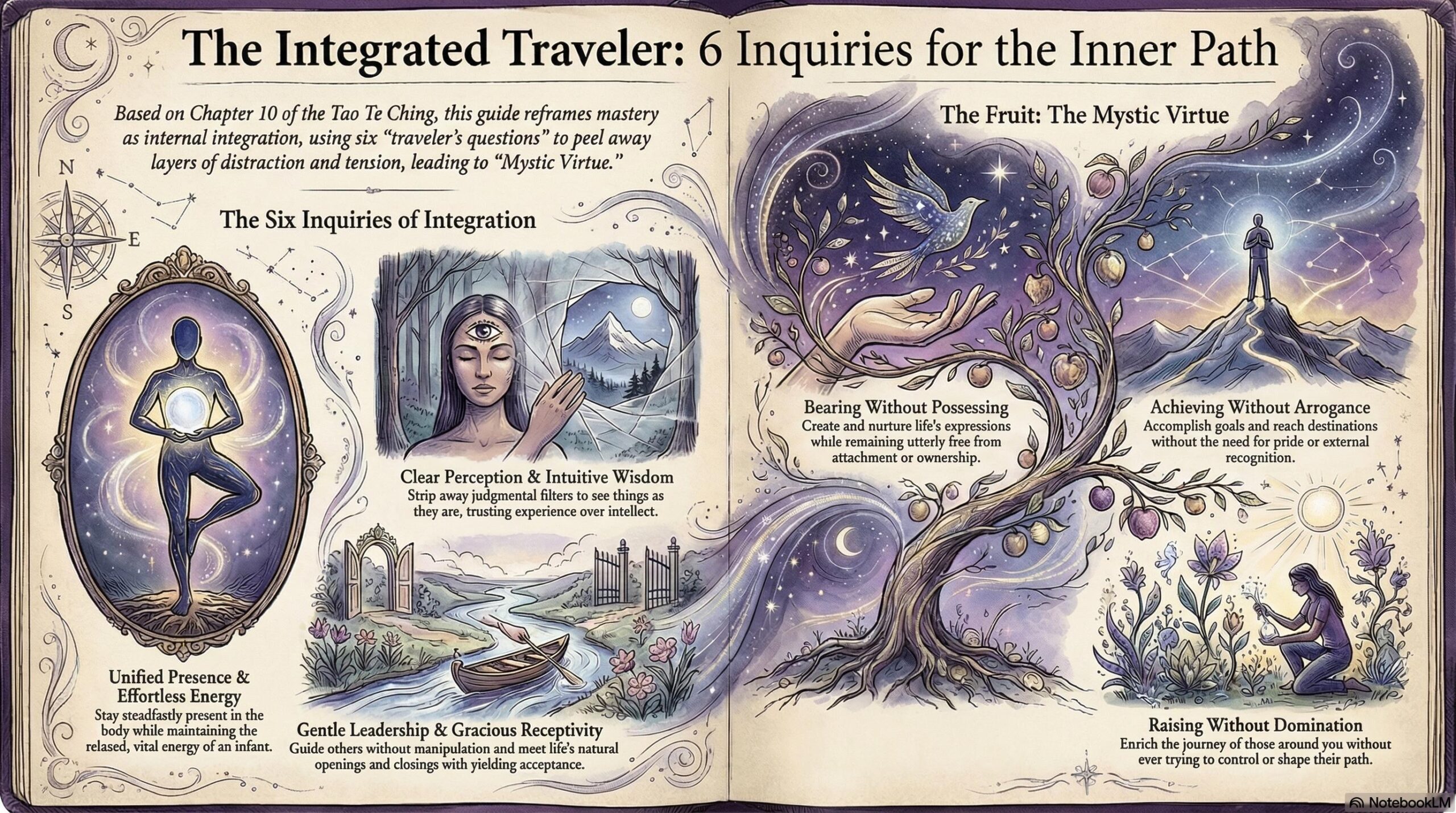
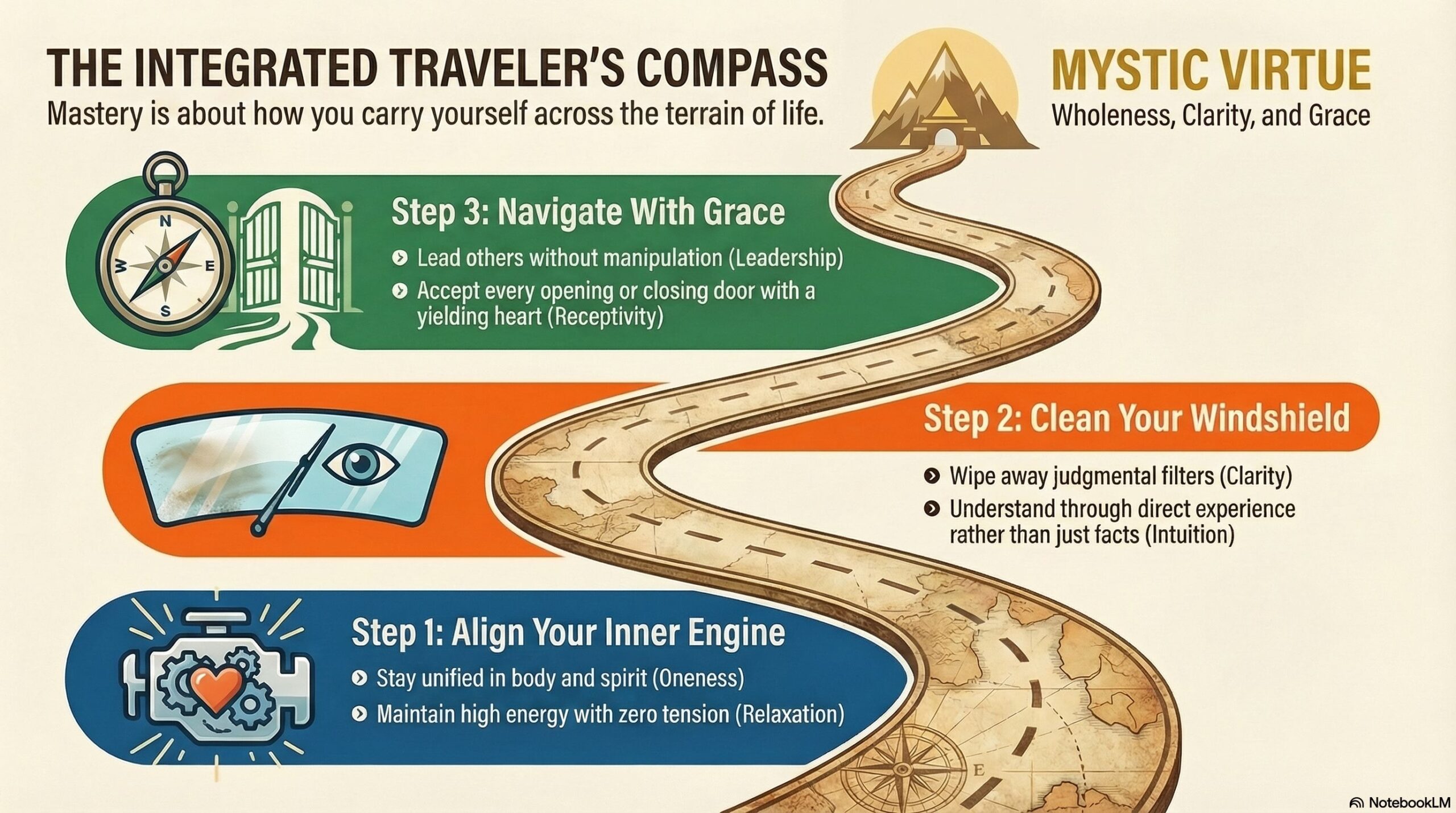
It offers six self‑inquiries that function as a traveler’s internal compass, asking how unified, relaxed, clear, loving, receptive, and intuitively wise we truly are. These questions invite presence without distraction, engagement without tension, perception without filters, leadership without control, acceptance of life’s natural openings and closings, and understanding that arises from direct experience rather than intellect.
Together, they point toward the “Mystic Virtue”—the ability to create, nurture, and accomplish without possession, pride, or domination. This is the mark of the integrated traveler: someone who enriches the world simply by being aligned with the Tao, guiding without imposing and experiencing without grasping.
Chapter 10 ultimately reminds us that this integrated traveler is not an ideal to chase but a nature to uncover, revealed as we peel away distraction, tension, and conditioned ways of seeing.
Chapter 10
In holding the soul and embracing oneness
Tao te ching 10 Of 81
Can one be steadfast, without straying?
In concentrating the energy and reaching relaxation
Can one be like an infant?
In cleaning away the worldly view
Can one be without imperfections?
In loving the people and ruling the nation
Can one be without manipulation?
In the heavenly gate’s opening and closing
Can one hold to the feminine principle?
In understanding clearly all directions
Can one be without intellectuality?
Bearing it, rearing it
Bearing without possession
Achieving without arrogance
Raising without domination
This is called the Mystic Virtue
The Traveler’s Self-Examination
After learning the art of timely withdrawal in Chapter 9, Tao Te Ching Chapter 10 invites us inward. Where previous chapters described the Tao’s nature and the sage’s actions, this chapter asks us to examine ourselves. It presents six questions—not as a test to pass, but as a mirror to hold up to our own journey.
For the traveler on life’s road, these questions become waypoints for self-reflection. They ask: How integrated are you? How present? How pure? How gentle? How receptive? How wise without knowing it? The answers reveal not your failings, but your next step on the path.
The Six Questions of the Integrated Traveler
The chapter opens with a series of poetic inquiries, each exploring a different dimension of embodied wisdom.
1. Holding Soul and Embracing Oneness
“In holding the soul and embracing oneness, can one be steadfast, without straying?”
This first question addresses integration—the union of body and spirit, of inner and outer. The soul (the spiritual, ethereal aspect) and the self (the embodied, physical aspect) must be held together as one.
The Traveler’s Insight: Have you ever met someone whose presence felt completely unified? They’re not thinking about how they look, worrying about what’s next, or regretting what’s past. They’re simply here, fully present in their body and their surroundings. This is “embracing oneness.” On a journey, this is the difference between the traveler who is always elsewhere in their mind—checking phones, planning the next stop, worrying about home—and the traveler who is steadfastly present, mile after mile, moment after moment. The question asks: Can you remain this unified, without straying into distraction?
2. Concentrating Energy and Reaching Relaxation
“In concentrating the energy and reaching relaxation, can one be like an infant?”
This question explores the paradox of effortless power. An infant has tremendous vital energy—they can cry, move, grow with astonishing intensity—yet they are completely relaxed. Their breathing is deep and natural. Their limbs are soft. They are both intensely alive and utterly at ease.
The Traveler’s Insight: Watch a skilled rock climber or a long-distance hiker. They move with concentration, yet their bodies are relaxed. Tension would exhaust them; relaxation allows them to channel energy efficiently. The question asks: Can you bring this same quality to your journey? Can you be fully engaged with the road without gripping it too tightly? Can you pour energy into your goals while remaining as relaxed as an infant sleeping in a moving vehicle?
3. Cleaning Away the Worldly View
“In cleaning away the worldly view, can one be without imperfections?”
This question addresses clarity of perception. The “worldly view” means the conditioned way of seeing—through filters of judgment, comparison, expectation, and fear. Cleaning it away reveals things as they actually are.
The Traveler’s Insight: Every traveler carries expectations. You’ve seen photos of the Grand Canyon, read about Paris, heard stories about Bali. These “worldly views” color what you actually see—often preventing you from seeing what’s really there. The traveler who can temporarily set aside all preconceptions, who can look at a place with fresh eyes, sees more deeply. The question asks: Can you clear away these filters so completely that your perception becomes, like a polished mirror, without distortion?
4. Loving People and Ruling Without Manipulation
“In loving the people and ruling the nation, can one be without manipulation?”
This question addresses the nature of true leadership and love. Can you care for others—whether traveling companions, family members, or colleagues—without trying to control them? Can you guide without manipulating?
The Traveler’s Insight: On group journeys, this question becomes immediate. The leader who must control every detail, who can’t tolerate deviations from the plan, who subtly (or not so subtly) manipulates others into doing things their way—this leader creates tension and resentment. The leader who loves their companions enough to trust them, who guides without grasping, who allows the journey to unfold collectively—this leader creates freedom and joy. The question asks: Can you love and lead without ever resorting to manipulation?
5. The Heavenly Gate’s Opening and Closing
“In the heavenly gate’s opening and closing, can one hold to the feminine principle?”
This mysterious line refers to the natural rhythms of the universe—the opening and closing of opportunities, the cycles of activity and rest, the breathing of existence itself. The “feminine principle” (the Valley Spirit from Chapter 6) means receptivity, yielding, and gentle acceptance.
The Traveler’s Insight: Life presents openings and closings constantly. A door opens—a job opportunity, a new relationship, an unexpected detour. A door closes—a plan falls through, a season ends, a goodbye arrives. The traveler who fights every closing, who tries to force doors back open, exhausts themselves. The traveler who holds to the feminine principle receives each opening with gratitude and each closing with grace. They flow with the rhythm rather than against it. The question asks: Can you meet every turning of the gate with this receptive, accepting stance?
6. Understanding Clearly Without Intellectuality
“In understanding clearly all directions, can one be without intellectuality?”
This final question addresses the difference between wisdom and mere knowledge. “Intellectuality” means knowing about things—accumulating information, making clever distinctions, building mental models. True understanding is direct, intuitive, embodied.
The Traveler’s Insight: The traveler who has read every guidebook, memorized every fact, and planned every detail often misses the living reality of a place. They know about it without knowing it. The traveler who arrives with an open mind and a receptive heart understands the place directly—its feeling, its rhythm, its soul. The question asks: Can you understand so clearly that you don’t need to think about it? Can your knowing be like the body’s knowledge of how to breathe—effortless, immediate, and true?
The Mystic Virtue: Bearing Without Possessing
The chapter concludes by describing the fruit of this integrated life:
“Bearing it, rearing it—bearing without possession, achieving without arrogance, raising without domination. This is called the Mystic Virtue.”
This is the summary of all six questions. When you live in this integrated way, you become like the Tao itself. You create, nurture, and achieve—but without attachment, without pride, without control. You give life its fullest expression while remaining utterly free.
The Traveler’s Insight: The Mystic Virtue is the traveler who shows you a beautiful place and then steps back, letting you experience it directly. It’s the guide who shares everything they know and then fades into the background, taking no credit. It’s the companion on the road who enriches your journey simply by being fully themselves, without ever trying to shape yours. This traveler has answered the six questions not with words, but with their whole being.
Your Roadmap: Practicing the Six Questions
How do you bring the inquiries of Chapter 10 into your daily journey?
- Take a “Oneness” Pause: Several times today, stop and ask: “Am I all here?” Bring your scattered attention back into your body and this moment. Practice being steadfast, without straying.
- Check Your Tension: Notice where you’re holding unnecessary tension—in your shoulders, your jaw, your grip on plans. Consciously relax while maintaining your focus. Practice being like an infant.
- Clear One Filter: Identify one preconception you’re carrying about a person, place, or situation. Set it aside, even temporarily, and look again with fresh eyes. Practice cleaning away the worldly view.
- Lead Without Directing: In a group situation today, offer guidance without insisting. Suggest without manipulating. Trust others to find their own way. Practice loving without controlling.
- Accept a Closing: Notice somewhere life is saying “no” to you—a closed door, a refused request, an ended season. Practice holding to the feminine principle—receive it with grace rather than fighting it.
- Know Without Thinking: In one area where you have expertise, try to set aside your intellectual knowledge and simply be with the experience. Trust your embodied wisdom. Practice understanding without intellectuality.
The Destination: Embodying the Mystic Virtue
Tao Te Ching Chapter 10 offers not answers but questions—living inquiries that can accompany you on every journey. They are not meant to be mastered once and checked off, but to be asked again and again, at every stage of the path.
The traveler who carries these questions travels differently. They are more present, more relaxed, more clear. They lead without manipulating and understand without thinking. They move through the world creating and nurturing and achieving, yet leaving no trace of possession, arrogance, or control.
This is the Mystic Virtue. This is the integrated traveler. This is what it looks like when the Tao moves through a human life.
And the beautiful truth is: this traveler is not some distant ideal. It is who you already are, beneath the accumulated layers of distraction, tension, and conditioning. The six questions are simply tools for peeling those layers away, revealing the wholeness that has been there all along.
Continue Your Journey: Having explored the inner integration of the Mystic Virtue, Chapter 11 examines the usefulness of emptiness—how the hollow of the wheel, the clay of the vessel, and the space of the room are where true function lies.
For the foundational maps of this philosophy, explore our Foundations of the Tao series.