Tired of forcing outcomes? Discover Wu Wei, Taoism’s secret to effortless flow. Learn how to sync your actions with the 5 Elements’ daily cycle to reduce struggle and achieve more with less effort. Your guide to working smarter, not harder.
Executive Summary
The article explains Wu Wei—a Taoist principle of effortless action—as acting in harmony with natural rhythms rather than forcing outcomes.
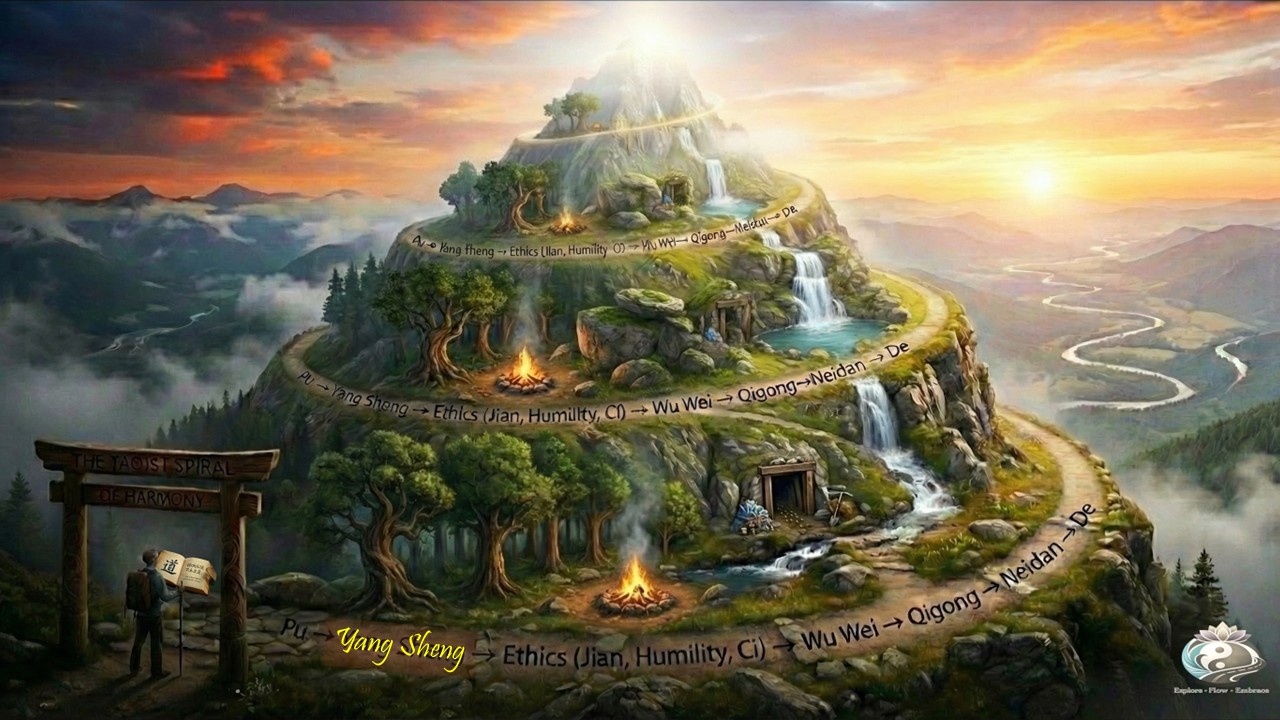
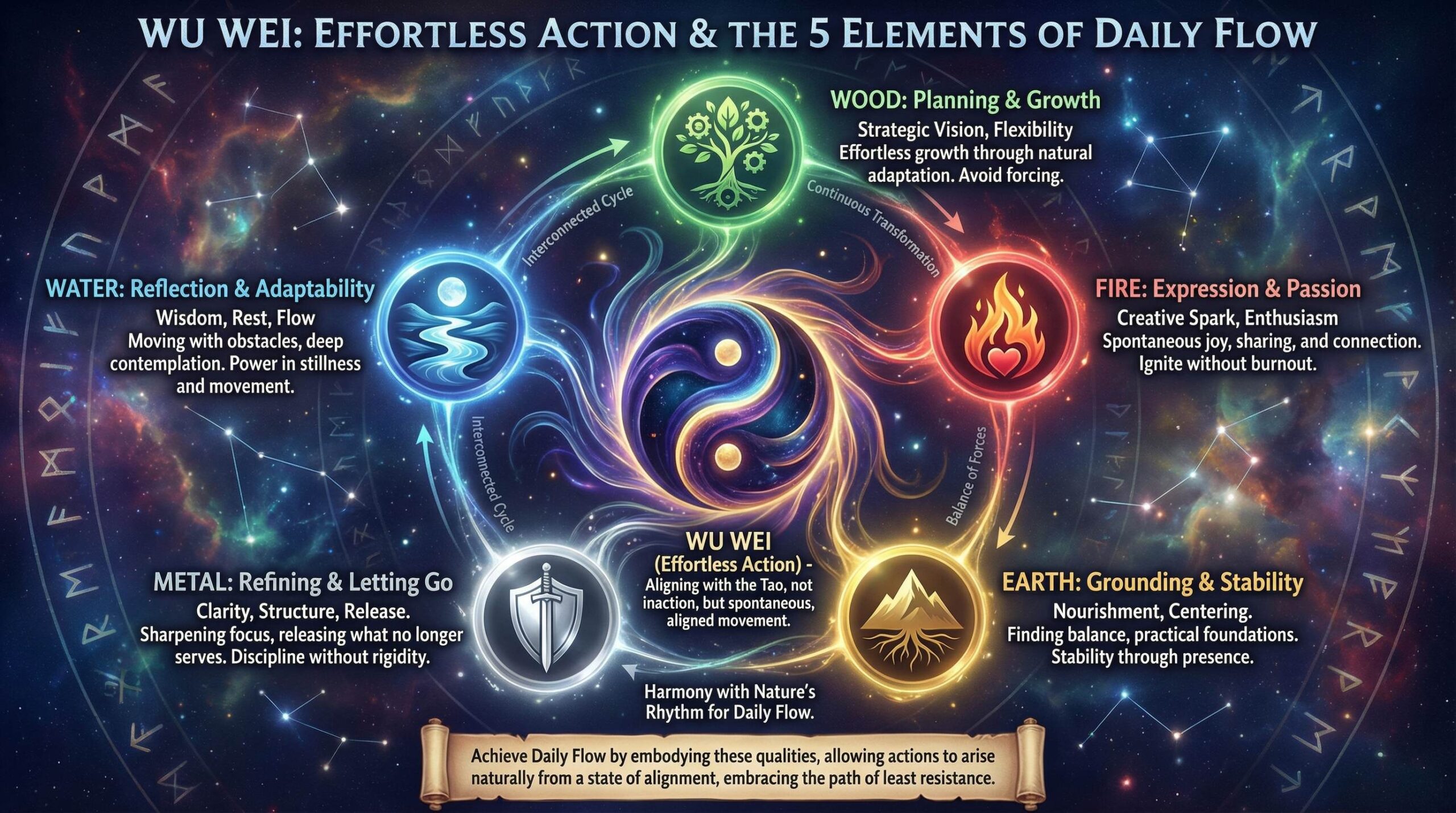
It frames Wu Wei within a Spiral of Harmony and aligns it with the Five Elements (Wood, Fire, Earth, Metal, Water) to offer a daily flow chart for living with less friction.
Each element corresponds to a phase of the day with recommended modes of action or non-action.
Practicing Wu Wei conserves energy and enhances clarity, enabling more effective and graceful engagement with life’s demands while avoiding burnout and unnecessary struggle.
The Taoist Spiral of Harmony Series
This is the fifth article in a short series on how to apply the Taoist Spiral of Harmony in your modern, busy life. Read Article 1.
The Myth of “Try Harder”: Why Forcing It Never Works
You know the feeling. Pushing against a stubborn problem. Hustling when you’re already drained. Trying to make things happen through sheer willpower, only to end up frustrated and exhausted.
Our achievement-obsessed culture worships this “forceful action.” But ancient Taoist wisdom proposes a radical alternative: Wu Wei.
Translated as “non-action” or “effortless action,” Wu Wei is the most misunderstood concept in Taoism. It is not about laziness, passivity, or checking out.
True Wu Wei is action so skillfully aligned with the natural flow of things that it appears effortless. It’s the master carpenter whose chisel follows the wood’s grain. It’s the sailor who trims the sails to use the wind, rather than exhausting themselves rowing against it.
But how do you find this “flow” in a chaotic modern day? The answer lies in the Taoist Spiral of Harmony—and its built-in timing system, the 5 Elements.
Wu Wei in the Spiral: The Fruit of Prepared Ground
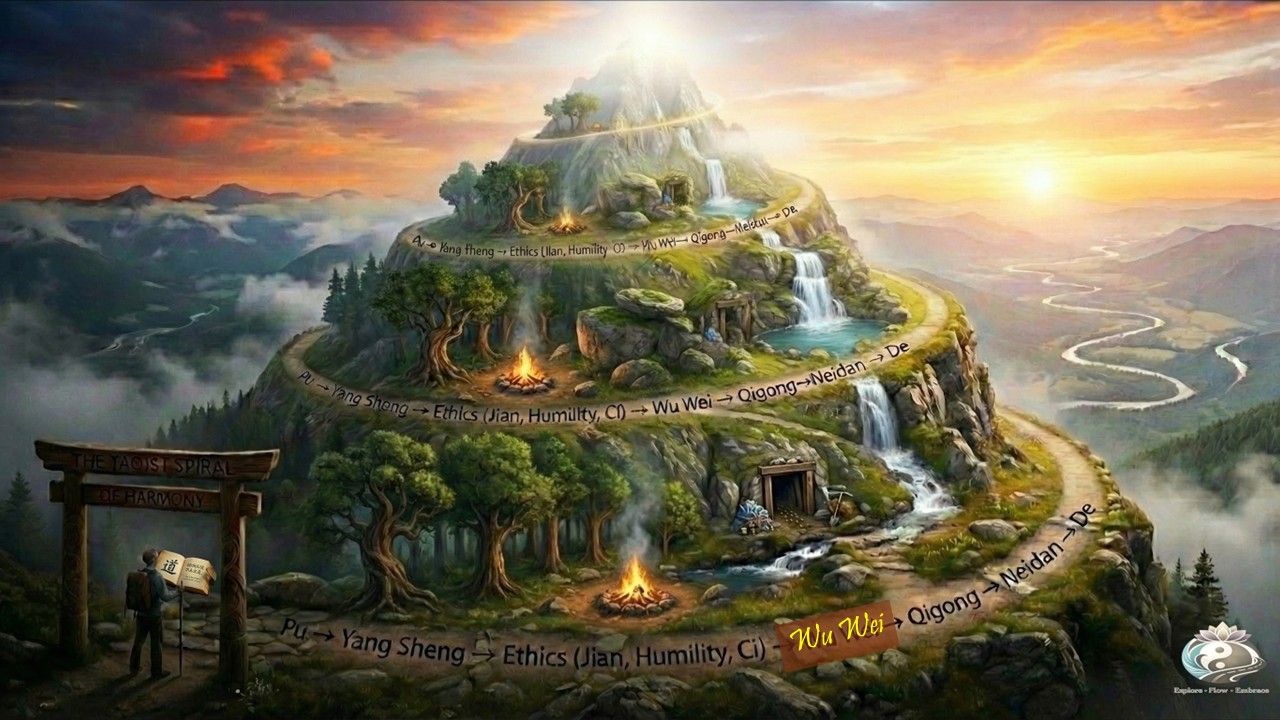
You cannot start with Wu Wei. It is not a technique you apply, but a state you grow into. In the Taoist spiral, Wu Wei emerges naturally after foundational work:
- Pu (The Uncarved Block): You clear mental clutter and ego-driven agendas.
- Yang Sheng (Nourish Life): You build a reservoir of steady energy (Qi).
- The Three Treasures (Ethics): You conserve that energy via frugality (Jian), humility, and compassion (Ci).
Only then do you have the clarity, vitality, and calm to perceive and join the natural flow. Wu Wei is the fourth turn of the spiral—the point where your prepared self meets the world’s rhythm, and magic happens.
And that rhythm is dictated by the 5 Elements.
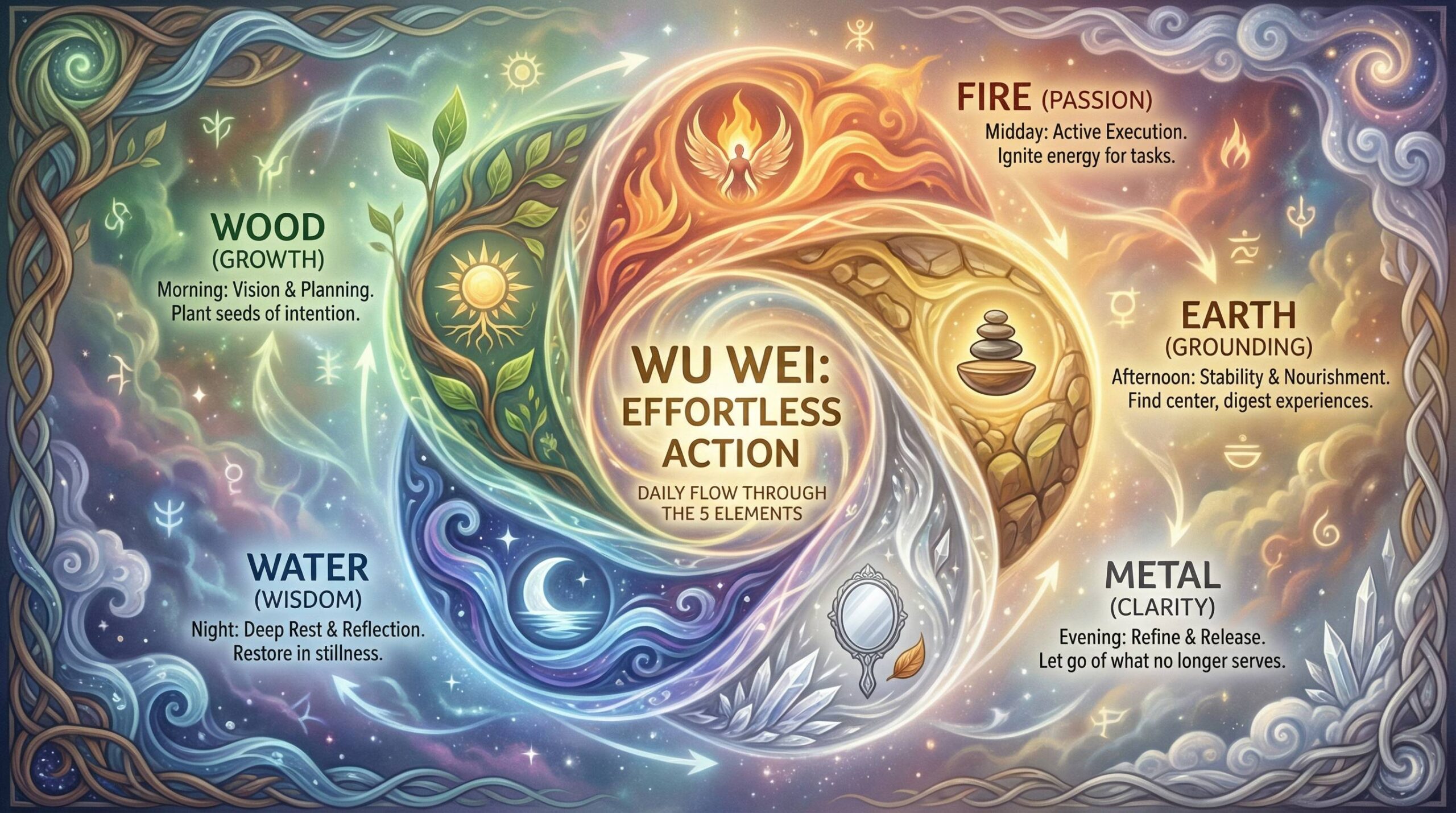
The 5 Elements: Your Daily Flow Chart for Wu Wei
The elements—Wood, Fire, Earth, Metal, Water—describe how energy moves through time. Practicing Wu Wei means matching your action (or non-action) to the element governing the present moment.
Here’s your 24-hour guide to acting without forcing.
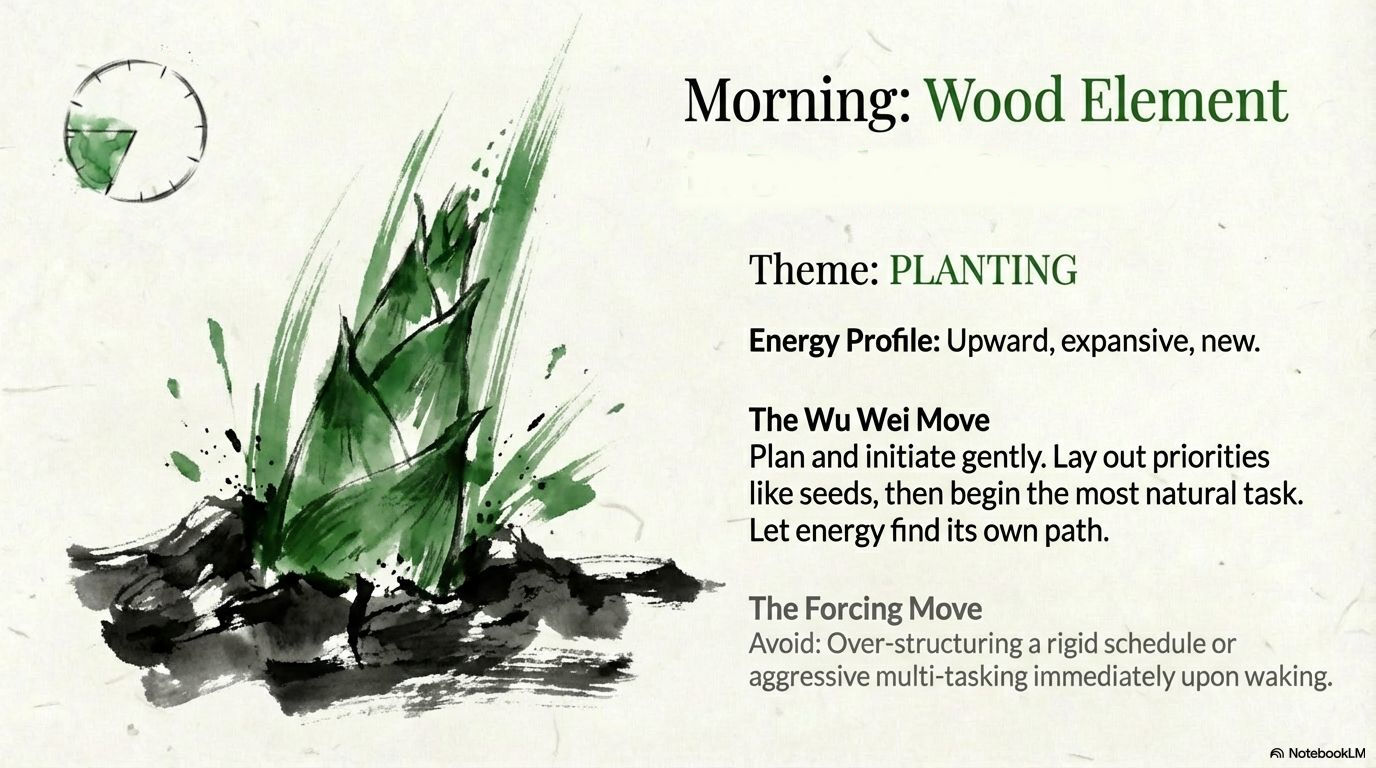
1. Morning (Wood Element) – Wu Wei as PLANTING, Not Pushing
The Energy: Wood is upward, expansive, and new—like a sprout breaking ground.
- The Wu Wei Move: Plan and initiate gently. Don’t force a rigid, hour-by-hour schedule. Instead, lay out your priorities like seeds. Then begin the first, most natural task. Your energy is fresh; let it find its own upward path.
- Forcing: Over-structuring, aggressive multi-tasking first thing.
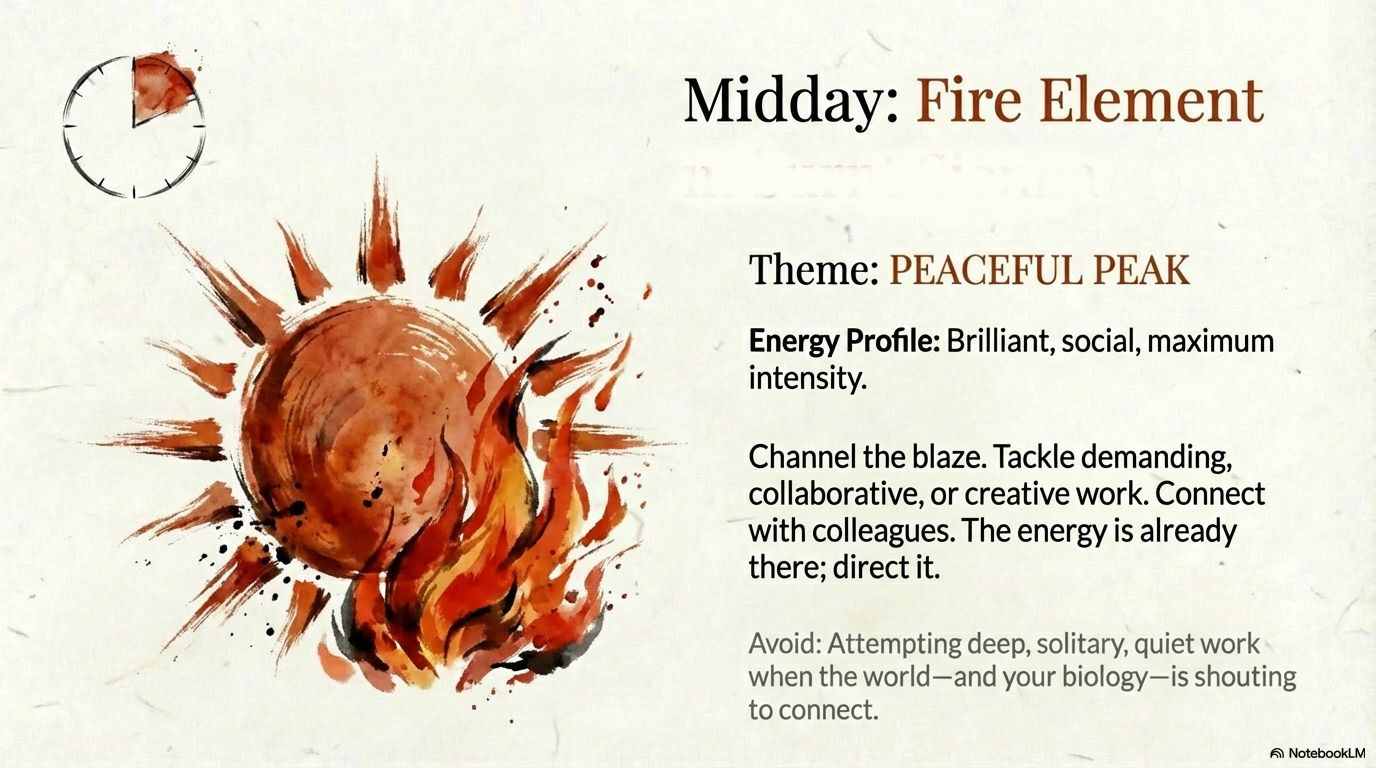
2. Midday (Fire Element) – Wu Wei as PEACEFUL PEAK, Not Burnout
The Energy: Fire is brilliant, social, and at its maximum intensity.
- The Wu Wei Move: Channel, don’t force, the blaze. Tackle your most demanding, collaborative, or creative work now. Speak up in meetings, connect with colleagues, drive projects forward. The energy is already there for it. Your job is to direct it smoothly, not create it from nothing.
- Forcing: Trying to do deep, quiet, solitary work when the world (and your energy) is shouting to connect and create.
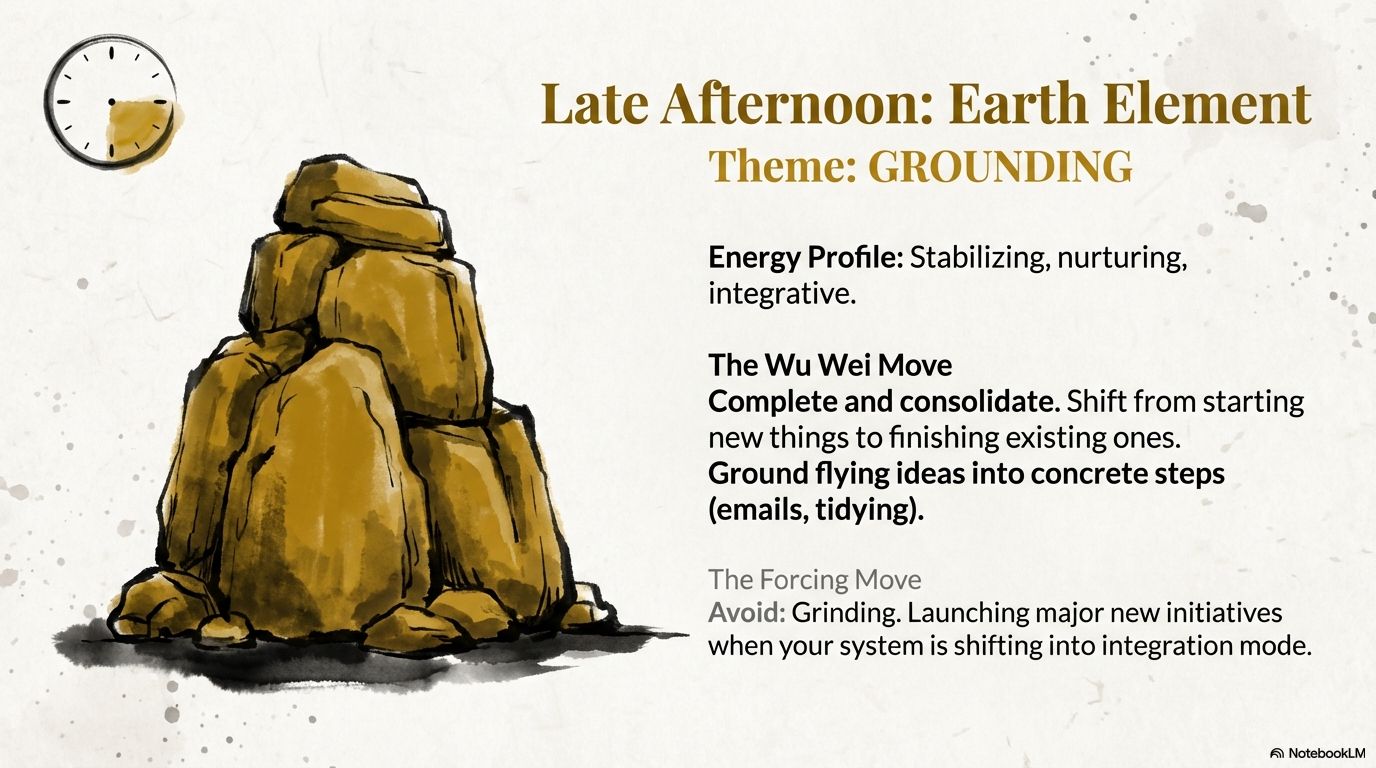
3. Late Afternoon (Earth Element) – Wu Wei as GROUNDING, Not Grinding
The Energy: Earth is stabilizing, nurturing, and integrative.
- The Wu Wei Move: Complete and consolidate. Shift from starting new things to finishing existing ones. Ground flying ideas into concrete steps. Answer emails, tidy your workspace, prepare for the evening. This is the action of harvesting, not planting.
- Forcing: Launching a major new initiative when your system is biologically shifting into integration mode.
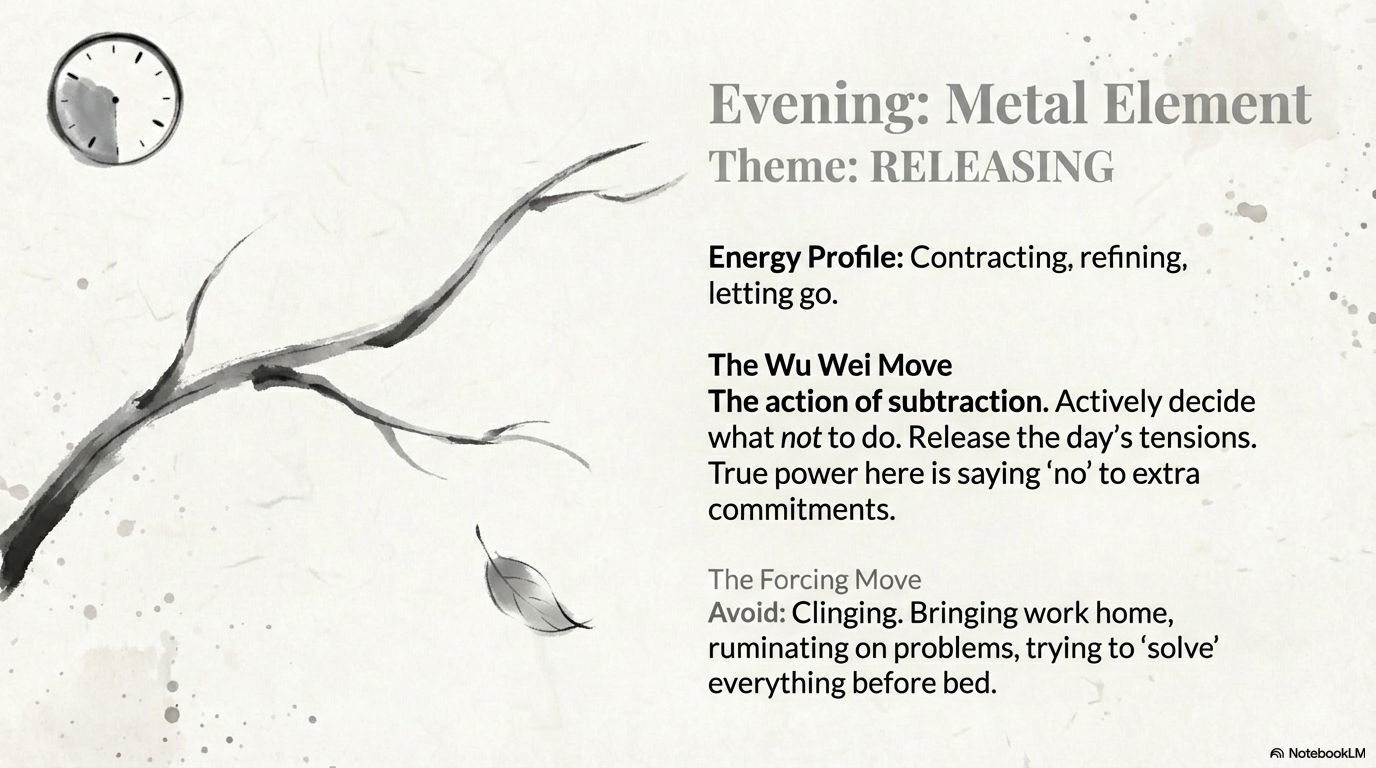
4. Evening (Metal Element) – Wu Wei as RELEASING, Not Clinging
The Energy: Metal is contracting, refining, and letting go.
- The Wu Wei Move: The action of release. This is a profound form of Wu Wei. Actively decide what not to do. Let go of the unfinished task. Release the day’s tensions through a walk or deep breaths. Say “no” to extra commitments. True power here is in subtraction.
- Forcing: Bringing work home, ruminating on problems, trying to “solve” everything before bed.
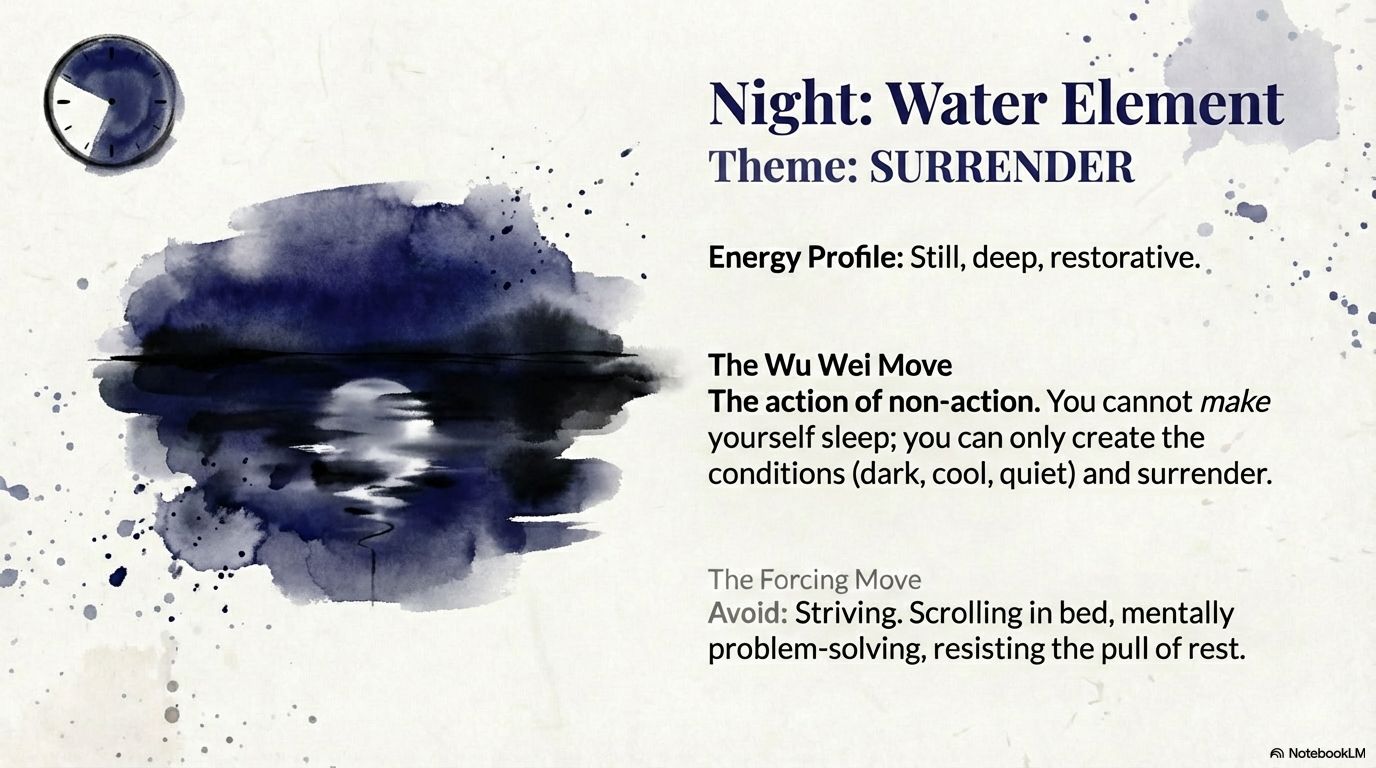
5. Night (Water Element) – Wu Wei as SURRENDER, Not Striving
The Energy: Water is still, deep, and restorative.
- The Wu Wei Move: The action of non-action. The most vital Wu Wei of all is surrendering to sleep. You cannot make yourself sleep through force. You create the conditions (dark, cool, quiet) and then you let go. Trust the deep, unconscious intelligence of your body to repair and recharge.
- Forcing: Scrolling in bed, mentally problem-solving, resisting rest.
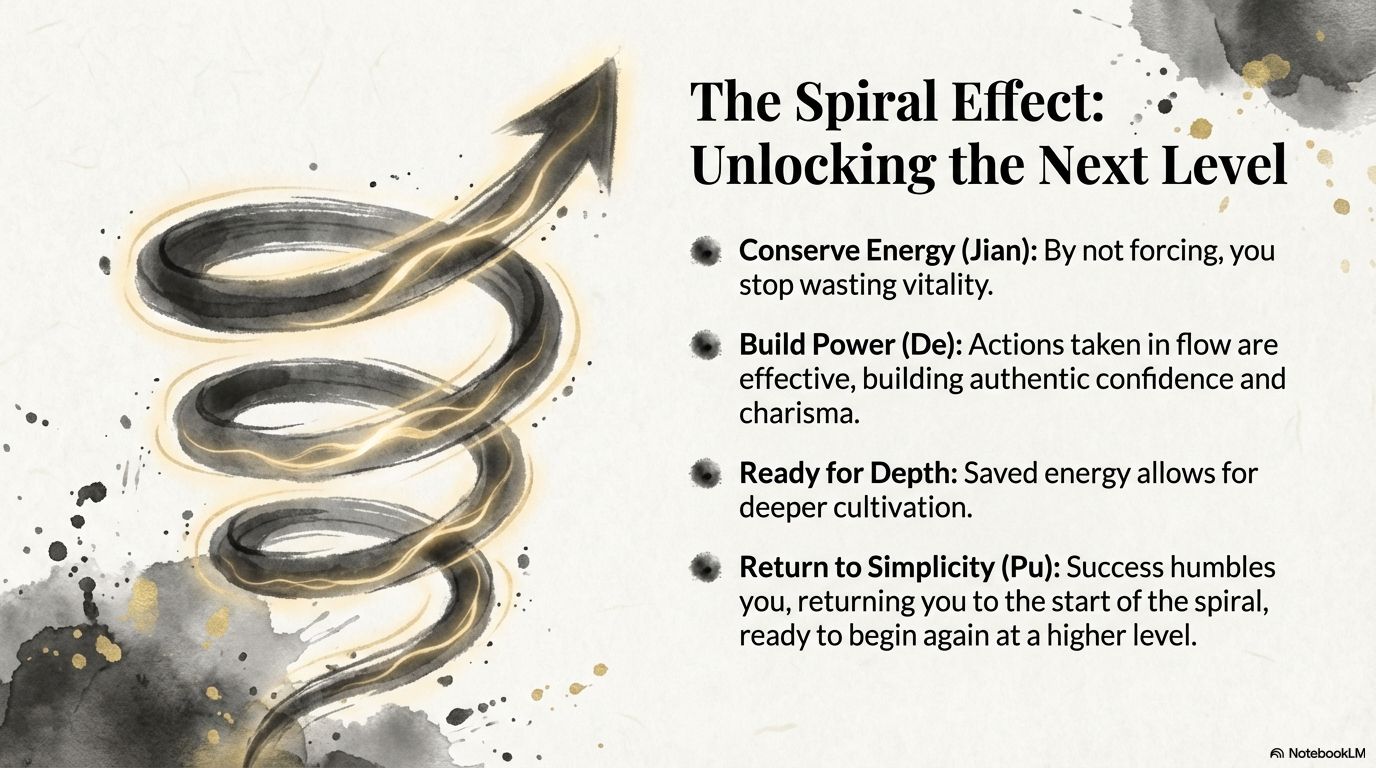
The Spiral Effect: How Wu Wei Unlocks the Next Level
When you practice Wu Wei aligned with the 5 Elements, you complete a powerful circuit in the Spiral of Harmony:
- Conserved Energy: By not forcing, you waste no energy (Jian).
- Clear Results: Actions taken in flow are more effective, building authentic confidence (De).
- Ready for Depth: With energy saved and a calm mind, you have the focus for Qigong (energy cultivation) and Neidan (inner alchemy).
- Return to Simplicity: The power (De) gained from this flow naturally humbles you, returning you to a wiser, quieter state of Pu—ready to begin the spiral anew, at a higher level.
Wu Wei is the pivot point where self-cultivation meets world engagement with grace.
FAQ: Wu Wei in a Modern World
Q: Does Wu Wei mean I should never work hard or face challenges?
A: No. It means you choose your challenges wisely and meet them with the appropriate energy. You work with your natural rhythms and the situation’s contours. Sometimes the “flow” is a rapid river (hard work), but you’re still riding it, not fighting the current.
Q: What if my job demands conflict with these rhythms (e.g., night shifts)?
A: Align with your personal cycle. Your “Fire” time is the peak after you wake. Your “Water” time is before your sleep. Map the elements onto your unique schedule. The principle is the same: match your action type to your energy phase.
Q: How do I know if I’m in Wu Wei or just being lazy?
A: Check your energy after the action. Lazy inaction leaves you dull and guilty. True Wu Wei, even in rest, leaves you feeling replenished, clear, and ready for what’s next. It’s nourishing, not draining.
Your First Step into the Flow
For one day, practice Metal Element Wu Wei during your evening.
At 8 PM, consciously release one thing. One task you won’t finish. One worry you’ll table until tomorrow. One digital distraction you’ll put away.
Do not force relaxation. Simply create the space for it by letting go. Feel the slight, effortless relief that follows. That is the seed of Wu Wei. It grows not from adding effort, but from removing friction.
That is the beginning of moving through your world—and your spiral—with grace.
Tags: #WuWei #EffortlessAction #Taoism #5Elements #FlowState #Productivity #WorkLifeBalance #CircadianRhythm #TheSpiralOfHarmony #MindfulAction