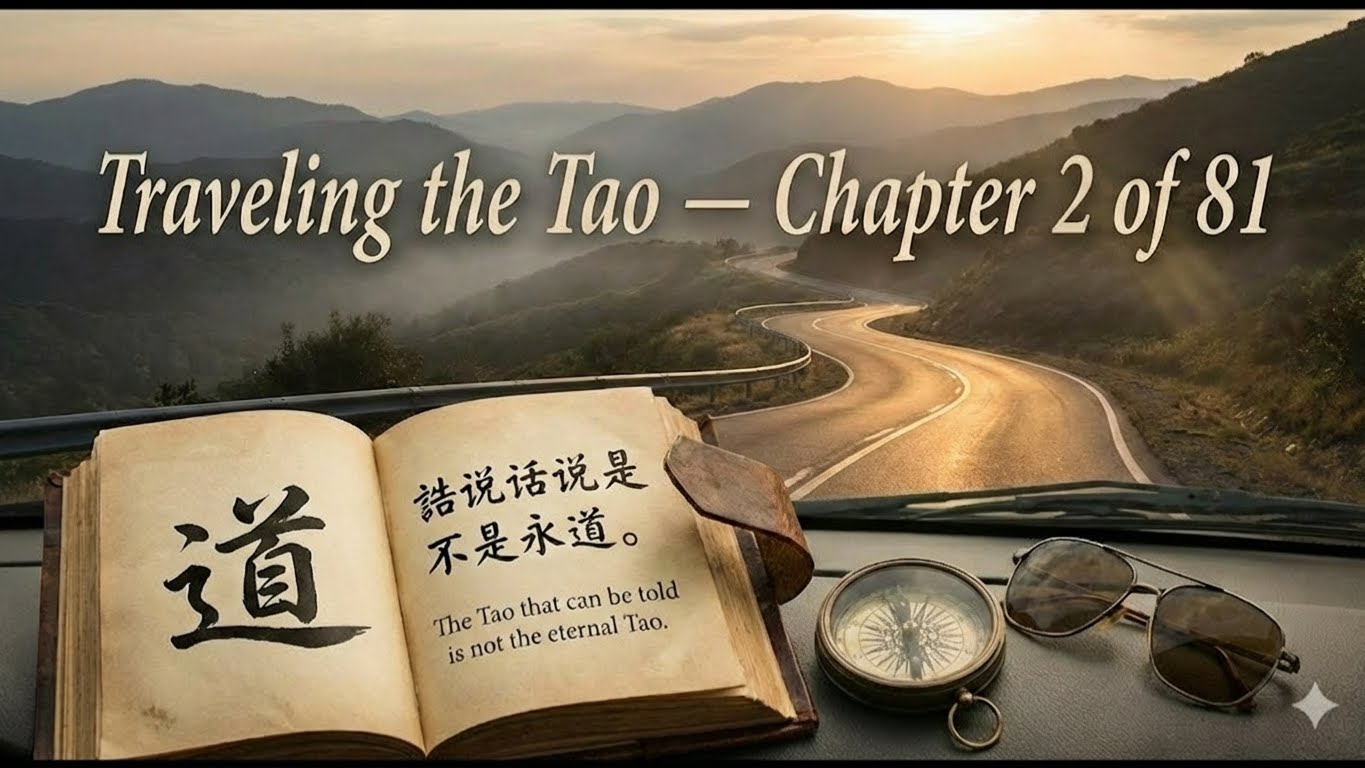
On a long road, the stillness of a valley is defined by the climb that preceded it, and the joy of arrival is given depth by the miles traveled. This is the practical wisdom of Tao Te Ching Chapter 2, which teaches that all meaning in life arises from contrast and relationship.
Executive Summary
This chapter frames Tao Te Ching Chapter 2 through the metaphor of travel. It teaches that the world becomes visible through contrast: beauty stands out only after monotony, ease is understood only after struggle, and high vistas exist because valleys support them. Every aspect of a journey—long vs. short, noise vs. silence, front vs. back—reveals that opposites define and depend on each other.
The article emphasizes that travelers learn this intuitively. Missed turns create discoveries, breakdowns become stories, and difficult stretches make the sweet moments sweeter. Nothing exists in isolation; everything is relational.
The second half describes the sage as a “master traveler.” Instead of forcing outcomes, they act without attachment, teach without excessive words, create without trying to possess, and succeed without clinging to success. This non‑grasping approach keeps the journey alive and prevents stagnation.
Ultimately, the chapter argues that freedom comes from moving with the road rather than trying to control it. By accepting contrast and releasing attachment, one travels—and lives—with greater harmony and ease.
Chapter 2
When the world knows beauty as beauty, ugliness arises
Tao te ching 2 Of 81
When it knows good as good, evil arises
Thus being and non-being produce each other
Difficult and easy bring about each other
Long and short reveal each other
High and low support each other
Music and voice harmonize each other
Front and back follow each other
Therefore the sages:
Manage the work of detached actions
Conduct the teaching of no words
They work with myriad things but do not control
They create but do not possess
They act but do not presume
They succeed but do not dwell on success
It is because they do not dwell on success
That it never goes away
The Core of Chapter 2: Relational Wisdom
Chapter 2 of the Tao Te Ching presents a foundational truth: nothing in our world exists in isolation. Beauty is known through ugliness, ease through difficulty, and success through struggle. This chapter moves beyond the metaphysical introduction of Chapter 1 to offer a practical lens for viewing daily life. By understanding that opposites define and complete each other, we can stop judging experiences as purely “good” or “bad” and start navigating life with greater fluidity and less resistance—the essence of Wu Wei (effortless action).
For the modern seeker, this is an antidote to black-and-white thinking. It’s not about eliminating contrast but about recognizing its essential role in creating a rich, meaningful experience, much like a skilled traveler who finds value in every stretch of the road.
Section 1: The World Is Built on Paired Opposites
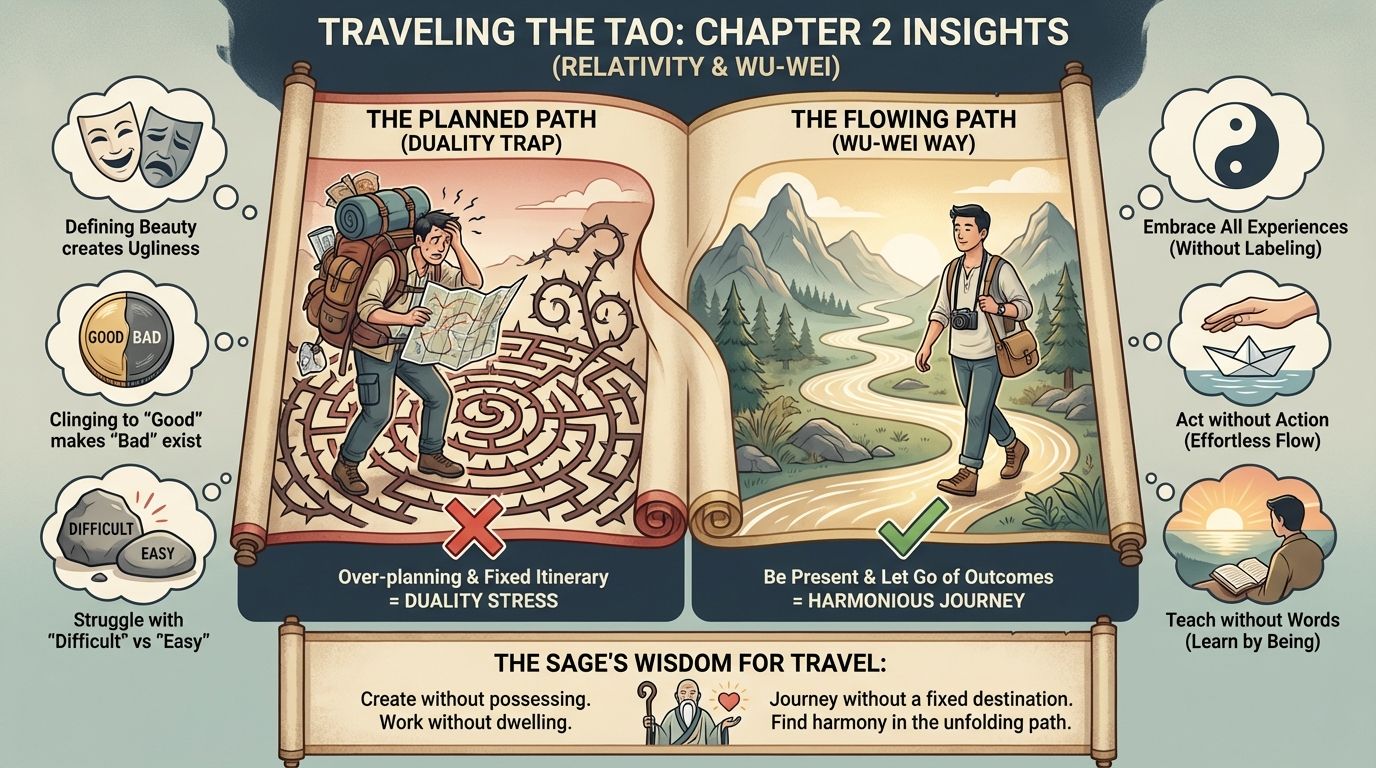
The first half of Chapter 2 systematically illustrates how our reality is structured through interdependence. The text presents a series of paired concepts, each giving meaning to the other:
- “Being and non-being produce each other.” A road (being) is defined by the empty space (non-being) around it. A meaningful journey exists because of the stillness between destinations.
- “Difficult and easy bring about each other.” The smooth, easy road is appreciated precisely because you have navigated difficult terrain. Confidence is born from past struggle.
- “Long and short reveal each other.” A short, pleasant drive feels brief only in contrast to a long, arduous one. Time is experienced relationally.
- “High and low support each other.” The majestic mountain peak does not float; it is supported by the vast valley below. In life, our peaks of success are grounded in humble effort and challenge.
- “Music and voice harmonize each other.” Harmony is not sameness. The melody of a street musician gains its beauty from the backdrop of city hum. Similarly, the rhythm of travel—engine noise, wind, moments of silence—creates a symphony.
- “Front and back follow each other.” You cannot be “ahead” without having something “behind” you. On a trail, the receding view is as much a part of the journey as the path forward.
The Traveler’s Insight: A breathtaking canyon vista has its impact magnified after miles of flat desert. A missed turn, initially “bad,” often leads to an unexpected discovery. Travel teaches intuitively what the Tao Te Ching states philosophically: contrast is not a flaw; it is the very mechanism that makes experience visible and profound.
Section 2: The Sage as the Master Traveler
The second half of Chapter 2 describes how a wise person (the Sage) operates within this world of interdependent opposites. This is the application of the theory—a guide to effortless action.
- “They manage the work of detached action.” The Sage, like a master traveler, plans but adapts. They act with intention but without forcing outcomes against the current of circumstances.
- “Conduct the teaching of no words.” Some lessons are absorbed through experience, not lecture. The sage knows that a silent, awe-inspiring landscape often teaches more than a verbose guidebook. True teaching often happens by example and shared experience.
- “They create but do not possess.” You cannot own a sunset, a mountain view, or a perfect moment on the road. The Sage creates value, nurtures projects, and fosters growth without clinging to them as possessions. This non-attachment is a profound form of freedom.
- “They succeed but do not dwell on success.” To stop forever at one beautiful overlook is to end the journey. The Sage accomplishes goals but does not stagnate in pride or nostalgia. By not dwelling, they remain open to the next moment’s potential.
- “Because they do not dwell, it never goes away.” This is the paradox of Wu Wei. By not clinging to success or joy, its essence remains with you. The traveler who keeps moving never runs out of road; the person who doesn’t cling to a single moment finds that peace becomes a constant companion.
Practical Application: Living Chapter 2 Today
How do we move from understanding to practice? Here are ways to integrate the wisdom of opposites and effortless action:
- Reframe “Difficulties” as Necessary Contrast: When faced with a challenge, consciously remind yourself: “This difficulty will make the eventual ease or resolution more meaningful.” It is the valley that defines the peak.
- Practice Non-Attached Action: In your next project, focus on the quality of your effort rather than the obsessive need for a specific outcome. Do the work skillfully, then release it. This reduces anxiety and increases effectiveness.
- Observe Interdependence: For one day, simply notice the pairs around you: silence and sound, work and rest, giving and receiving. See them not as conflicts but as partners in the dance of your day.
- Embrace the Fluid Journey: Make a small decision to be more adaptable. If your plan for the day is interrupted, pause and ask: “What unexpected value might this ‘detour’ offer?”
The Journey Forward
Chapter 2 provides the navigational chart for the journey introduced in Chapter 1. It assures us that the twists, turns, highs, and lows are not mistakes in the route but are the route itself. By releasing our judgments and rigid attachments, we stop fighting the road and start flowing with it.
This chapter ultimately teaches that harmony is not the absence of contrast, but the graceful movement between its poles. It invites you to become the master traveler of your own life—acting without strain, creating without clinging, and succeeding without stagnating.
Continue Your Journey: Ready to see how these opposites manifest in human behavior? Chapter 3 explores the dangers of excessive desire and competition, offering a path back to natural simplicity. For a deeper look at the philosophical structure behind these ideas, visit our Foundations of the Tao series.