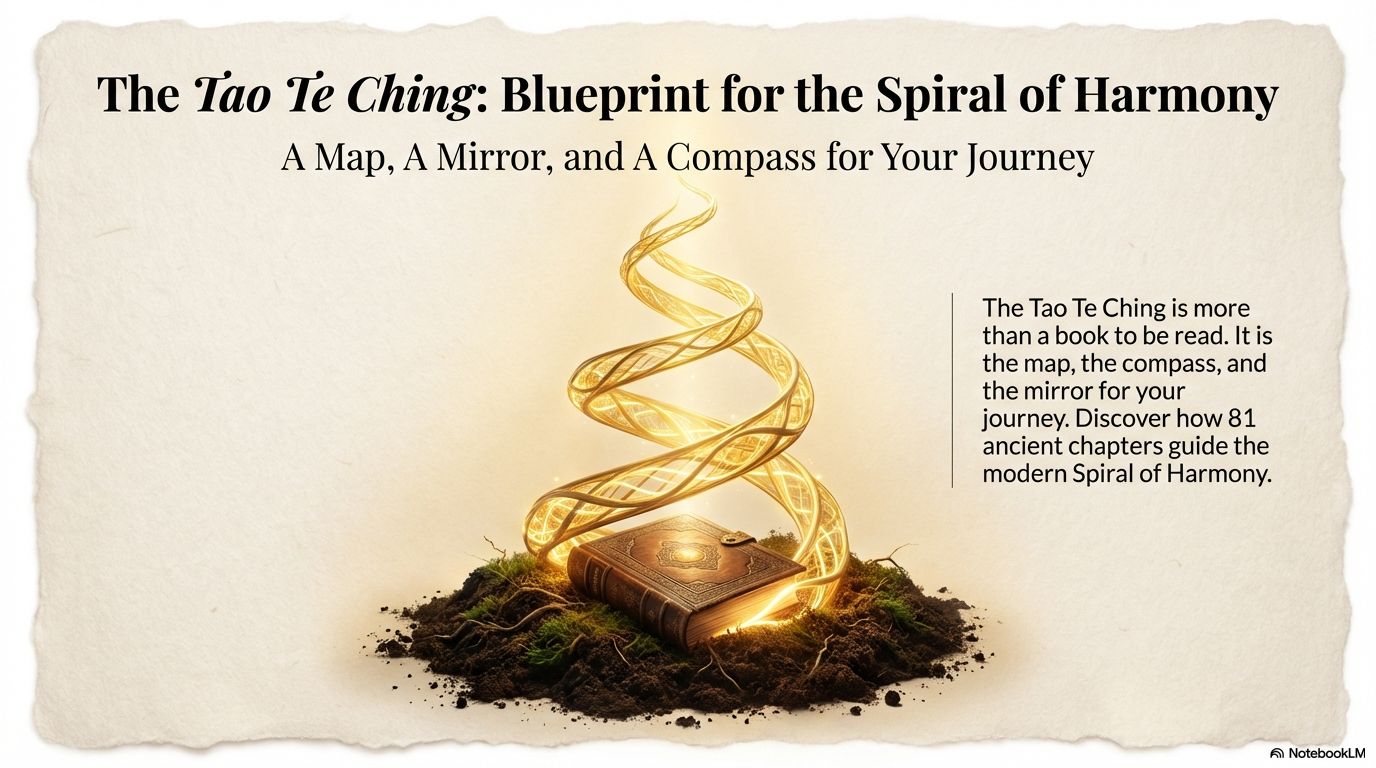
Do you wonder how the Tao Te Ching acts as both a spiritual compass and a deepening mirror for the Taoist Spiral of Harmony? Learn to use its 81 chapters as a map for practice and a mirror for growth in Pu, Wu Wei, De, and beyond.
Executive Summary
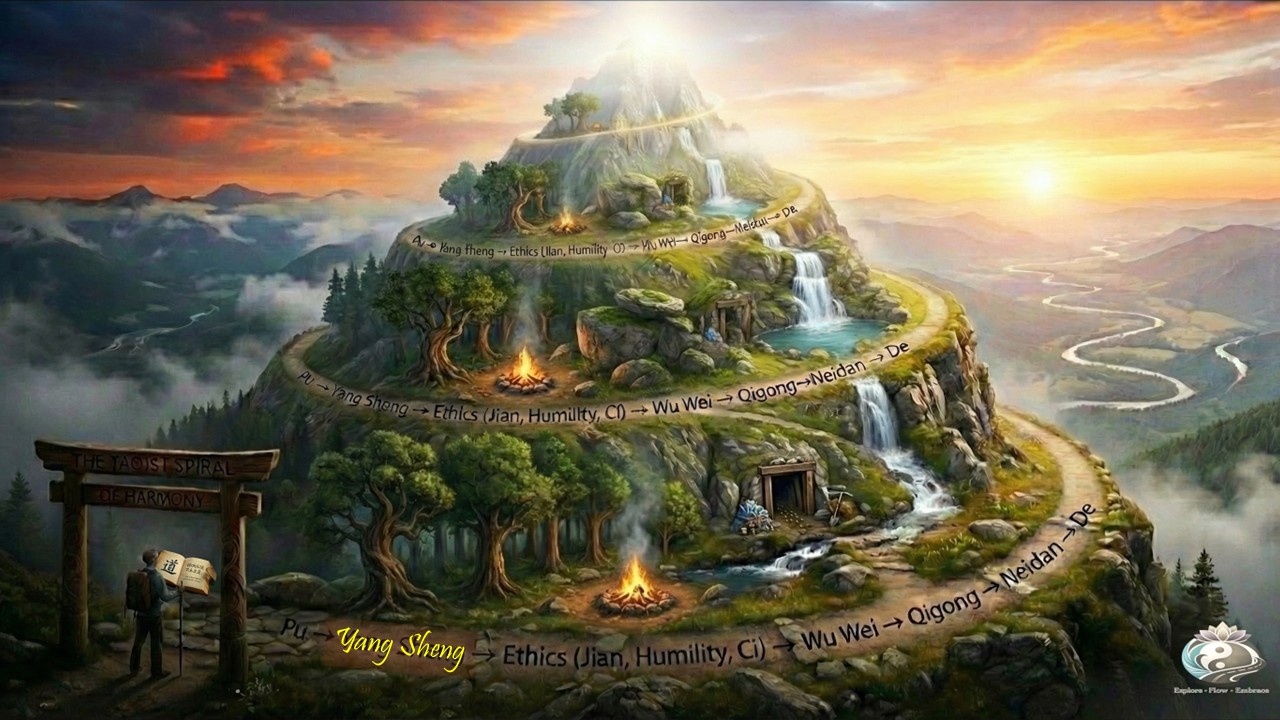
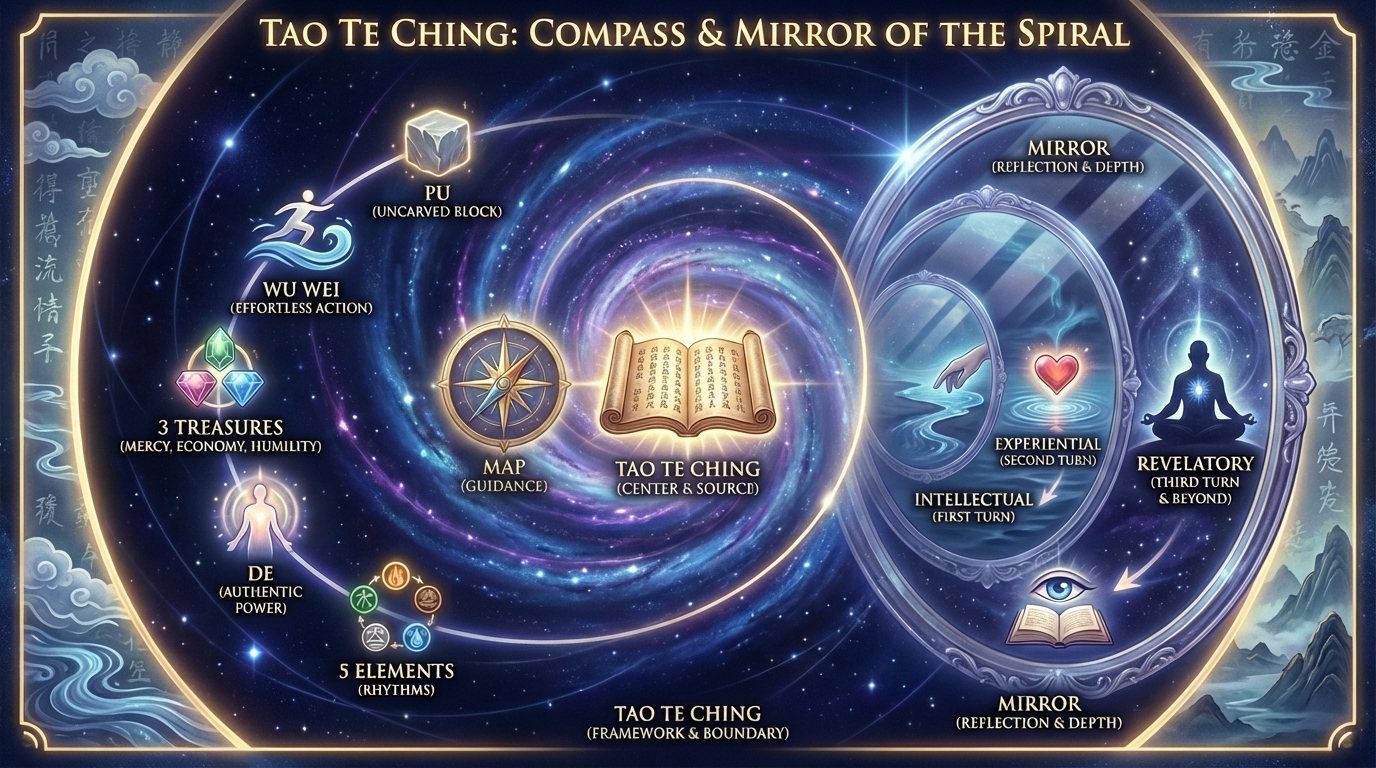
The Tao Te Ching is the living blueprint of the Taoist Spiral of Harmony, serving simultaneously as map and mirror.
Its verses define every stage of the spiral—Pu, Wu Wei, the Ethical Treasures, De, and the elemental cycles—providing the philosophical foundation for embodied practice.
As you evolve, the text evolves with you: first as inspiration, then as lived confirmation, and eventually as a profound mirror reflecting your inner state.
It sits at the spiral’s center as core wisdom and around its perimeter as guiding context.
The Tao Te Ching is the heartbeat of the journey, deepening each turn toward harmony.
The Taoist Spiral of Harmony Series
This is the tenth and final article in a short series on how to apply the Taoist Spiral of Harmony in your modern, busy life. Read Article 1.
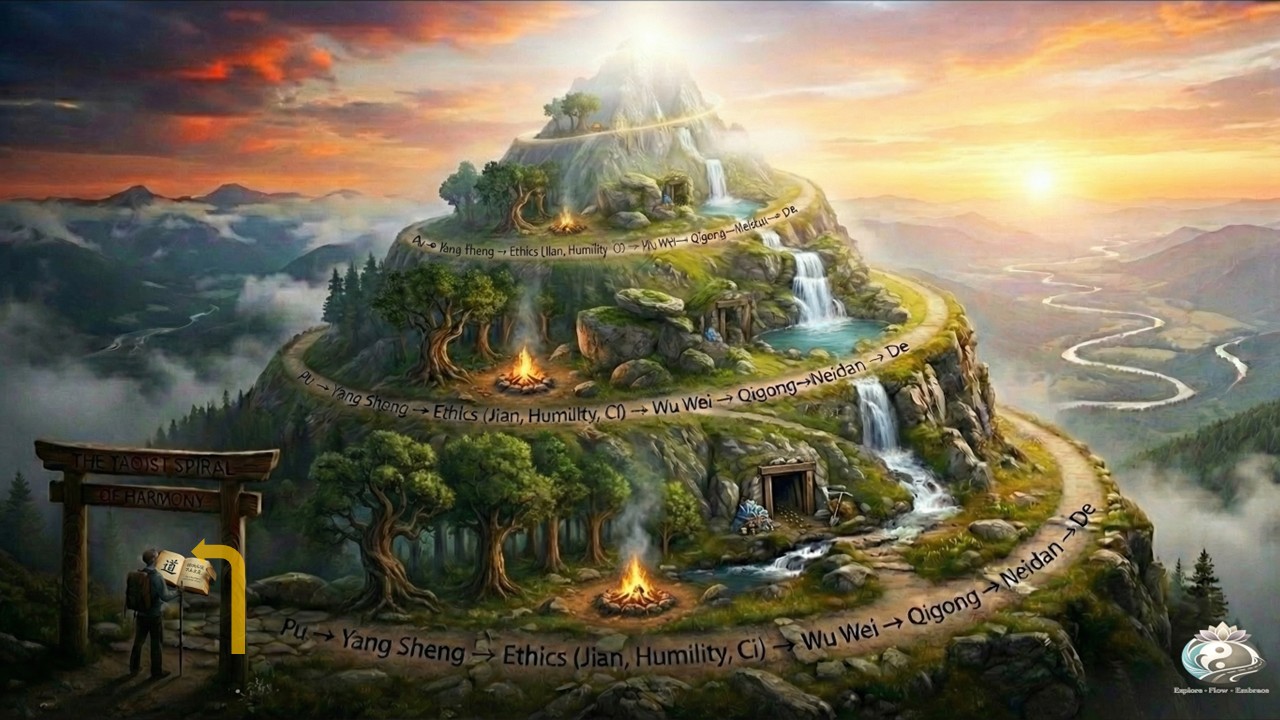
The Tao Te Ching is not merely a book to be read; it is the original blueprint, the spiritual compass, and the ever-deepening mirror for the entire Taoist Spiral of Harmony.
It doesn’t occupy a single step on the spiral. Instead, it permeates every turn in two vital ways:
1. The Tao Te Ching as the MAP (The Compass)
Its 81 short chapters provide the core philosophy that every stage of the spiral puts into practice.
- For Pu (The Uncarved Block): It is the primary source. “Return to the state of the Uncarved Block.” (Ch. 28) This isn’t just a concept; it’s the spiral’s starting point, defined here.
- For Wu Wei (Effortless Action): The entire text is a meditation on it. “The Tao does nothing, yet nothing is left undone.” (Ch. 37) This is the operating manual for the spiral’s action phase.
- For the 3 Ethical Treasures: Chapter 67 explicitly names them: “I have three treasures which I hold and keep. The first is mercy; the second is economy; the third is daring not to be ahead of the world…” (Compassion, Frugality, Humility). This is your ethical guardrail.
- For De (Authentic Power): It distinguishes true power from force. “The highest virtue is not virtuous; thus it has virtue.” (Ch. 38). This describes the De that emerges at the spiral’s peak—power so natural it doesn’t appear as “virtue.”
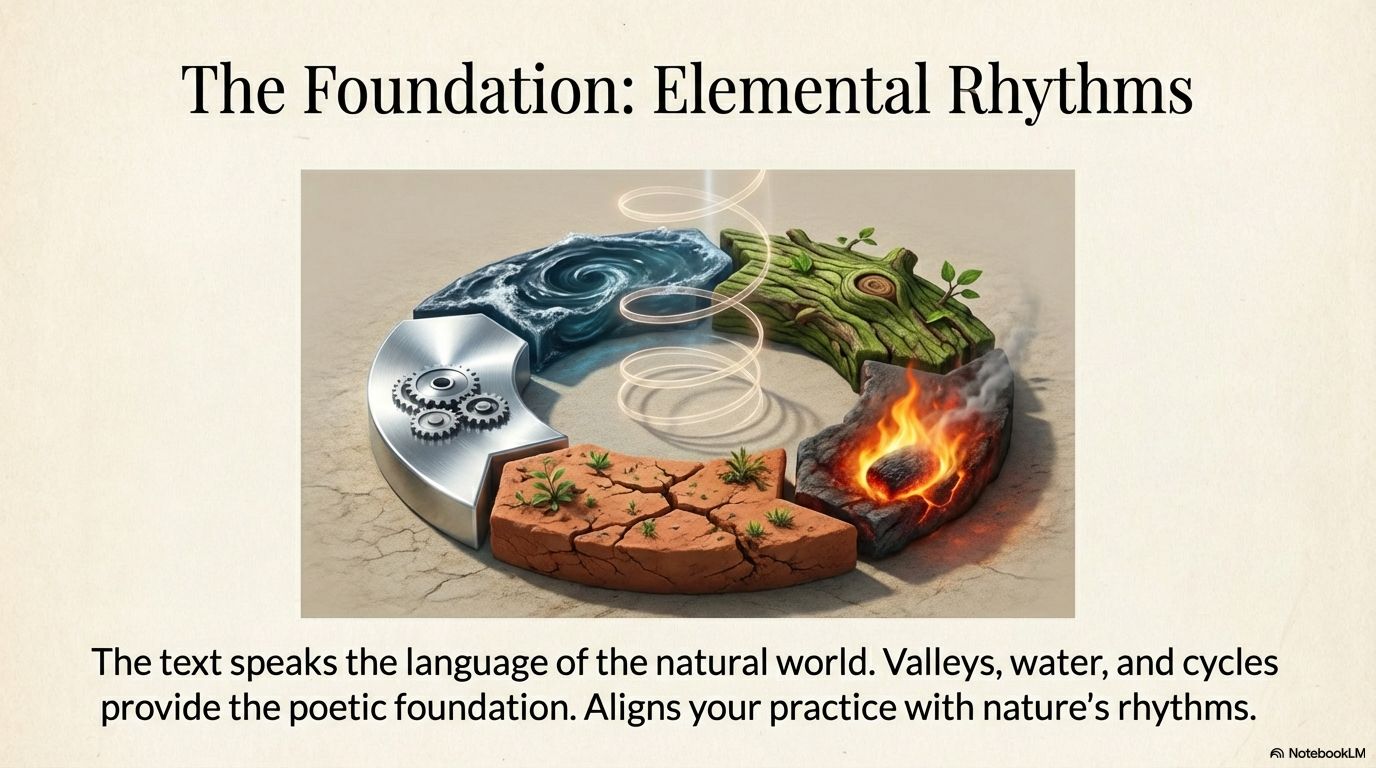
- For the 5 Elements & Cycles: It speaks constantly of the natural world—water, valleys, uncarved wood, the feminine, the cyclical—providing the poetic foundation for aligning with elemental rhythms.
In short, you are walking the path the Tao Te Ching describes. The spiral is the applied, living expression of its verses.
2. The Tao Te Ching as the MIRROR (The Measure of Depth)
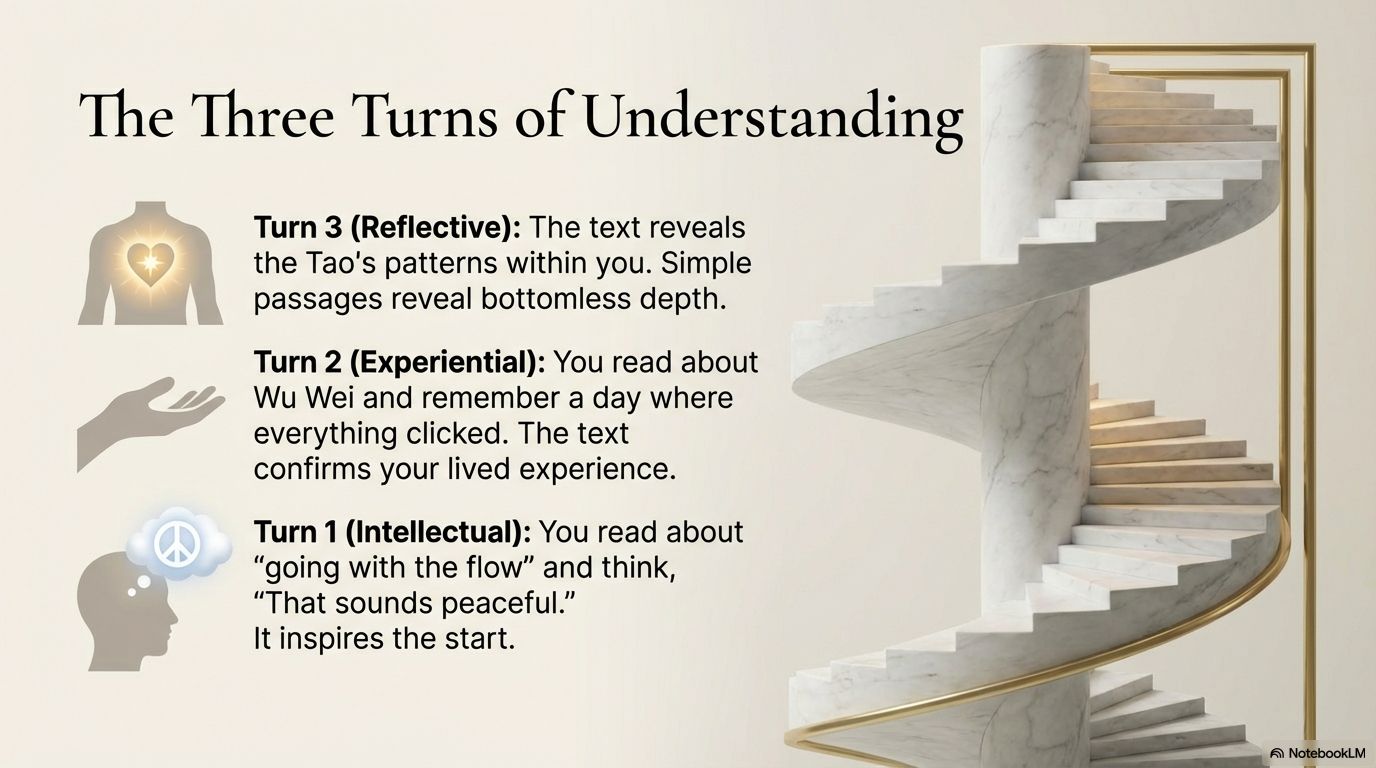
This is its most profound role in the perpetual spiral. The book’s meaning changes and deepens as you ascend.
- On the First Turn: You read it intellectually. You underline passages about “going with the flow” and think, “That sounds peaceful.” It inspires you to start.
- On the Second Turn (After experiencing De): You read it experientially. The same verses now resonate in your bones. When you read about Wu Wei, you remember the feeling of a day where everything clicked without force. The text confirms your lived experience.
- On the Third Turn and Beyond: You read it as a mirror of your current state. The opaque passages become clear. The simple passages reveal bottomless depth. The text doesn’t teach you new things; it reveals the Tao’s patterns within you. A single line can stop you for a week, not because you don’t understand it, but because you feel its truth at a new level of your being.
The spiral is your life in motion. The Tao Te Ching is the timeless, silent witness that validates and deepens each cycle.
Where to Place It on the Spiral: The Center and the Perimeter
Visually, if the spiral is a climbing vine, the Tao Te Ching is both the seed from which it grew and the sunlight that feeds it.
- At the Center: It is the core wisdom (the Tao itself) that the spiral seeks to orbit and embody. It is the “why” behind the “how.”
- Encircling the Spiral: It is the perimeter that contains and defines the entire journey. Every practice—Pu, Yang Sheng, Wu Wei, Neidan—exists within the cosmological and ethical framework it establishes.
Practical Integration: How to Use the Tao Te Ching with the Spiral
- As a Daily Anchor: Read one chapter (they are very short) in the morning (Wood time). Don’t analyze. Let it sit in your mind as you move through your day. See how its wisdom manifests in your interactions and challenges.
- As a Diagnostic Tool: When you feel stuck on the spiral—frustrated in Wu Wei, depleted in Yang Sheng—open the book at random. Read the chapter. It will often shed light on the very principle you are struggling with, not as advice, but as a reflection of a natural law you’ve forgotten.
- As a Celebration of De: When you feel a moment of calm, authentic influence (De), reflect on a verse like “The sage stays behind, thus he is ahead.” (Ch. 7). You will feel a smile of recognition. The text confirms the truth you’ve just lived.
The Ultimate Relationship: A Dialogue Across Time
Your journey on the spiral is a dialogue with Lao Tzu (the attributed author).
- You (the Practitioner): “Here is what I experienced today when I tried not to force.”
- The Tao Te Ching (the Wisdom): “Do you have the patience to wait until your mud settles and the water is clear?” (Ch. 15)
- You: “Ah. Yes. That is exactly what happened.”
The spiral is your lived experience. The Tao Te Ching is the eternal echo that makes sense of it. One cannot be complete without the other. The book without the lived spiral is just philosophy. The spiral without the book risks becoming a self-help technique, untethered from its profound, root wisdom.
In Conclusion:
The Tao Te Ching is the heartbeat of the spiral. It is the constant, subtle pulse that gives life, direction, and infinite depth to the never-ending, upward turn toward harmony. You don’t “add” it to the spiral. You discover that you have been walking its path all along.