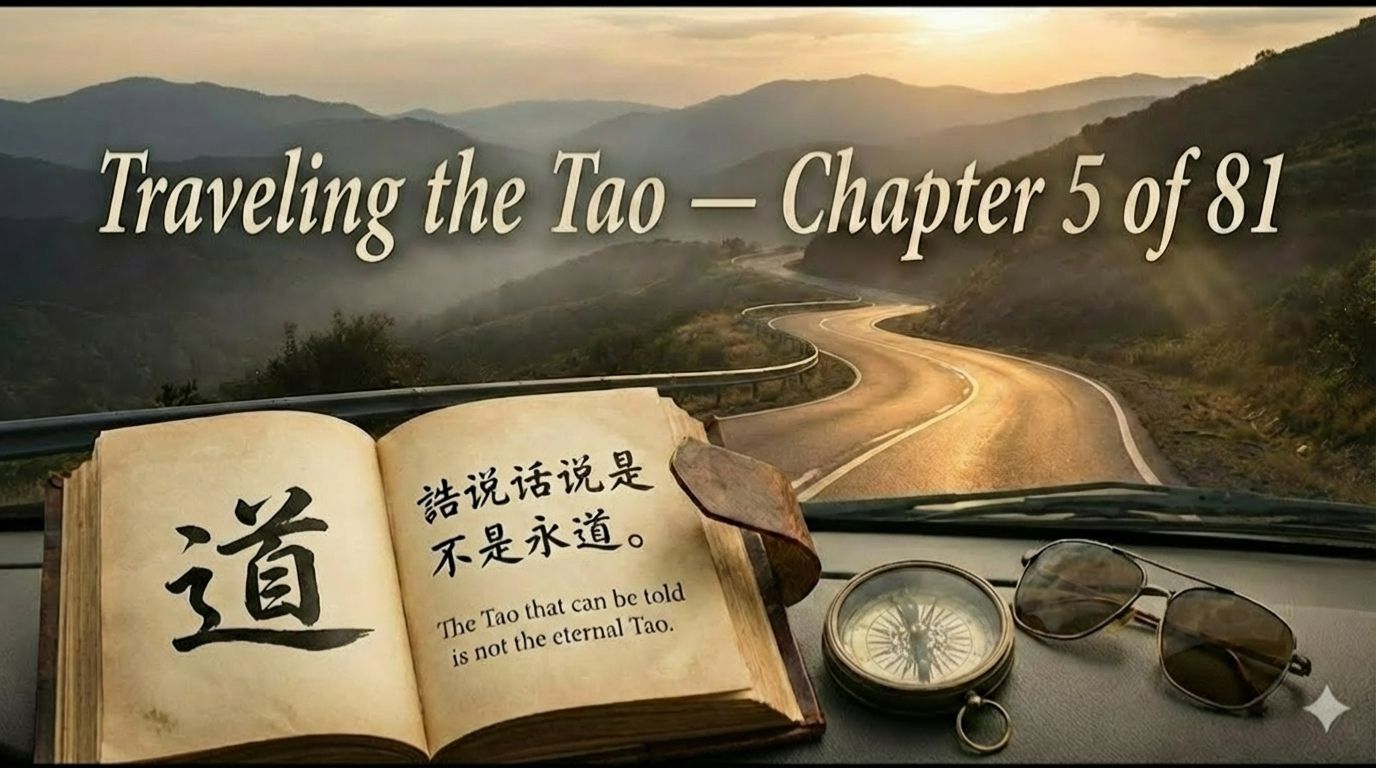
The open road does not play favorites—it offers its expanse to the hurried commuter and the meandering wanderer alike. In the same way, the ancient sage teaches us that freedom is found not in taking sides, but in moving with the impartial, ever-productive rhythm of life itself.
Executive Summary
This article interprets the fifth chapter of the Tao Te Ching through the lens of a modern traveler, emphasizing the importance of impartiality and non-attachment.
It explains that nature operates without personal bias, suggesting that individuals should interact with life’s events like “straw dogs”—valued in the moment but released without grief when their purpose ends.
The text uses the metaphor of a bellows to illustrate how staying empty and quiet allows for a more productive, rhythmic flow of energy than forced planning ever could.
By letting go of rigid itineraries and excessive internal commentary, a person can align with the natural world’s effortless movement.
Ultimately, the source serves as a guide for achieving resilience and peace by embracing the void and moving in harmony with the shifting seasons of existence.
The Traveler’s Lesson in Impartiality
Following the deep emptiness of Chapter 4, Tao Te Ching Chapter 5 presents a more challenging, yet profoundly freeing, quality of the Tao: impartiality.
Using Derek Lin’s poignant translation, this chapter asks us to see the world—and our place in it—with the serene detachment of a seasoned traveler who witnesses all landscapes without clinging to any single view.
It teaches that true peace comes from aligning with the natural, impersonal flow of existence, which gives and takes away with equal grace.
For anyone feeling bruised by life’s ups and downs or exhausted by taking everything personally, this chapter is a guide to resilient and effortless travel through all of life’s seasons.
Chapter 5
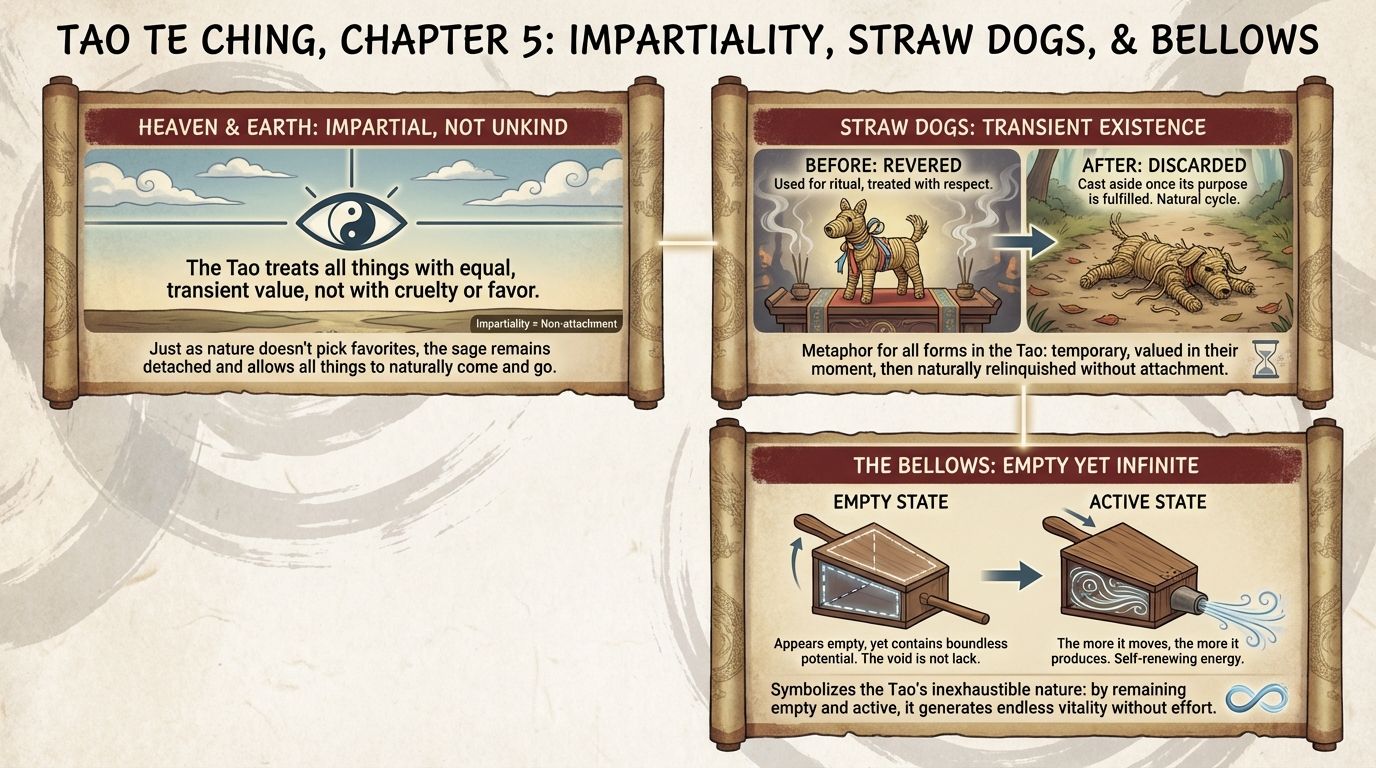
Heaven and Earth are impartial
Tao te ching 5 Of 81
They regard myriad things as straw dogs
The sages are impartial
They regard people as straw dogs
The space between Heaven and Earth
Is it not like a bellows?
Empty, and yet never exhausted
It moves, and produces more
Too many words hasten failure
Cannot compare to keeping to the void
The Metaphor of the Straw Dogs: Traveling Light Through Change
The chapter opens with a striking image:
“Heaven and Earth are impartial; They regard myriad things as straw dogs. The sages are impartial; They regard people as straw dogs.”
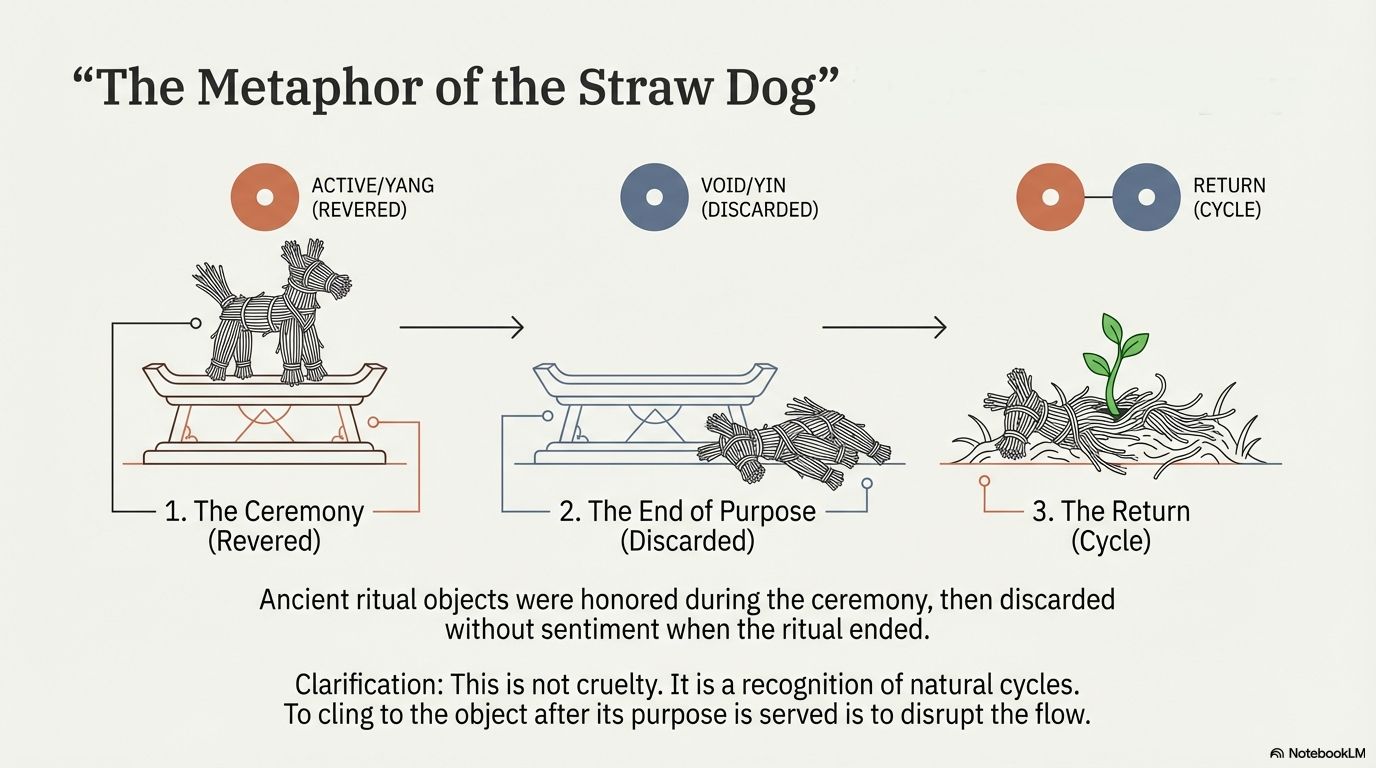
In ancient rituals, “straw dogs” were sacred objects revered during a ceremony but discarded without sentiment once their purpose was served. This is not cruelty, but a recognition of natural cycles.
The Traveler’s Insight: A master traveler understands this deeply. You pack gear for a specific purpose—a raincoat for a storm, sandals for a beach. You use them fully while the conditions demand, but you don’t cling to them when the climate changes or the journey ends. You don’t curse the raincoat when the sun comes out, nor do you desperately try to wear your hiking boots on a city stroll.
Heaven and Earth treat all things this way—seasons change, landscapes erode, and life gives way to new life, all without personal sentiment.
The sage, and the wise traveler, learn to do the same with experiences, roles, and even relationships. They engage fully in the present moment—the “ceremony” of now—without clinging to it when its time has passed.
This non-attachment is the key to moving freely through life’s constant transformations without being broken by them.
The Bellows of the World: The Rhythm of Effortless Giving
Next, the text offers a beautiful mechanical metaphor for the Tao’s operation:
“The space between Heaven and Earth, Is it not like a bellows? Empty, and yet never exhausted; It moves, and produces more.”
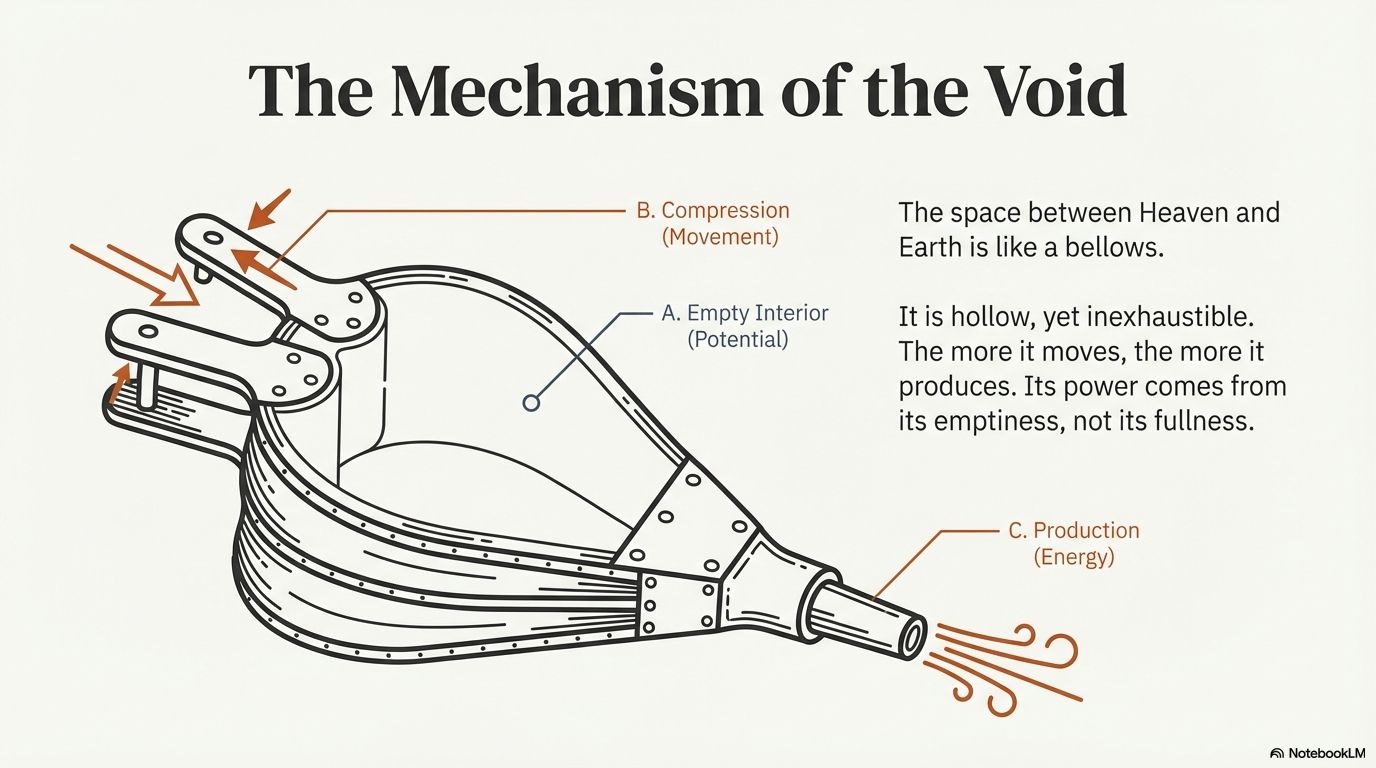
A bellows is hollow, yet its very emptiness allows it to draw in and give out air infinitely, fueling the fire without ever being used up.
The Traveler’s Insight: This is the perfect description of Wu Wei (effortless action) in motion. Imagine your own breath on a journey. You don’t force each inhale and exhale; you trust the natural rhythm. The bellows is like the journey itself—the empty space between departure and arrival. It seems inert, but within that space is the potential for every mile, every vista, every chance encounter. The act of traveling (the movement) produces endless experience (the air for the fire) without ever depleting the road itself.
When you align with this rhythm, you become like the bellows.
Your actions—your decisions, your engagements—become efficient and productive not through strain, but through natural, rhythmic movement.
You give of yourself without exhausting your core because you are connected to an inexhaustible source.
The Danger of the Itinerary: When Words Replace Experience
The chapter concludes with a practical warning that every traveler has felt:
“Too many words hasten failure; Cannot compare to keeping to the void.”
The Traveler’s Insight: This is the tragedy of the over-planned trip. When your journey is governed by a rigid, word-heavy itinerary—every hour scheduled, every site pre-judged by a guidebook—you strangle spontaneity. You “hasten failure” by creating expectations that reality cannot match, leading to disappointment. The constant chatter of planning, comparing, and narrating (“This should be better,” “That guidebook said…”) pulls you out of the direct experience.
“Keeping to the void” means returning to the quiet, open space within—the “empty bellows” of your own mind.
It’s choosing to sometimes put the map away, silence the podcast, and just be present with the landscape.
The deepest truths of the road are felt in the silence between thoughts, not in the commentary about them.
Your Roadmap: Traveling with Impartiality and Rhythm
How do you bring this wisdom of impartiality and natural rhythm onto your life’s path?
- Practice “Straw Dog” Detachment: Identify one current worry or attachment—a project outcome, a social expectation. Consciously say, “For this season, I will engage fully. But I release my need for it to last forever.” See it as gear for this leg of the trip, not a permanent burden.
- Find Your Bellows Rhythm: In a daily task, focus on finding a smooth, rhythmic pace rather than forcing productivity. Whether it’s writing, cleaning, or even conversation, seek the effortless “inhale and exhale” of action and rest.
- Create a “Word-Free” Zone: Dedicate part of your day or week to an activity without commentary. Take a walk without a podcast, cook without a recipe, or sit without scrolling. Dwell in the “void” and observe what arises from the silence.
- Observe Impartially: When faced with a frustrating situation (like traffic), try to see it as Heaven and Earth might—an impersonal event in the flow of cause and effect, not a personal attack. This shift in perspective dissolves resentment.
The Destination: Harmony with the Impersonal Journey
Tao Te Ching Chapter 5 does not teach cold indifference.
It teaches a warm, resilient harmony with the way things are. It invites you to be the sage traveler: engaging passionately with each moment while holding it lightly, acting effectively by moving with life’s natural rhythm, and finding profound peace in the spaces between your own thoughts.
By embracing the impartiality of the road and the endless productivity of the empty bellows, you learn to travel through life with an unshakable freedom, never exhausted because the Tao itself carries you.
Continue Your Journey: Having learned to move with impartial rhythm, Chapter 6 explores the nurturing, feminine aspect of the Tao—the valley spirit that is the source of all life. For the foundational maps of this philosophy, explore our Foundations of the Tao series.