The most seasoned travelers know a secret: a lighter pack leads to a farther journey. Tao Te Ching Chapter 3 teaches that the endless pursuit of more—more sights, more gear, more exotic checkboxes—only exhausts the traveler. True exploration begins when you learn what to leave behind.
Executive summary
This chapter reframes Tao Te Ching Chapter 3 through the metaphor of mindful travel. It opens by explaining that glorifying “achievers” and chasing rare, hard‑to‑obtain goods creates inner restlessness—much like comparing your trip to glamorous influencers makes you feel behind on your own journey. The more you fixate on others’ highlights, the more you “squabble” with your own reality.
The text encourages traveling light: emptying the heart of cluttered desires, filling the belly with what truly nourishes, and strengthening the “bones”—your core character and stability. This shift turns you from a frantic tourist into a grounded nomad who feels at home anywhere.
The second section applies the verse to modern prosperity. It argues that abundance is not accumulation but stability. By avoiding lifestyle creep and focusing on fundamentals—health, skills, infrastructure—you become resilient and trustworthy. When you stop forcing outcomes and act without contrivance, you align with natural flow. Ironically, this non‑attachment often leads to greater success because you can see opportunities that greed blinds others to.
Ultimately, Chapter 3 teaches that contentment, clarity, and effortless effectiveness arise when you stop chasing the shiny and start strengthening what’s real.
The Core Challenge of Chapter 3: The Restless Mind
Following the exploration of opposites in Chapter 2, Tao Te Ching Chapter 3 tackles a primary obstacle to peace: the restless, desire-driven mind. This chapter provides a practical guide for leaders and individuals on how to cultivate a calm and effective life by managing desires—both in oneself and others. Its wisdom counters the modern culture of excess, offering a path to contentment and clarity through the principle of Wu Wei (effortless action).
At its heart, Chapter 3 asks: What happens when we stop glorifying what we don’t have and start finding depth in what we do?
Chapter 3
Do not glorify the achievers
Tao te ching 3 Of 81
So the people will not squabble
Do not treasure goods that are hard to obtain
So the people will not become thieves
Do not show the desired things
So their hearts will not be confused
Thus the governance of the sage:
Empties their hearts
Fills their bellies
Weakens their ambitions
Strengthens their bones
Let the people have no cunning and no greed
So those who scheme will not dare to meddle
Act without contrivance
And nothing will be beyond control
The Roadside Trap of Comparison
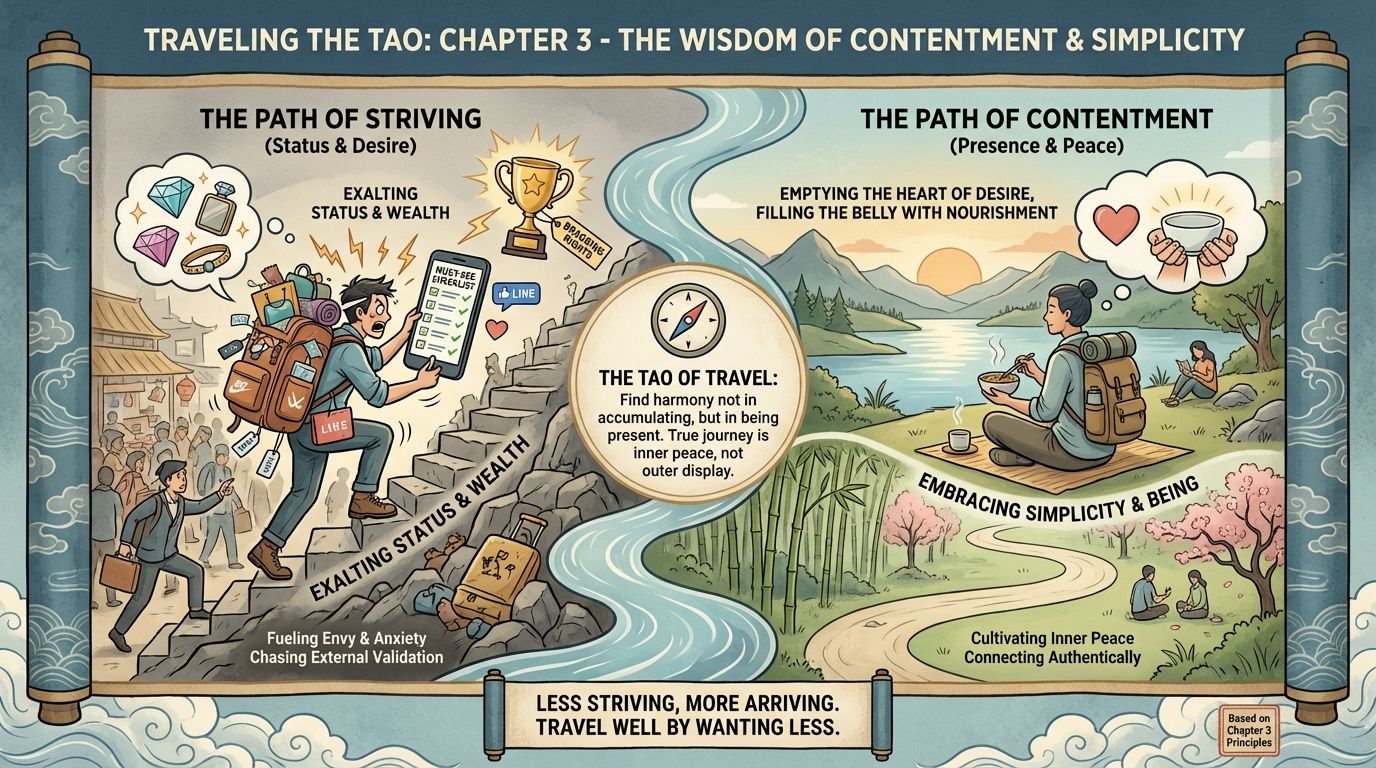
Every journey has a pitfall long before the first mile: the trap of measuring your trip against others’. Chapter 3 of the Tao Te Ching begins with a crucial piece of navigational advice: “Do not glorify the achievers.”
In the age of social media, this is the equivalent of constantly comparing your cross-country road trip to someone else’s curated highlight reel of luxurious resorts and private tours.
When you focus on the “achievers” and their “rare goods,” you initiate a silent, wearying argument with your own journey. You start to see your reliable sedan, your cozy campsite, and your unplanned route as lacking.
This comparison is the first weight that slows you down, making you believe you are on the wrong path simply because it looks different from someone else’s.
The Sage’s Packing List: Traveling Light to Move Freely
The sage traveler understands that freedom is found in simplicity, or Pu. This isn’t about having nothing; it’s about carrying only what serves the journey.
Emptying the Heart’s Luggage
The text advises us to “empty the heart” and “fill the belly.”
In travel terms, this means unloading the heavy baggage of envy and restless desire (“emptying the heart”) and instead finding deep nourishment in the simple, present experience (“filling the belly”).
It’s the difference between a frantic tourist at a scenic overlook, frustrated they can’t get the perfect photo for social media, and a quiet hiker who sits on a rock, soaking in the view and the feeling of the sun.
One is hungry for validation; the other is nourished by presence.
Strengthening Your Travel Bones
This practice “strengthens the bones.”
On a long trek, your bones are your core stability and endurance. In life, your “bones” are your character, resilience, and inner peace. By refusing to be tossed about by every new want or trend, you build a sturdy foundation.
You become the traveler who remains calm and resourceful when the map fails, the weather turns, or the road is closed. Your strength comes from within, not from the external gear you own.
Navigating Life’s Terrain with Wu Wei
The second half of Chapter 3 applies this “light pack” philosophy to prosperity and action, framing it as the ultimate travel strategy for life’s long journey.
The Map to True Prosperity
We often confuse prosperity with a full trunk—crammed with possessions, status, and trophies.
The sage traveler knows that real prosperity is a full tank, a reliable engine, and a clear map. It’s the stability that comes from needing less.
By “not showing the desired things,” you avoid “lifestyle creep”—the exhausting cycle of upgrading your rental car, your hotel room, and your itinerary to impress invisible spectators.
This clarity of purpose is your most valuable asset, allowing you to navigate financial and professional landscapes without getting lost in detours of greed.
The Power of Effortless Progress (Wu Wei)
Finally, the chapter concludes with the principle of Wu Wei: “Act without contrivance, and nothing will be beyond your control.”
This is the art of effortless action, like a sailor who trims the sails to catch the wind rather than fighting against it.
The master traveler doesn’t force the journey.
They don’t white-knuckle the wheel against every curve or rage against a traffic delay. They plan a direction but adapt to the conditions. They understand that sometimes the most profound discoveries are found on the unplanned detour, and the most meaningful connections are made in the unexpected stop.
By releasing the need to control every outcome rigidly, they find that the journey itself supports them, revealing solutions and opportunities that the controlling mind would never see.
Your Practical Guide: Applying Chapter 3 on the Road
- Pack a Metaphorical “Not-To-Do” List: Before your next big “trip”—be it a project, a goal, or an actual vacation—write down what you will consciously not pursue. What distractions, comparisons, or unnecessary complexities can you leave behind?
- Find One Anchor of “Enough”: Identify a simple pleasure in your daily routine—your morning coffee, a walk, a quiet moment—and practice being fully nourished by it. Let it be your “full belly” that anchors you against wanting more.
- Navigate a Challenge with Wu Wei: When faced with a problem, pause. Instead of forcing your first instinct, ask: “What is the natural flow here? What would a lighter, more adaptable approach look like?” Look for the current, not just the effort.
The Destination is the Journey
Tao Te Ching Chapter 3 ultimately teaches that the path to peace is not an ascent to a distant peak, but the art of shedding weight so you can walk further with more joy.
It invites you to become the sage traveler of your own life: unburdened by comparison, nourished by simplicity, and moving through the world with the graceful, adaptable ease of Wu Wei.
When you stop racing for a distant horizon, you discover the entire landscape is your home.
Continue Your Journey: Having learned to travel light, Chapter 4 explores the profound power of the empty space within—the silent engine of all potential. For the foundational maps of this philosophy, visit our Foundations of the Tao series.