If you’ve ever planned a road trip and thought, “Surely there’s a better way to do this,” congratulations—you’re already ahead of where we started.
Most people approach travel planning with the same strategy they use for assembling a gas grill: lay out the parts, ignore the instructions, and hope nothing explodes.
This year, we’re doing something different. In a series of 6 or so blog posts, we’re using AI to design the perfect Arizona itinerary for us—and if that sounds ambitious, it is. But it’s also the first time we’ve had a planning partner who doesn’t get tired, doesn’t get cranky, and doesn’t ask, “Are we there yet?”
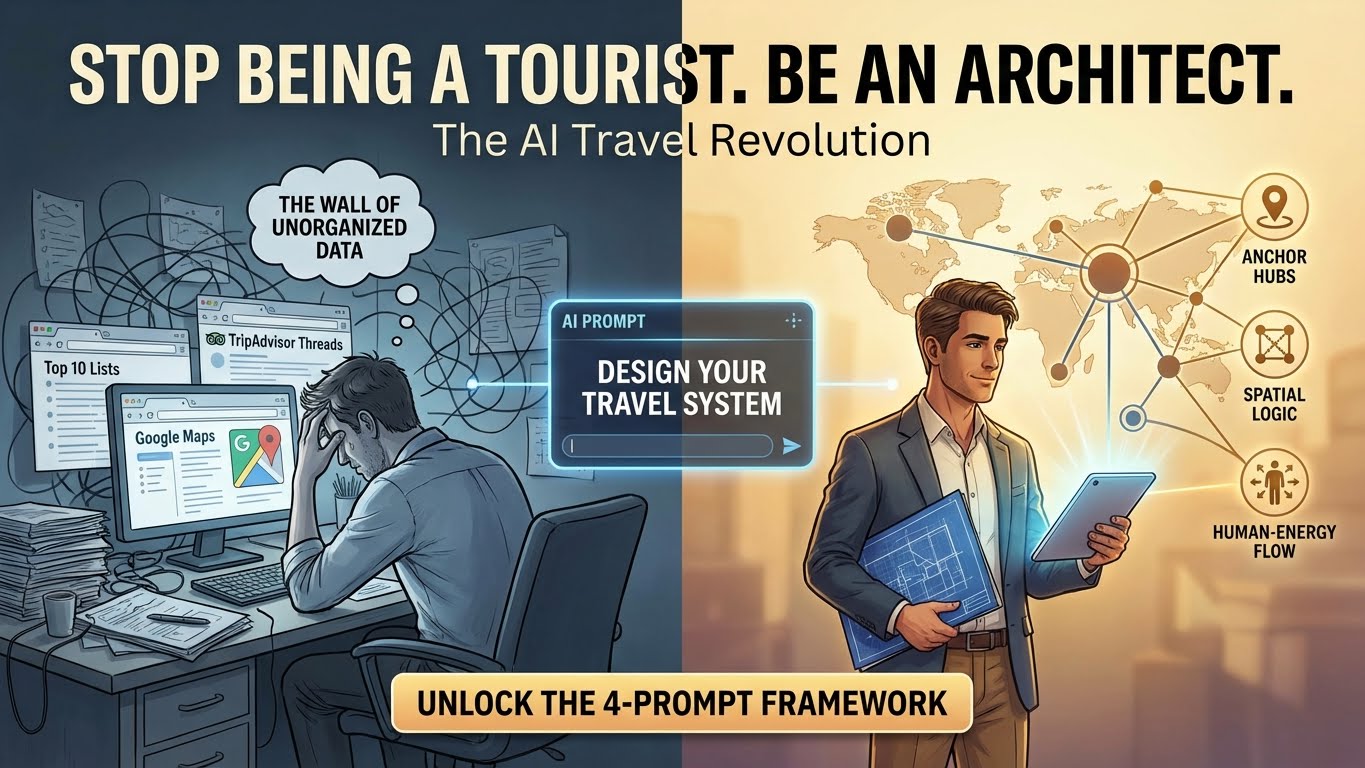
And while we’re building this itinerary, we’re also creating a set of prompts and AI agents that anyone can use to design their own perfect trip. Because if we can figure this out, trust us—anyone can.
Why We’re Using AI (Besides the Obvious Reason: Sanity)
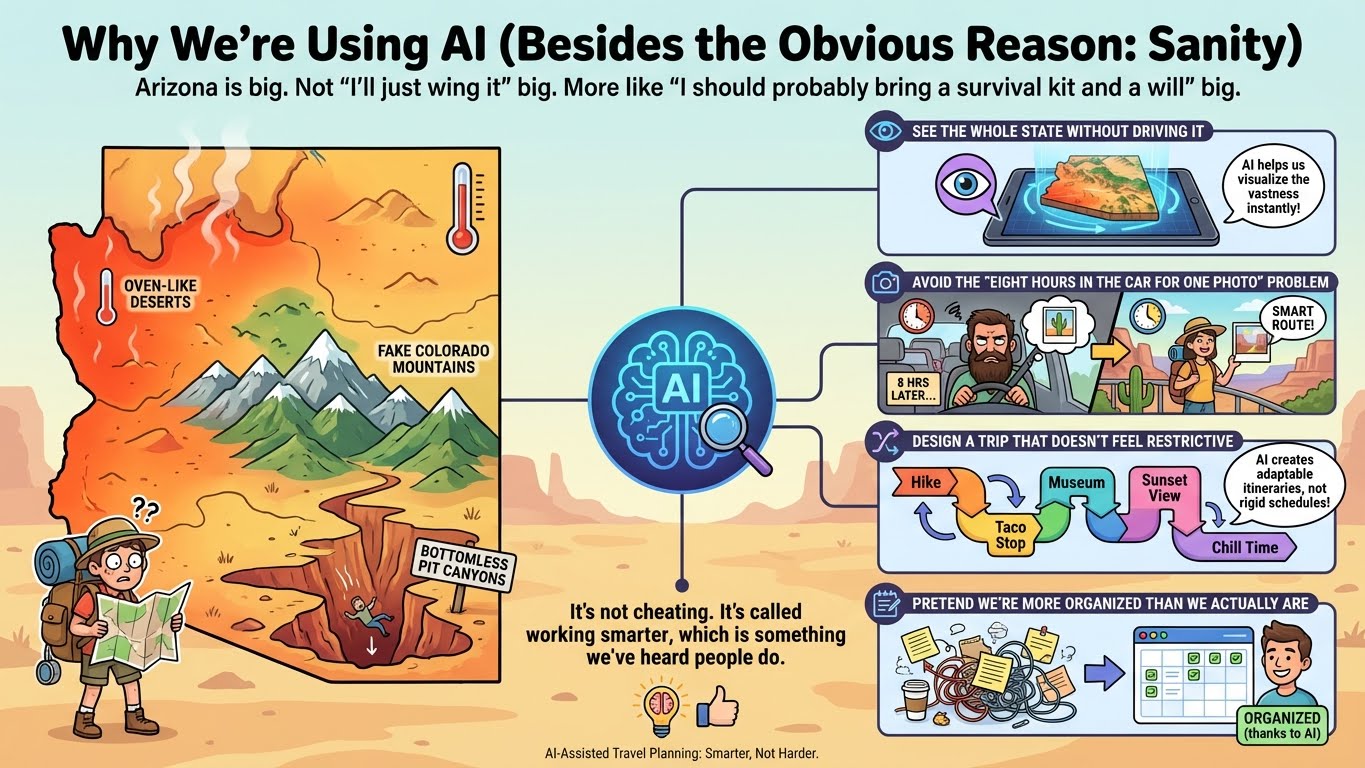
Arizona is big. Not “I’ll just wing it” big. More like “I should probably bring a survival kit and a will” big.
You’ve got deserts pretending to be ovens, mountains pretending to be Colorado, and canyons pretending to be bottomless pits. It’s a lot.
AI helps us:
- see the whole state without driving it
- avoid the “eight hours in the car for one photo” problem
- design a trip that doesn’t feel like a hostage situation
- pretend we’re more organized than we actually are
It’s not cheating. It’s called working smarter, which is something we’ve heard people do.
The Four Prompts That Keep Us From Spiraling
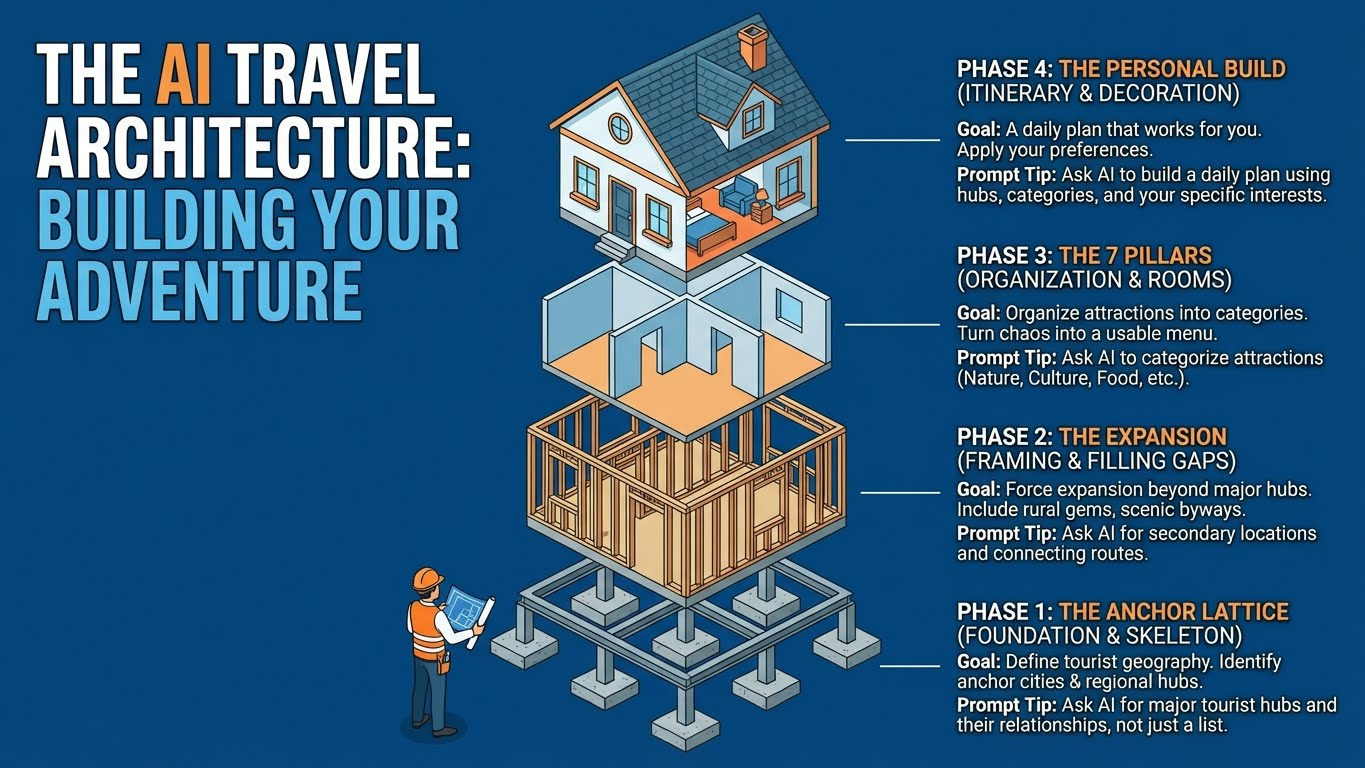
To keep this whole thing from turning into a Choose‑Your‑Own‑Adventure tragedy, we’re using four prompts—simple, structured, and surprisingly effective.
1. The Anchor Lattice
This identifies the places where you should actually stay. Not the places Instagram tells you to stay. The places that make sense.
2. The Expansion Layer
This fills in the gaps with scenic drives, small towns, and the occasional “Why is this here?” roadside attraction.
3. The Seven Travel Pillars
Nature, culture, food, history, adventure, relaxation, and “things you’ll tell your friends about even if they didn’t ask.”
4. The Personal Build
This is where we admit we’re not 22 anymore and design days that won’t require medical attention.
Introducing AI Travel Agents (Because Apparently We Have Employees Now)

Prompts are great, but we wanted something more… coordinated. So we’re building a team of AI agents—specialists who do the heavy lifting while we sit here pretending to supervise.
- Hub Architect – finds the places worth sleeping in
- Route Weaver – makes sure we don’t backtrack like confused squirrels
- Category Curator – organizes attractions so we don’t end up at a museum when we meant to be at a taco truck
- Itinerary Composer – assembles the daily plan
- Pacing Analyst – prevents unnecessary long drives
- Seasonal Strategist – keeps us from hiking in July, which is how people meet their Maker early
These agents will eventually work together like a well‑oiled machine. Or at least a machine that’s been oiled recently.
Why We Use Hub‑and‑Spoke Instead of the Classic Loop
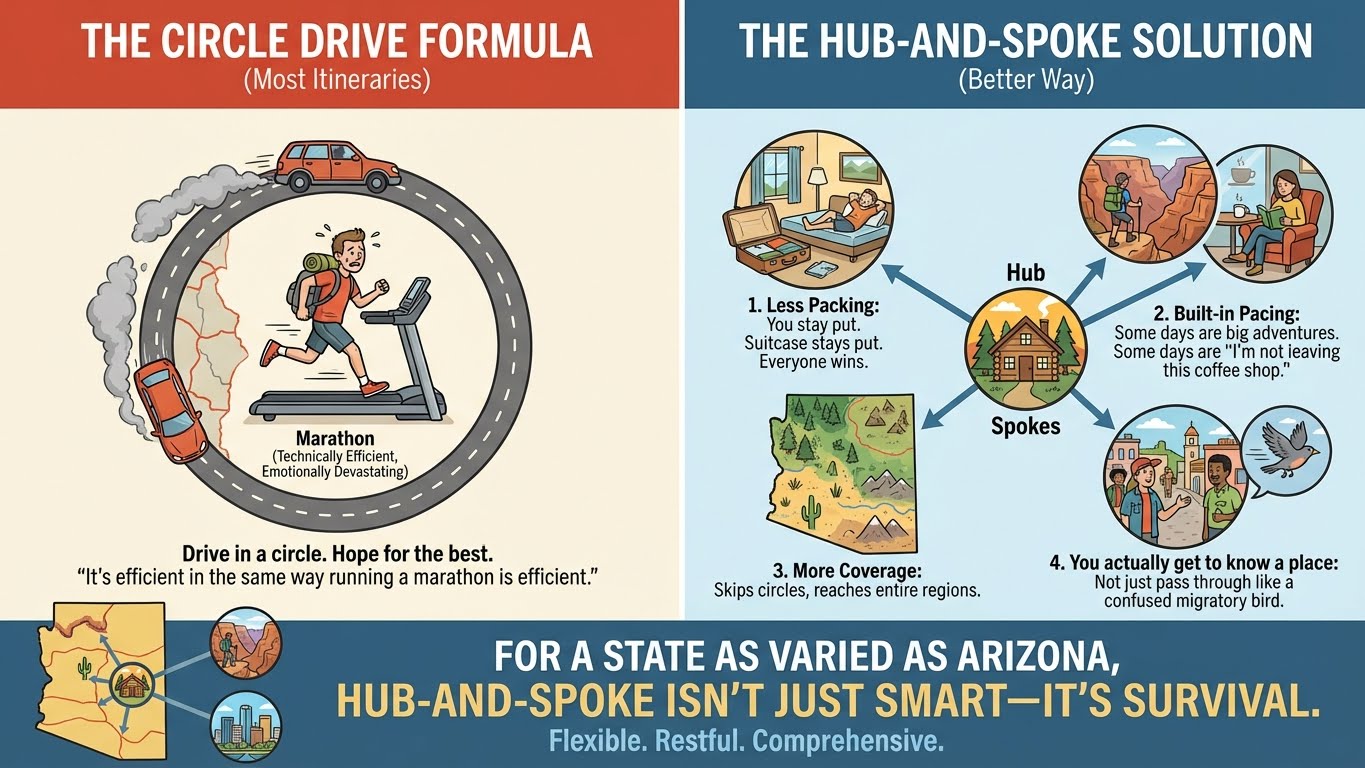
Most itineraries follow a simple formula: Drive in a circle. Hope for the best.
It’s efficient in the same way running a marathon is efficient: technically true, but emotionally devastating.
Hub‑and‑Spoke is better.
1. Less packing
You stay put for a few nights. Your suitcase stays put too. Everyone wins.
2. Built‑in pacing
Some days are big adventures. Some days are “I’m not leaving this coffee shop.”
3. More coverage
Linear loops skip entire regions because they don’t fit the circle. Hub‑and‑Spoke doesn’t care about circles.
4. You actually get to know a place
Not just pass through it like a confused migratory bird.
For a state as varied as Arizona, Hub‑and‑Spoke isn’t just smart—it’s survival.
What This Project Will Produce (Assuming We Don’t Wander Off)
By the end of this experiment, we’ll have:
- A complete Arizona itinerary that won’t require a chiropractor
- A reusable prompt system anyone can adapt
- A suite of travel‑planning agents
- A YouTube series documenting the chaos
- A framework for designing itineraries anywhere
This isn’t about perfection. It’s about building a system that works for real humans with real energy levels and real attention spans.
AI isn’t replacing the traveler. It’s just helping us stop making the same mistakes.
And Arizona is where we’re starting.