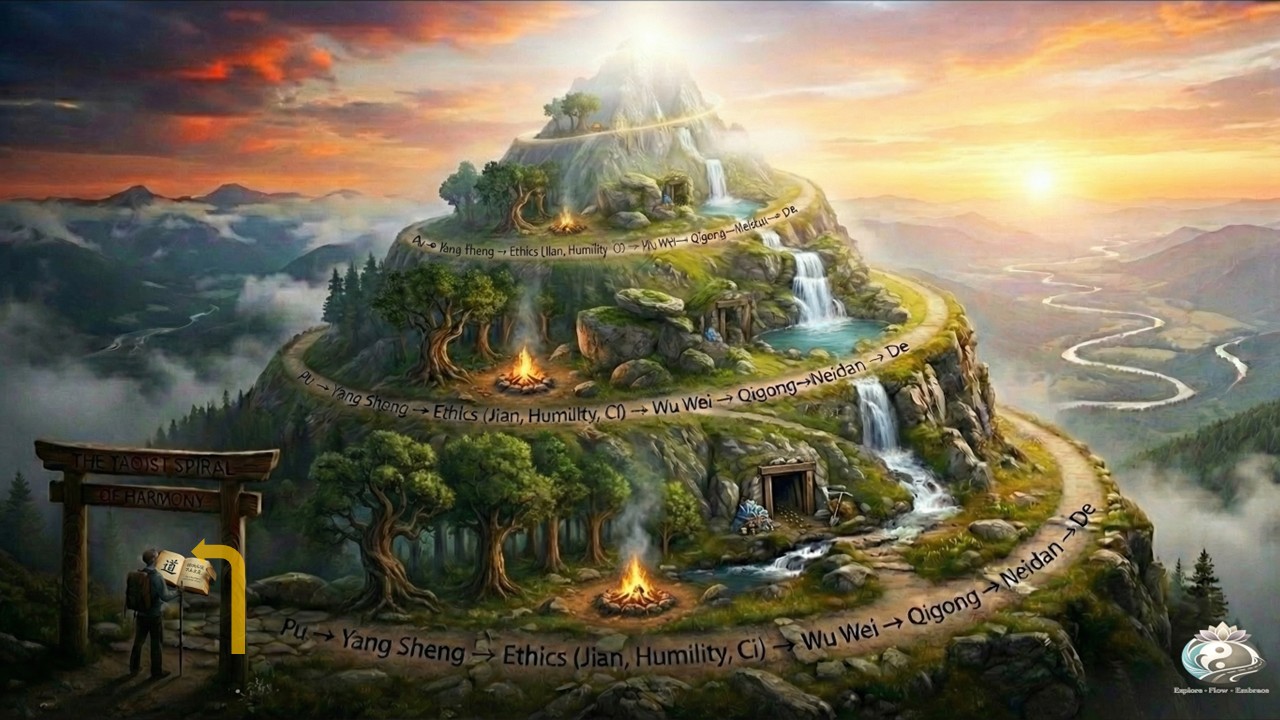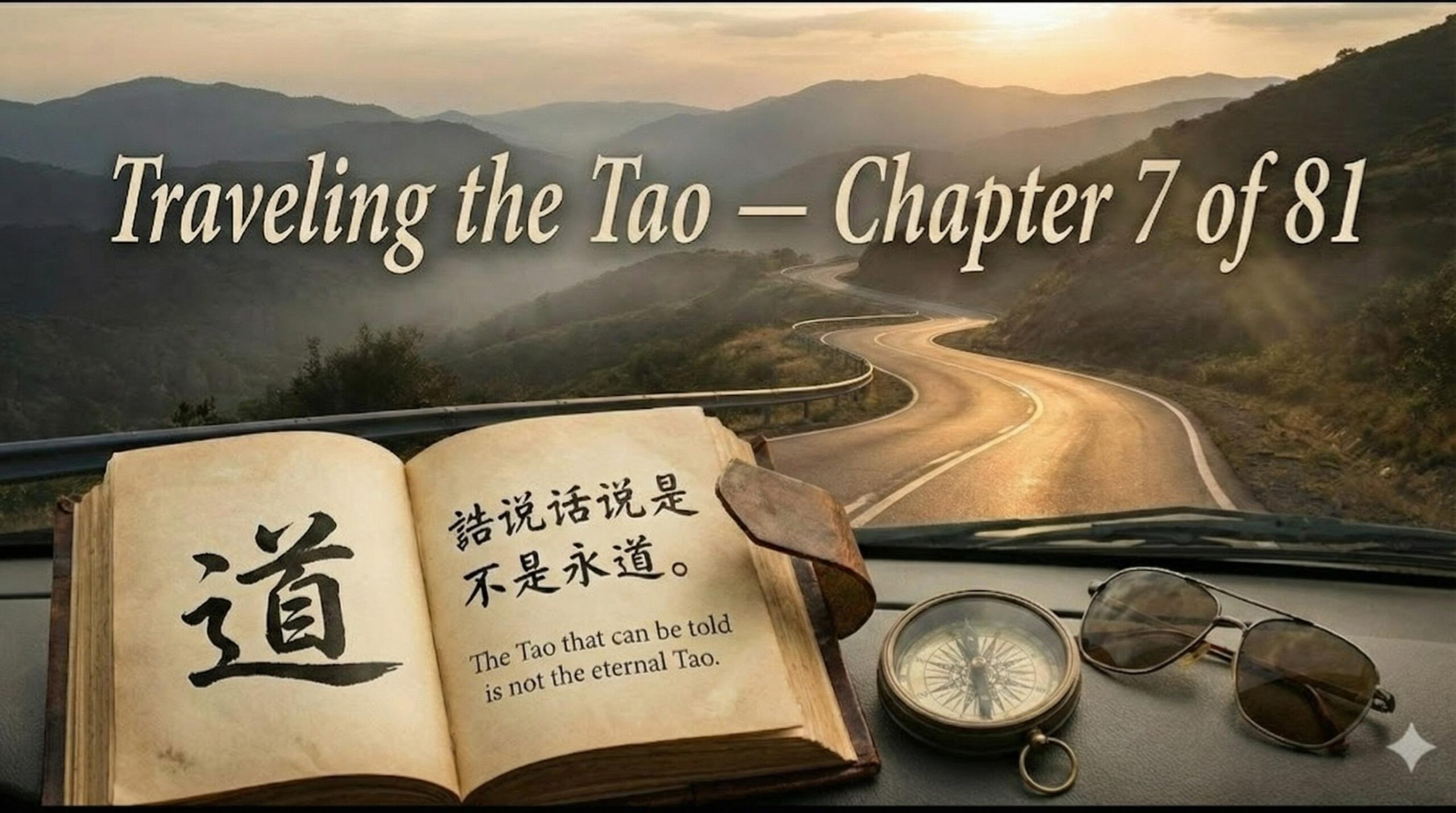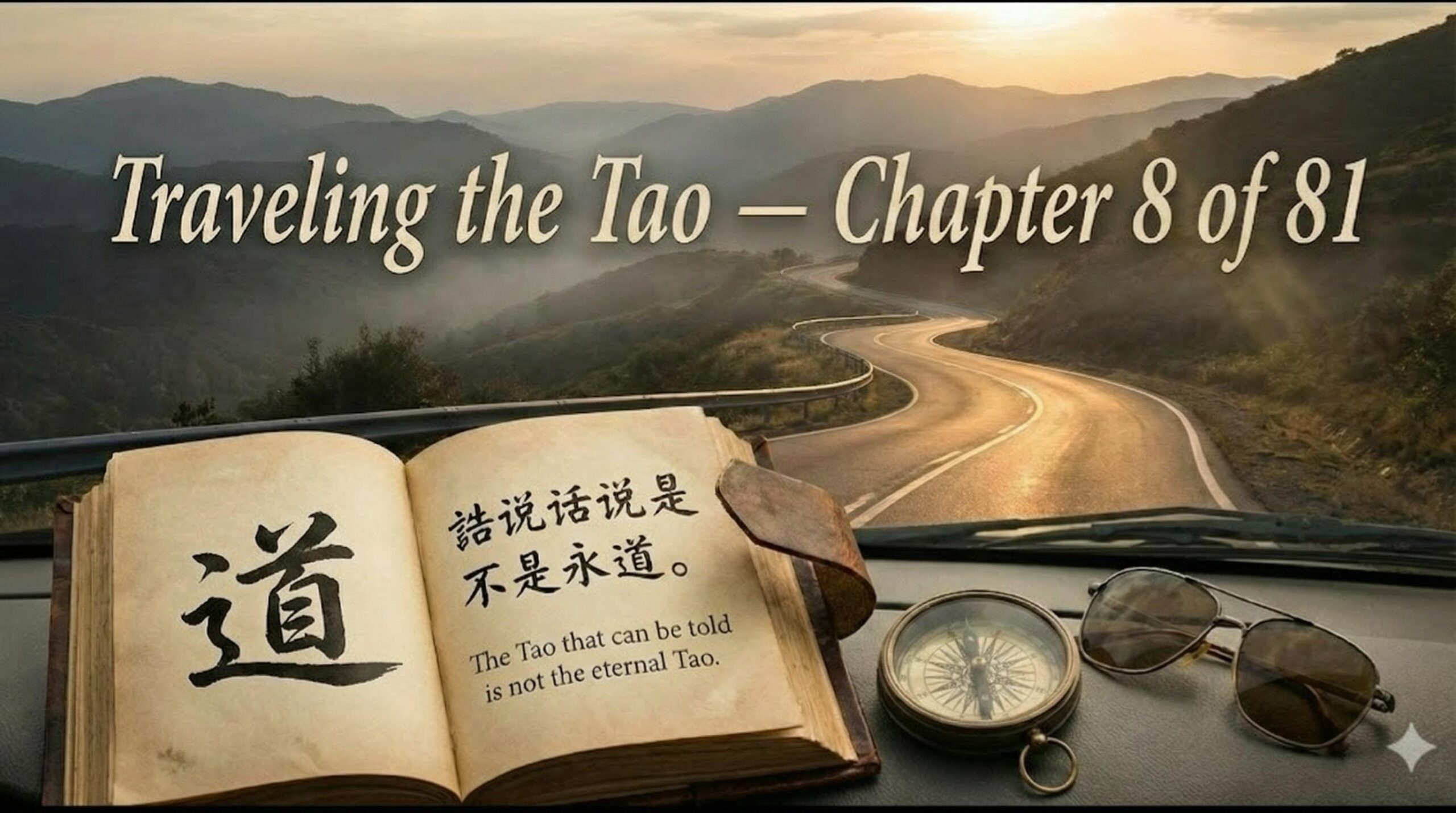
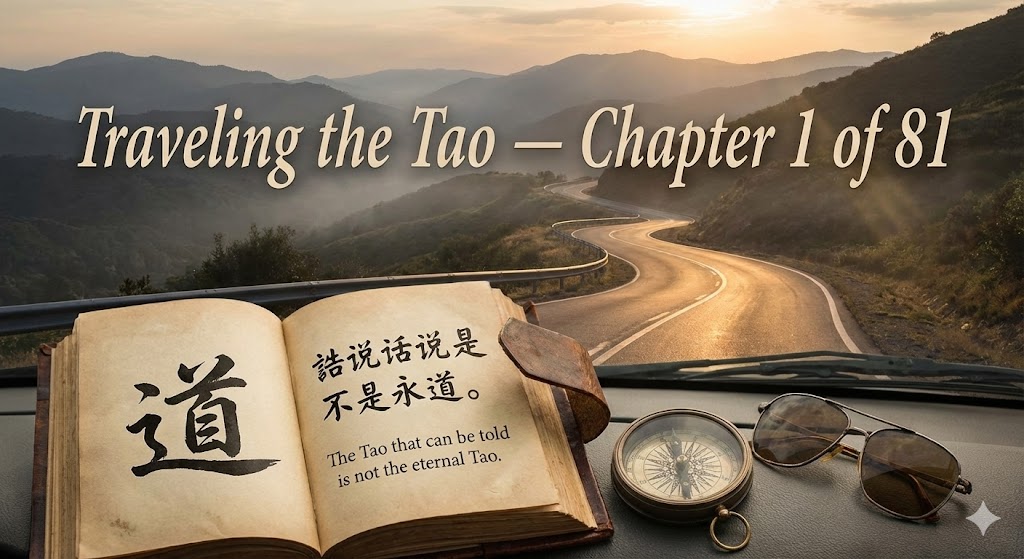
The map is not the territory. This ancient principle, central to both philosophy and modern systems thinking, finds its earliest and most elegant expression in the opening lines of the Tao Te Ching. Just as a GPS can guide you to the Grand Canyon but cannot convey its awe-inspiring vastness, the words of this chapter point toward an experience that fundamentally defies description.
Executive Summary
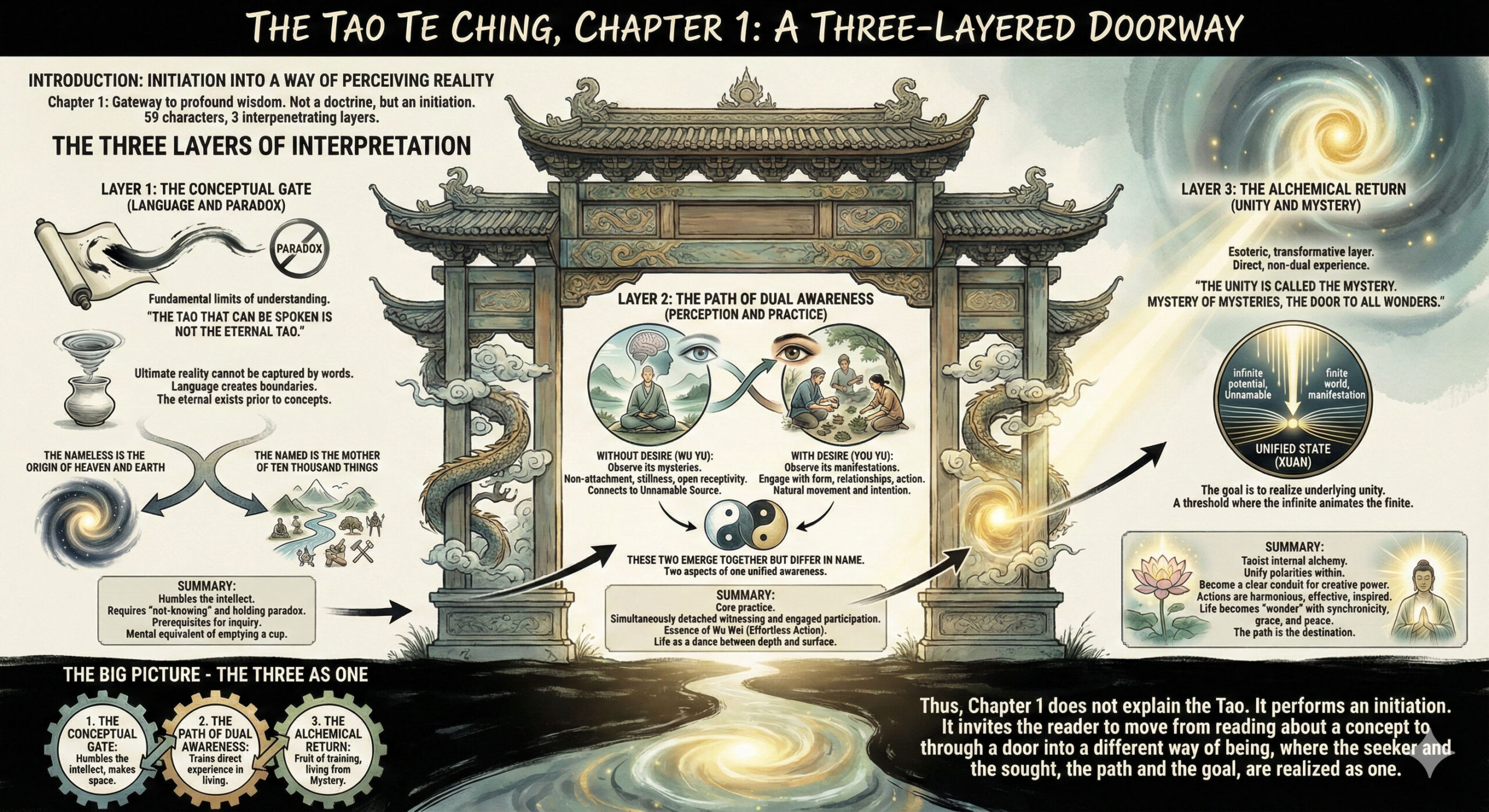
Chapter 1 of Traveling the Tao explains that the Tao can’t be captured by words, labels, or definitions—just as a map can never replace the lived experience of a journey. The article frames Lao Tzu’s opening verse as a three‑layered doorway.
Layer 1: The Conceptual Gate. Words divide reality into pieces, but the Tao is the unbroken landscape beneath them. Like staring at a guidebook instead of the Grand Canyon, clinging to concepts keeps you from the real thing. The first step is loosening mental rigidity.
Layer 2: Dual Awareness in Practice. The text distinguishes two modes of perception:
- Without desire: quiet, receptive awareness that sees the deeper pattern.
- With desire: active engagement with the world. These aren’t opposites—they arise together, like being both a relaxed local and a purposeful tourist. Their harmony is the basis of wu wei, effortless action.
Layer 3: The Alchemical Return When stillness and action merge, you enter the “Mystery”—the inner doorway where life feels aligned, meaningful, and guided. This unity is the threshold to all wonders.
Ultimately, Chapter 1 teaches that the Tao isn’t a definition to memorize, but a way of seeing that turns the entire journey of life into the destination itself.
Why This Chapter Matters More Than Ever
In an age of constant digital noise and endless information, the timeless wisdom of the Tao Te Ching’s first chapter offers a crucial counterpoint. It teaches us to value direct experience over conceptual understanding and to find harmony between stillness and action. This isn’t just ancient Chinese philosophy—it’s a practical framework for navigating modern life with more peace and less friction.
Written over 2,500 years ago and attributed to the sage Lao Tzu, the Tao Te Ching is a foundational text of Taoism (Daoism). Its 81 short chapters are dense with insight, beginning with this profound and often misunderstood introduction to “The Way” (Tao).
Decoding the Structure: More Than Just 81 Chapters
While universally recognized as 81 chapters, this structure is itself a teaching tool. Scholars believe the 81-chapter format (9×9) was a later addition, with the number 9 representing the ultimate “yang” in Chinese numerology. The text is divided into two main sections:
- Part 1: The Tao Ching (Chapters 1-37) focuses on the metaphysical nature of reality—the unnameable source and principle of all things.
- Part 2: The Te Ching (Chapters 38-81) shifts to practical wisdom, exploring Te (virtue or power) and how the Tao manifests in human affairs, leadership, and ethical living.
Chapter 1 sits as the gateway to both.
The Tao that can be spoken is not the eternal Tao
Tao te ching 1 Of 81
The name that can be named is not the eternal name
The nameless is the origin of Heaven and Earth
The named is the mother of myriad things
Thus, constantly without desire, one observes its essence
Constantly with desire, one observes its manifestations
These two emerge together but differ in name
The unity is said to be the mystery
Mystery of mysteries, the door to all wonders
A Three-Layer Journey into Chapter 1
To move beyond a superficial reading, we can explore this chapter through three interdependent layers—a method that mirrors the Taoist love for paradox and depth.
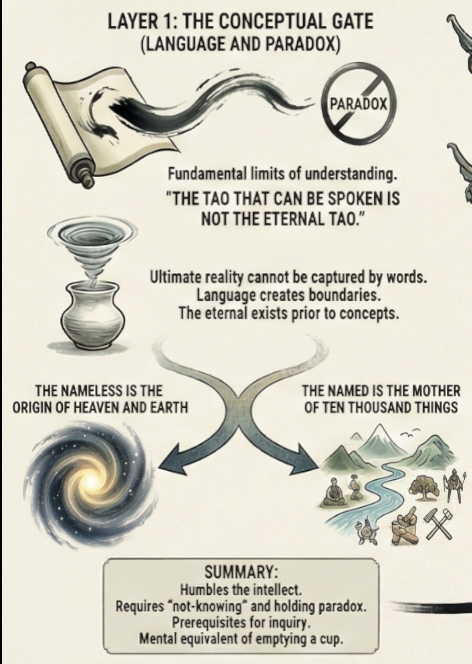
Layer 1: The Conceptual Gate – When Your Map Fails You
Core Verse: “The Tao that can be spoken is not the eternal Tao. The name that can be named is not the eternal name.”
This opening is a radical intellectual humility. It asserts that the ultimate reality—the true nature of existence—cannot be captured or contained by language, thought, or any conceptual model.
- The Nameless: The origin, the undifferentiated source of everything (Heaven and Earth).
- The Named: The act of naming creates distinction, giving birth to the world of “ten thousand things”—all the separate phenomena and objects we experience.
The Practical Insight: Your thoughts and labels are useful tools, but they are not the full reality. To approach genuine truth, you must first loosen your grip on certainty and make space for “not-knowing.” It’s the mental equivalent of emptying a cup before it can be filled with something new.
🚗 Travel Metaphor: The Map vs. The Landscape
Planning a trip with maps and guidebooks is essential, but the brochure is not the destination. If you spend your entire vacation staring at your phone, you’ll never truly feel the Grand Canyon’s majesty. The Tao is the raw, living landscape; our words about it are just the map.
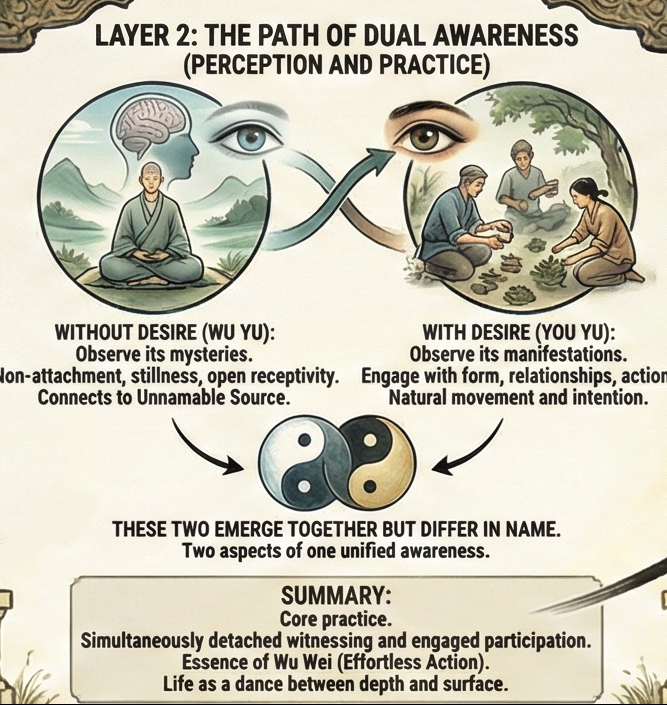
Layer 2: The Path of Dual Awareness – How to Be in the World
Core Verse: “Constantly without desire, one observes its mysteries. Constantly with desire, one observes its manifestations.”
This is the core of Taoist practice. It’s not a command to eliminate desire but an instruction to cultivate two essential modes of perception simultaneously:
- Without Desire (Wu Yu): Observing from a state of non-attachment and open receptivity. This is witnessing the world without the filter of personal agenda, allowing you to connect with the underlying mystery and flow.
- With Desire (You Yu): Engaging actively with the world of form—making choices, building relationships, and taking action. This is the natural movement of life and intention.
The critical insight? These two arise together. They are not opposites but two aspects of a single, unified awareness. The art is to act in the world while resting in inner stillness. This balance is the essence of Wu Wei, or “effortless action.”
🚗 Travel Metaphor: The Tourist vs. The Local
A skilled traveler seamlessly blends both modes. They need the “desire” to read a train schedule and book a tour (engaged action). They also need the “desireless” capacity to get lost in a back alley, soaking in the atmosphere without an agenda (detached witnessing). Mastery lies in the flow between the two.
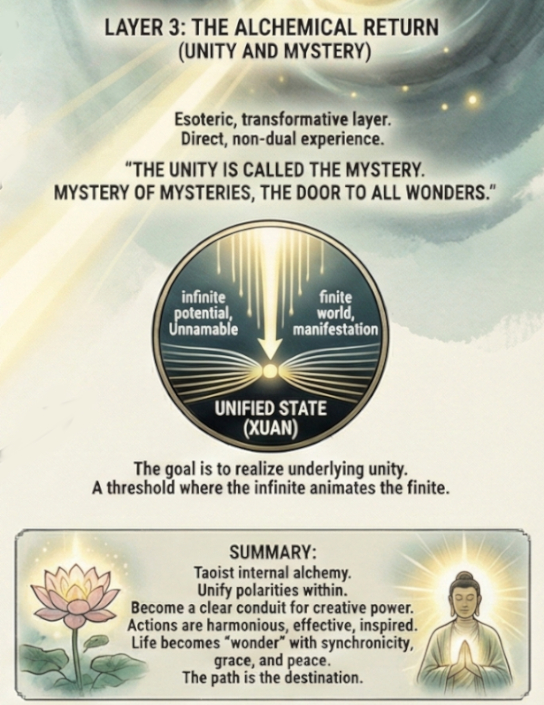
Layer 3: The Alchemical Return – Where the Journey Transforms You
Core Verse: “Mystery of mysteries, the door to all wonders.”
The ultimate goal isn’t to choose between the Nameless and the Named, but to realize their underlying unity. This unified state is called “Mystery” (Xuan)—a profound, unfathomable depth.
- “The door to all wonders” is the key phrase. This unity is not a passive endpoint but an active threshold. It’s the point where infinite potential flows into and animates our finite, everyday world.
The Transformational Insight: When inner stillness and outer action merge, life ceases to be a struggle. Actions begin to feel guided, synchronicities increase, and you operate from a place of aligned clarity. This is the beginning of Taoist internal alchemy, where life itself becomes the practice.
🚗 Travel Metaphor: The Journey is the Destination
This is the moment on a long trip where the distinction between “you” (the traveler) and “the world” (the destination) softens. You realize the mountain’s beauty isn’t just “out there”—it’s happening within your perception of it. You stop fighting the road and become one with the journey. The trip itself becomes the teacher.
Applying Chapter 1 to Your Life: Actionable Steps
This philosophy is meant to be lived. Here’s how to start:
- Practice “Cup-Emptying”: Once a day, consciously acknowledge that your current opinion or understanding of a situation is partial. Make mental space for other possibilities.
- Balance Your “Modes”: In a stressful, action-oriented task (e.g., a work project), pause for 60 seconds to simply observe your breath and surroundings without judgment (Wu Yu). Then re-engage.
- Look for the “Door”: At the end of the day, reflect on one moment where things simply “flowed.” It could be a conversation, a solved problem, or a moment of peace. Acknowledge it as a touchpoint of unity.
The Three Layers as One Path
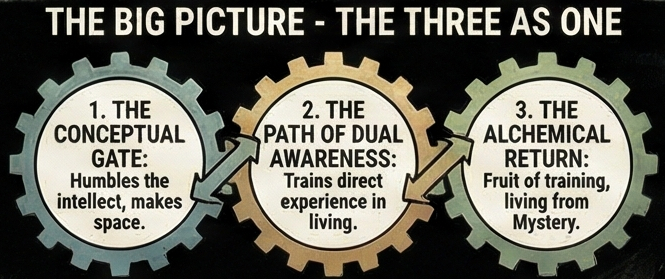
These layers aren’t steps. They’re simultaneous dimensions of the same insight:
- The Conceptual Gate
Loosen your grip on rigid thinking. - The Path of Dual Awareness
Learn to see with both stillness and engagement. - The Alchemical Return
Let those two merge into a unified way of being.
A Travel‑Cosmology Reflection
Think of Chapter 1 like the moment you step into your car at the beginning of a long road trip.
- You don’t know exactly what you’ll encounter
- You can’t predict the weather, the people, or the surprises
- You can only bring an open mind and a willingness to engage
The Tao is the landscape itself — vast, shifting, alive.
Your concepts are the map — helpful, but limited.
Your journey requires both:
- the quiet awareness that notices the horizon,
- and the active engagement that chooses the next turn.
When those two ways of seeing merge, the road becomes more than a route.
It becomes a teacher.
Closing Thought
Chapter 1 is the Tao Te Ching’s way of saying:
“If you want to understand life, start by changing how you look at life.”
It invites you into a way of being where mystery isn’t a problem — it’s the doorway to wonder.
If you want to live according to the Tao:
- Pack Light: Don’t let your labels and “maps” weigh you down.
- Drive Mindfully: Be aware of your surroundings while still keeping your hands on the wheel.
- Enjoy the Ride: Realize that the road, the car, and the driver are all part of the same incredible trip.