Why This Page Exists
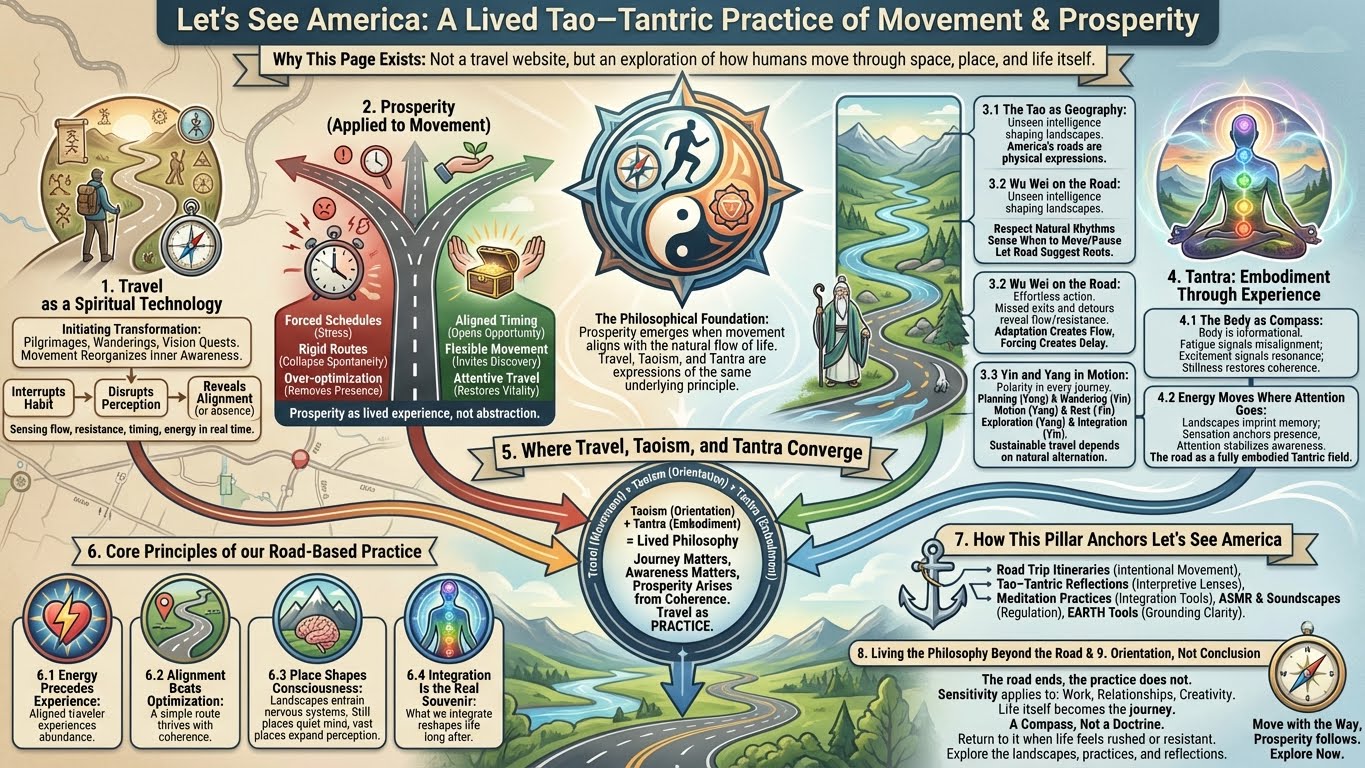
Let’s See America is not simply a travel website.
It is an exploration of how humans move through space, place, and life itself.
This pillar page establishes the philosophical foundation beneath every road trip, itinerary, reflection, and practice shared on this site. It explains why travel, Taoism, and Tantra are not separate themes here — but expressions of the same underlying principle:
Prosperity emerges when movement aligns with the natural flow of life.
Let’s See America provides the lens through which travel becomes more than transportation — it becomes a lived Tao–Tantric practice.
Travel as a Spiritual Technology
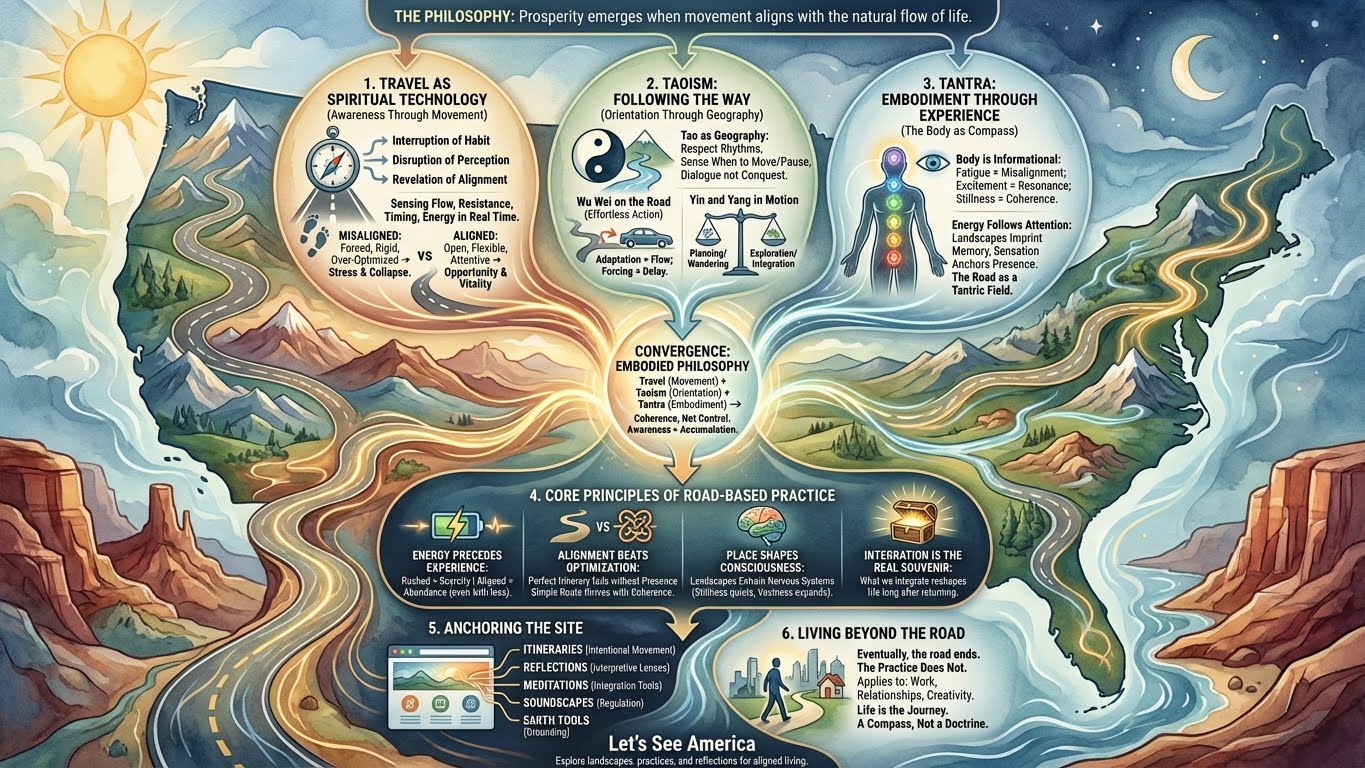
Since ancient times, humans have used journeys to initiate transformation.
Pilgrimages, trade routes, wandering sages, and vision quests all recognized the same truth:
Movement through landscape reorganizes inner awareness.
Travel interrupts habit.
Habit disrupts perception.
Perception reveals alignment — or its absence.
At Let’s See America, travel is treated as a technology of awareness — a way to sense flow, resistance, timing, and energy in real time.
Prosperity (Applied to Movement)
When energy aligns with the deeper order of life, prosperity arises naturally.
On the road, this becomes immediately observable:
- Forced schedules create stress
- Rigid routes collapse spontaneity
- Over-optimization removes presence
Conversely:
- Aligned timing opens opportunity
- Flexible movement invites discovery
- Attentive travel restores vitality
Travel reveals Prosperity not as abstraction, but as lived experience.
Why Tao–Tantra as a Life Framework?
A wonderful question—and the answer is beautifully straightforward.
We see ourselves as lifelong students of reality, especially when it comes to self‑development. That means we naturally pay attention to any philosophy or practice that helps us live with more clarity, freedom, and prosperity.
Over the years, we’ve explored many frameworks: Essentialism, Minimalism, Existentialism, Materialism, Simplism, Ecstasis, Ikigai, Lagom, Hygge, and even the KonMari Method. Each offers something valuable, and many of their principles have found a home in our daily lives.
But long ago, we chose to root ourselves in a different foundation—Taoism.
Taoism gives us a way to weave the best of these systems into a single, coherent lifestyle. For example:
- Minimalism aligns with frugality, one of Taoism’s Three Treasures.
- The KonMari Method echoes feng shui, the Taoist art of harmonizing environmental qi. Clearing clutter improves the flow of energy, just as feng shui teaches.
- Lagom, the Swedish principle of “just enough,” mirrors Taoism’s devotion to balance between yin and yang—avoiding both excess and deprivation.
Taoism, at its heart, is about living in harmony with the Tao, the natural flow of life. It teaches us to move with reality rather than against it.
But there is one limitation.
Most Taoist cultivation is solo practice. Even as a couple, the traditional path asks each person to refine their energy individually. We honor this lineage, yet we also feel the very human longing for touch, connection, and shared energetic intimacy.
Modern synchronized “couples tai chi” is a lovely contemporary adaptation that supports connection, but it isn’t part of classical Taoist cultivation.
And this is where Tantra enters the picture.
Tantra doesn’t use the word qi, yet it describes the same energetic movement through:
- prana exchange — the subtle breath of life shared between partners
- nadis and chakras — channels and centers that open and entrain
- shiva–shakti polarity — the dynamic tension that creates flow
- heart‑field resonance — the merging that arises through presence
In classical Tantra, energy circulates between partners through:
- breath
- gaze
- mantra
- touch
- shared stillness
So our approach is simple:
- For shared energetic cultivation as a couple, we turn to Tantra.
- For individual cultivation, we follow Taoism—sometimes synchronized, always personal.
There is much more to say about how these two lineages complement each other in our lives, but that’s a story for another article.
Taoism: Following the Way Through Landscape
The Tao as Geography
In Taoism, the Tao is the unseen intelligence shaping rivers, mountains, deserts, and seasons.
America’s landscapes — highways, canyons, coastlines, and back roads — are physical expressions of this same unfolding order.
To travel Taoistically is to:
- Respect natural rhythms (weather, light, fatigue)
- Sense when to move and when to pause
- Let the road suggest the route
The journey becomes a dialogue, not a conquest.
Wu Wei on the Road
Wu wei — effortless action — is most easily understood while traveling.
Missed exits, closed roads, and unexpected detours reveal whether we resist life or move with it.
On the road:
- Forcing creates delay
- Adaptation creates flow
Travel teaches wu wei faster than theory ever could.
Yin and Yang in Motion
Every journey contains polarity:
- Planning (yang) and wandering (yin)
- Motion (yang) and rest (yin)
- Exploration (yang) and integration (yin)
Sustainable travel — and sustainable life — depends on allowing these forces to alternate naturally.
Two Ways of Entering the Tao
Within the Inner Journeys Pillar, Taoism is explored through two complementary series of articles:
Foundations of the Tao
Introduces the essential principles of Taoist thought—ideas like the Dao, wu wei, yin and yang, naturalness, and harmony. These articles provide structure, language, and context. Some use travel as a metaphor; others speak directly and plainly.
Traveling the Tao
It is a slower journey. It walks verse by verse through 81 verses of the Tao Te Ching, using the road, landscape, and lived experience as metaphors for each teaching. This series is not about mastering Taoism, but about traveling with it—one passage at a time.
Readers may begin with either path.
Some prefer a map before the road.
Others learn by walking.
Tantra: Embodiment Through Experience
The Body as Compass
Tantra teaches that the body is not incidental — it is informational.
On the road, the body responds immediately:
- Fatigue signals misalignment
- Excitement signals resonance
- Stillness restores coherence
Travel strips away abstraction and returns awareness to sensation.
Energy Moves Where Attention Goes
Tantra observes that energy follows attention.
When traveling consciously:
- Landscapes imprint memory
- Sensation anchors presence
- Attention stabilizes awareness
The road becomes a Tantric field — fully embodied.
Where Travel, Taoism, and Tantra Converge
At their intersection:
- Travel provides movement
- Taoism provides orientation
- Tantra provides embodiment
Together, they create a lived philosophy where:
- The journey matters as much as the destination
- Awareness matters more than accumulation
- Prosperity arises from coherence, not control
This is why travel is central to this site — not as content, but as practice.
Core Principles of our Road-Based Practice
Energy Precedes Experience
A rushed traveler experiences scarcity.
An aligned traveler experiences abundance — even with less.
Alignment Beats Optimization
The perfect itinerary fails without presence.
A simple route thrives with coherence.
Place Shapes Consciousness
Landscapes entrain nervous systems.
Still places quiet the mind.
Vast places expand perception.
Integration Is the Real Souvenir
What we integrate from travel reshapes life long after returning home.
How This Pillar Anchors Let’s See America
Every section of Let’s See America flows from this foundation:
- Road trip itineraries as intentional movement
- Tao–Tantric reflections as interpretive lenses
- Meditation practices as integration tools
- ASMR and soundscapes as nervous-system regulation
- EARTH tools as grounding clarity
This pillar explains why these belong together.
Living the Philosophy Beyond the Road
Eventually, the road ends.
The practice does not.
The same sensitivity learned through travel applies to:
- Work
- Relationships
- Creativity, and more
Life itself becomes the journey.
Orientation, Not Conclusion
This page is a compass, not a doctrine.
Return to it when planning a journey.
Return to it when life feels rushed or resistant.
When movement aligns with the Way, prosperity follows — on the road and beyond it.
From here, explore the landscapes, practices, and reflections that bring this philosophy to life.