Executive Summary
For decades, Saffordite has captivated collectors and spiritual seekers alike, marketed as the enigmatic “Cintamani Stone” with origins shrouded in metaphysical mystery. Its South American counterpart, Colombianite, shares a similar lore as the ancient “Piedra de Rayo” (Lightning Stone), a name bestowed by local indigenous peoples in Colombia.
But Colombianite recently received definitive scientific closure: a 2021 peer-reviewed study in the journal Geology formally identified it as a highly weathered rhyolitic obsidian originating from Colombia’s Paletará Caldera.
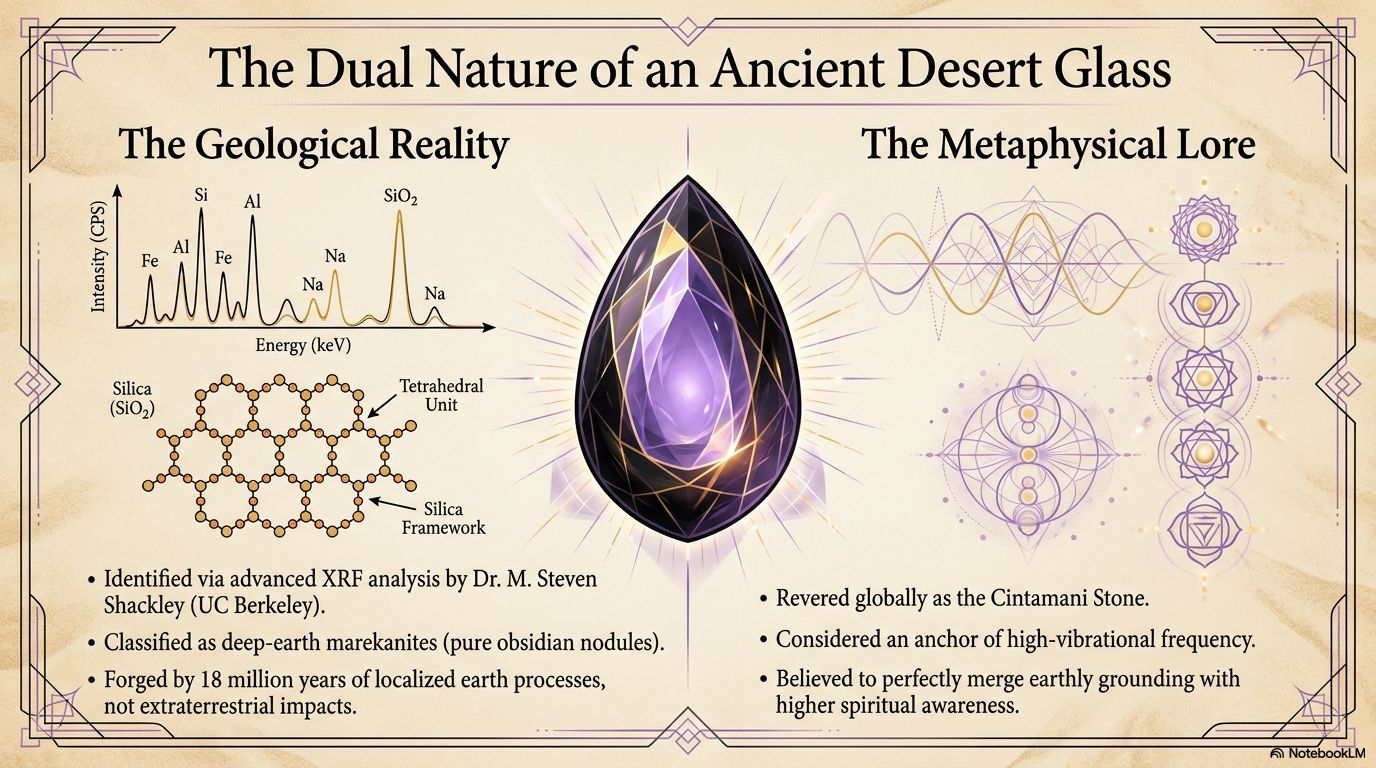
Yet, while many in the crystal community claim Saffordite’s origins remain an unsolved scientific anomaly, the truth is far more grounded—and equally fascinating. Decades of rigorous geoarchaeological research by the lab of Dr. M. Steven Shackley at UC Berkeley, utilizing advanced X-ray fluorescence (XRF), have definitively traced these Arizona “pseudotektites” to Tertiary-period volcanic events, specifically the Cow Canyon and Mule Creek flows.
Notably, these formations are approximately 18 million years old—a refinement from the often-cited metaphysical lore of 30 million years. Rather than being extraterrestrial tektites, Saffordites are ancient, naturally tumbled marekanites (obsidian nodules) uniquely etched by millions of years of desert weathering. Their prized violet translucency—and, more rarely, a subtle honey-gold or yellow-orange tint when backlit—is a direct result of this specific, localized geochemical recipe.
Rather than diminishing its magic, this geological reality explains exactly why Saffordite commands such high value. This article explores the intersecting worlds of rigorous science and cultural legend, detailing the specific, highly localized geochemical recipe that gave birth to Saffordite’s prized translucency, the rigorous journey these stones took through ancient river systems, and why this remarkable desert glass remains one of the rarest and most sought-after collector’s pieces on the market today.
Here is the story of how Earth created a masterpiece.
The Fiery Birth: Forged in the Tertiary Period
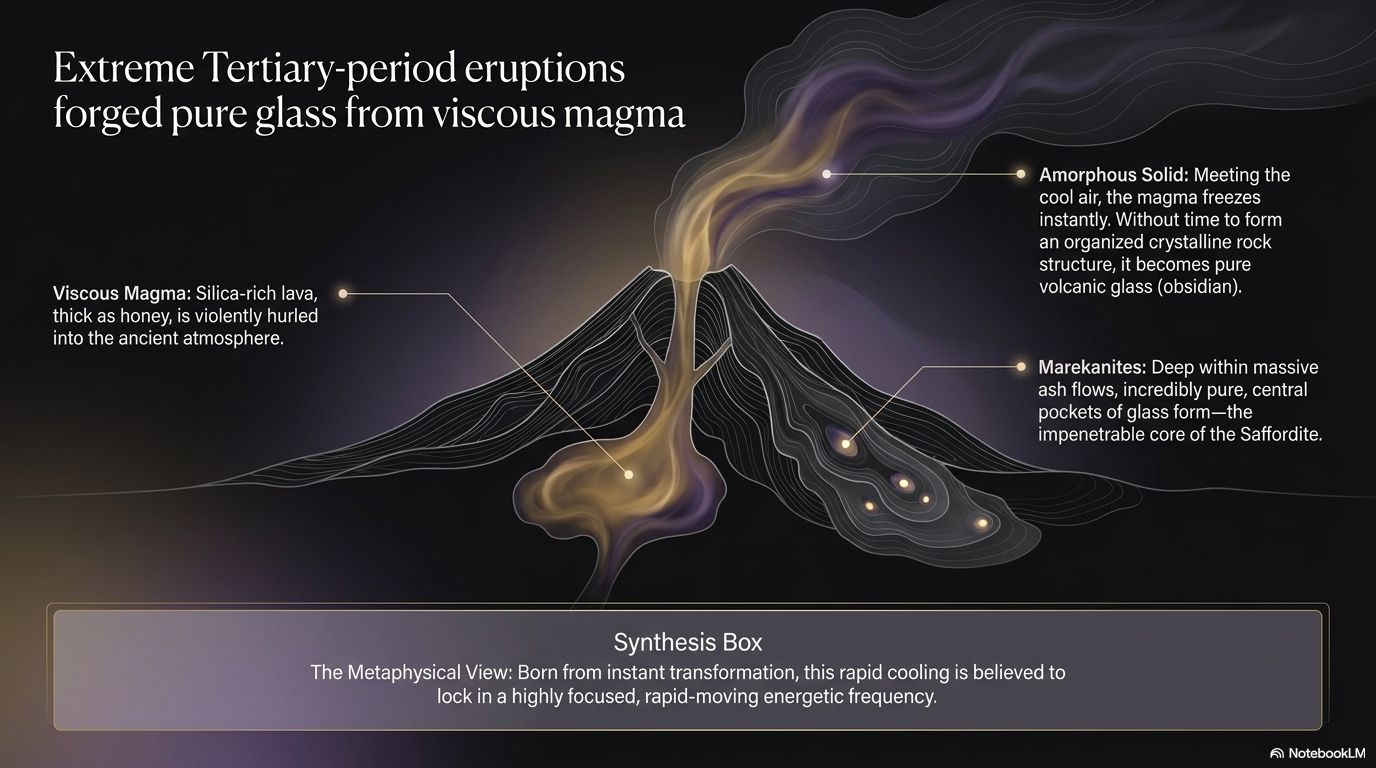
The story of a Saffordite begins 18 million years ago during the Tertiary period. Massive, catastrophic volcanic eruptions ripped through what is now the American Southwest—specifically from vents like the Cow Canyon and Mule Creek flows.
These eruptions produced immense oceans of silica-rich lava. When this specific type of magma cools incredibly fast, it doesn’t have time to form a standard crystalline rock structure. Instead, it freezes into an amorphous solid: pure volcanic glass, or obsidian. Deep within these massive ash flows, small, incredibly pure pockets of glass formed. These central cores, free from the impurities that make standard obsidian opaque, are geologically known as marekanites.
A Journey of Millions of Years: Weathering and Etching
So, how did a piece of volcanic glass buried deep in ancient rock get its distinct, alien-looking texture? The answer is time and water.
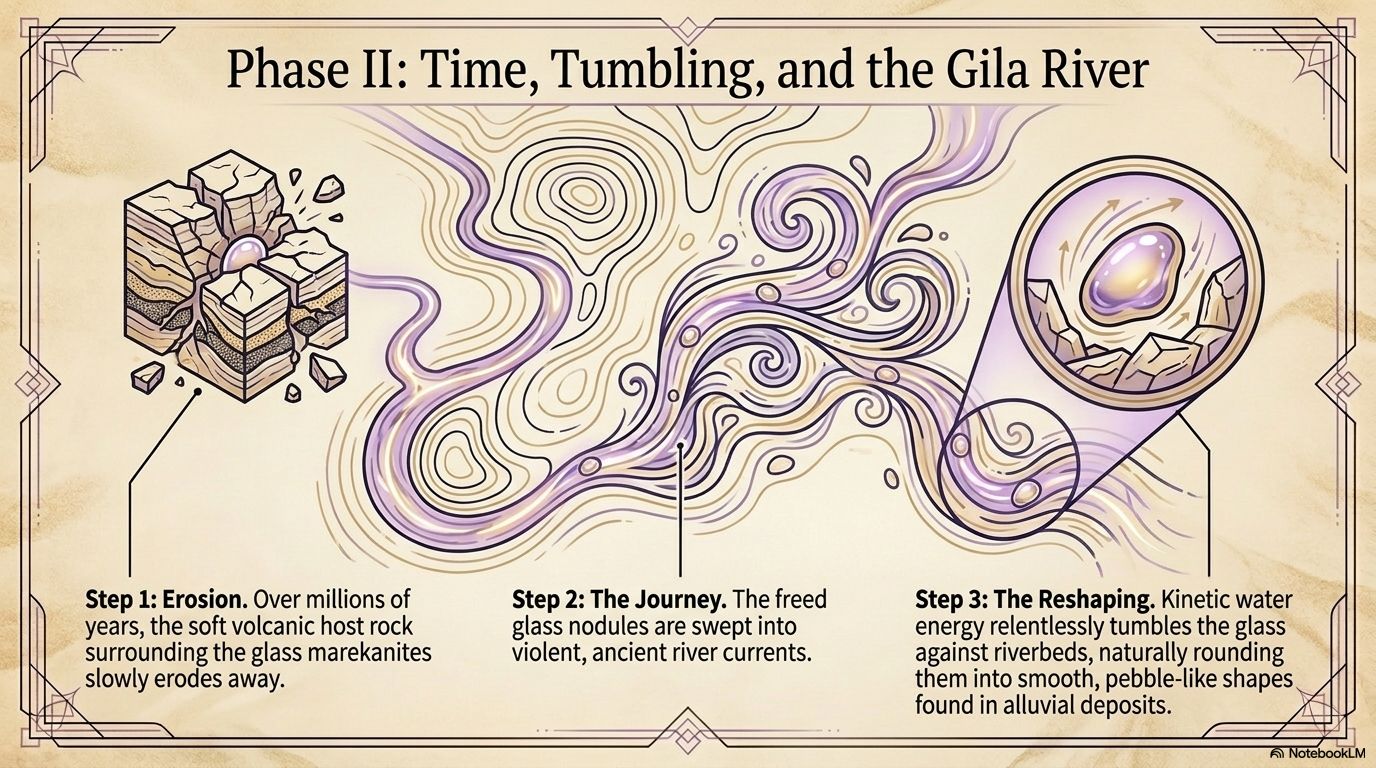
Over millions of years, the softer volcanic rock surrounding these glass nodules eroded. The freed marekanites were swept up by ancient river systems, relentlessly tumbling down the Gila River network. This brutal journey naturally rounded the stones into the pebble-like shapes we see today.
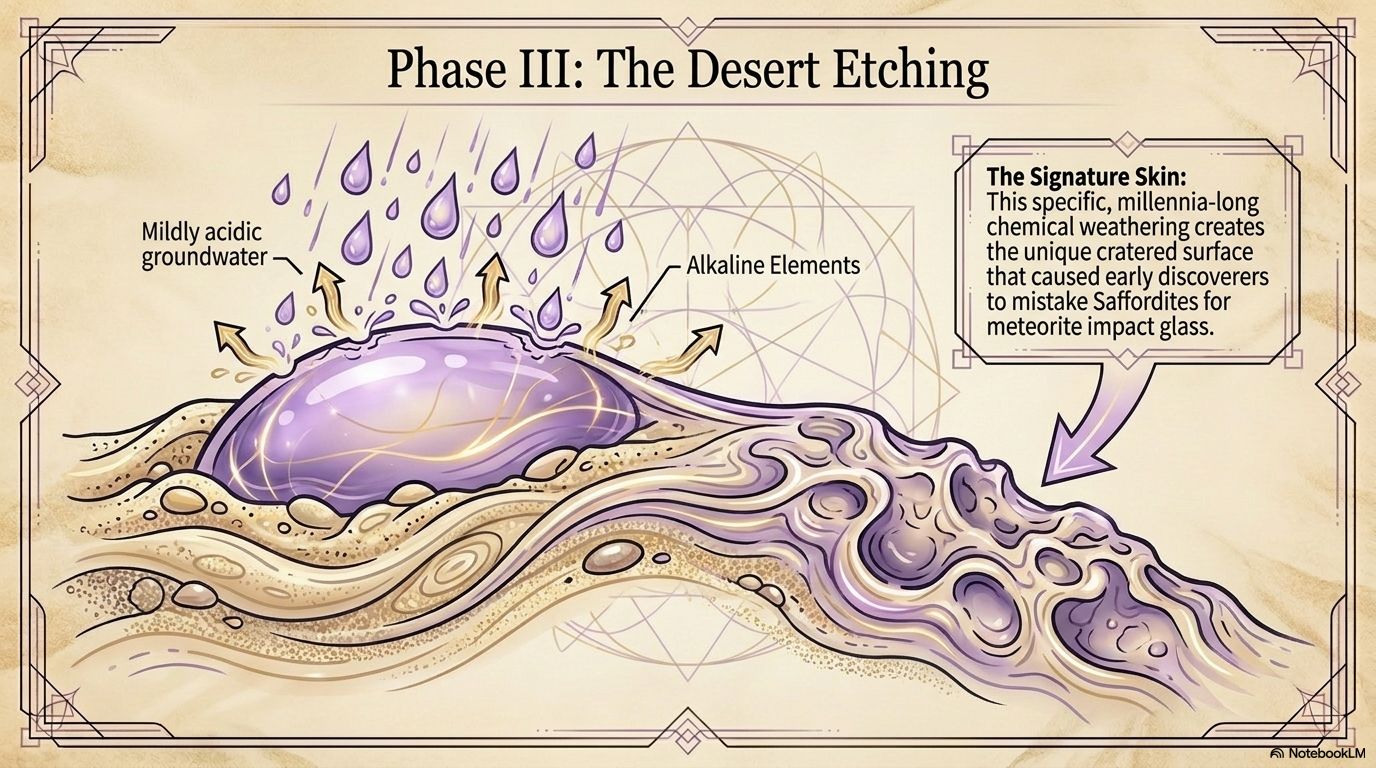
As they settled into alluvial deposits in the desert, mildly acidic groundwater went to work. The water slowly leached alkaline elements out of the glass surface, etching the stones over millennia. This chemical weathering is what gives Saffordite its signature “raisin-like” dimpled skin and cratered surface, causing early discoverers to mistake it for tektites (meteorite impact glass).
Why We Find Them on the Surface
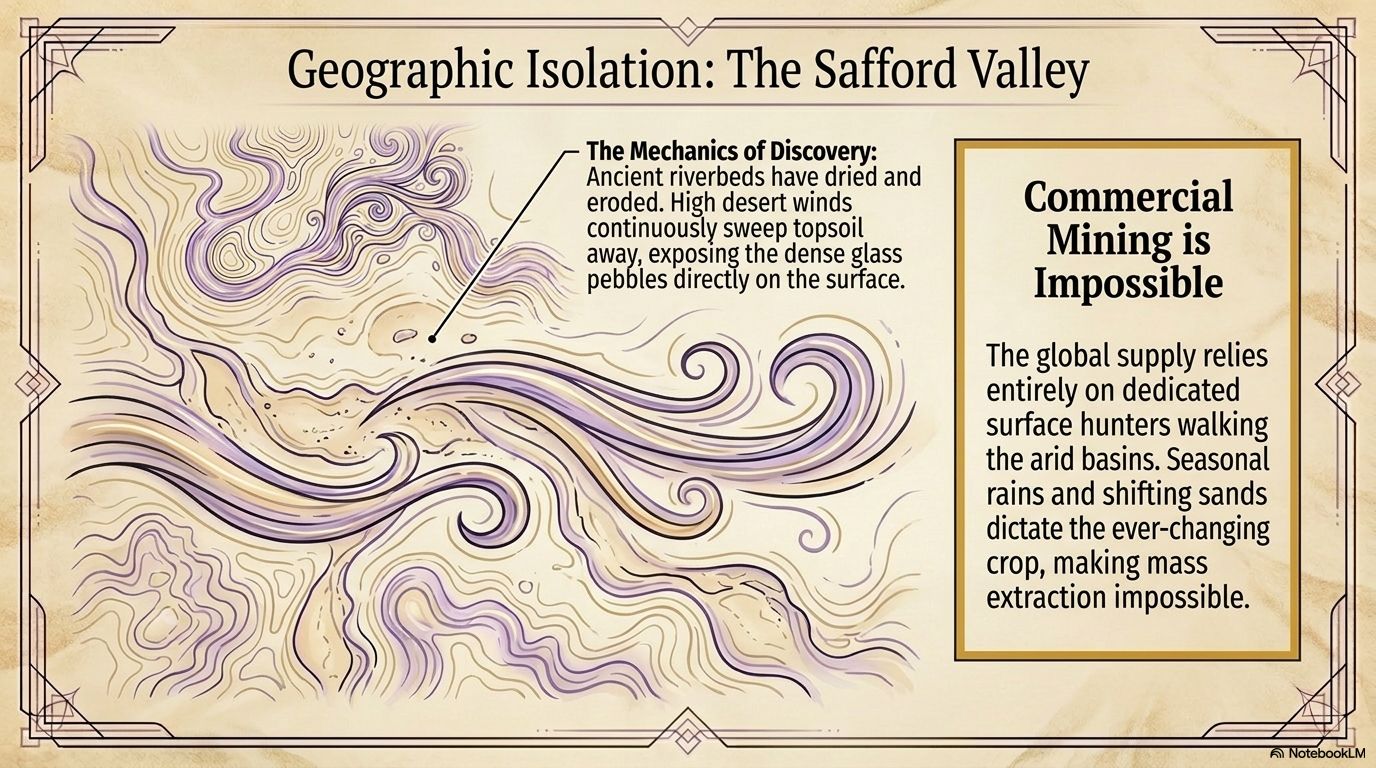
Today, Saffordites are found exclusively scattered across the desert surface in a highly localized area of the Safford Valley in Arizona. They sit on the surface because the ancient riverbeds that deposited them have long since dried up and eroded. High desert winds continuously sweep away the topsoil, leaving the heavier, dense glass pebbles exposed to the Arizona sun, waiting to be found by dedicated rockhounds.
The Rarity: A Geochemical Anomaly
Saffordite is exceptionally rare. You cannot mine it; you can only walk the desert and hope the earth has revealed one.
There is no commercial mining operation for Saffordites. Instead, the global supply relies entirely on the efforts of individual “surface hunters” who walk the arid basins and washes. Seasonal rains and shifting sands constantly work to reveal new stones while burying others, meaning the “crop” is always changing. This accessibility—and the fact that anyone can, in theory, find one—adds a romantic allure to the stone. It isn’t blasted from the earth, but discovered with patience and a keen eye.
Once the surface supply in the Safford Valley is exhausted, none will be made.
But its true rarity lies in its chemistry.
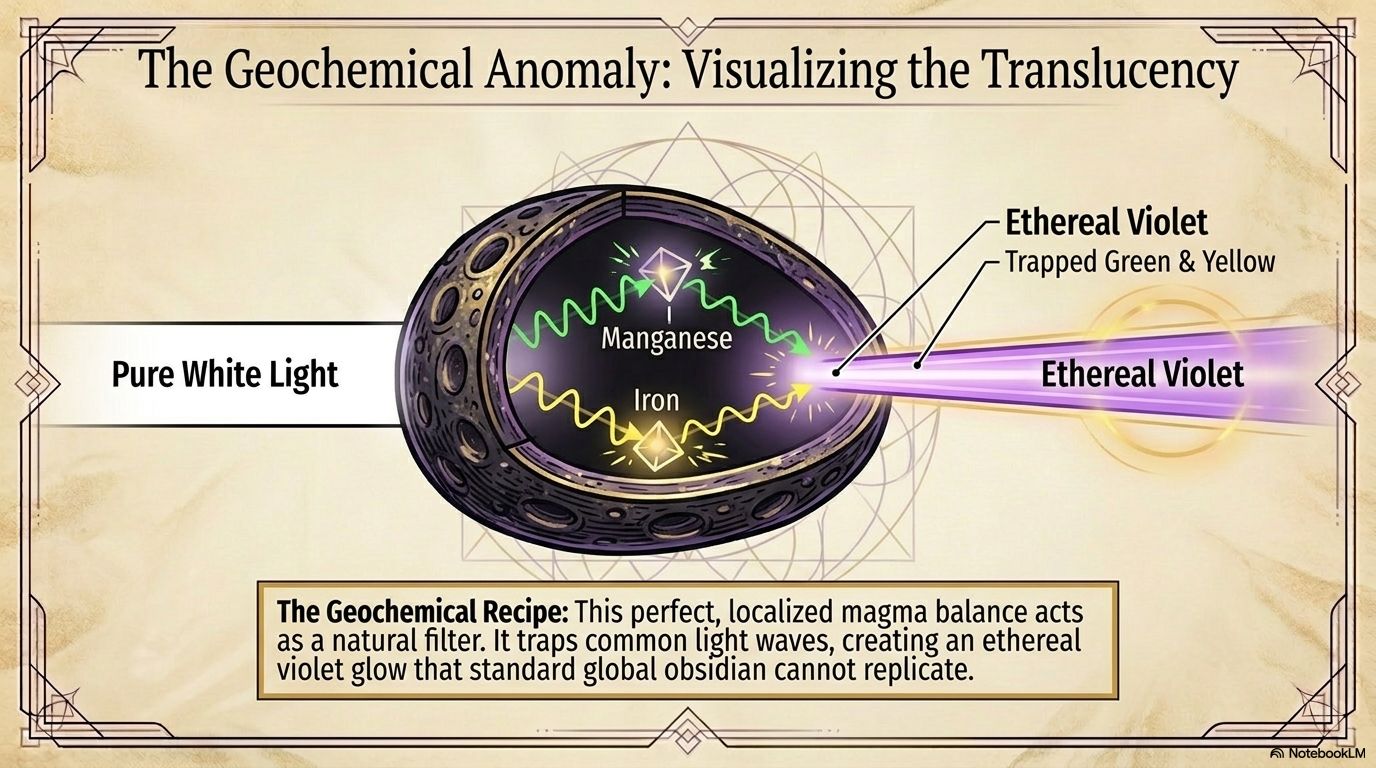
While obsidian is common worldwide, Saffordite’s famous translucent violet glow is a geological anomaly. The magma that formed these specific stones contained a highly unusual, perfect balance of trace elements—specifically manganese and iron. This specific geochemical “recipe” acts as a natural filter, absorbing green and yellow light and allowing only that ethereal lavender hue to pass through.
Prized Rarity and Authenticity
Several factors converge to make Saffordite one of the rarest and most valuable natural glasses on the planet. The information below explains why.
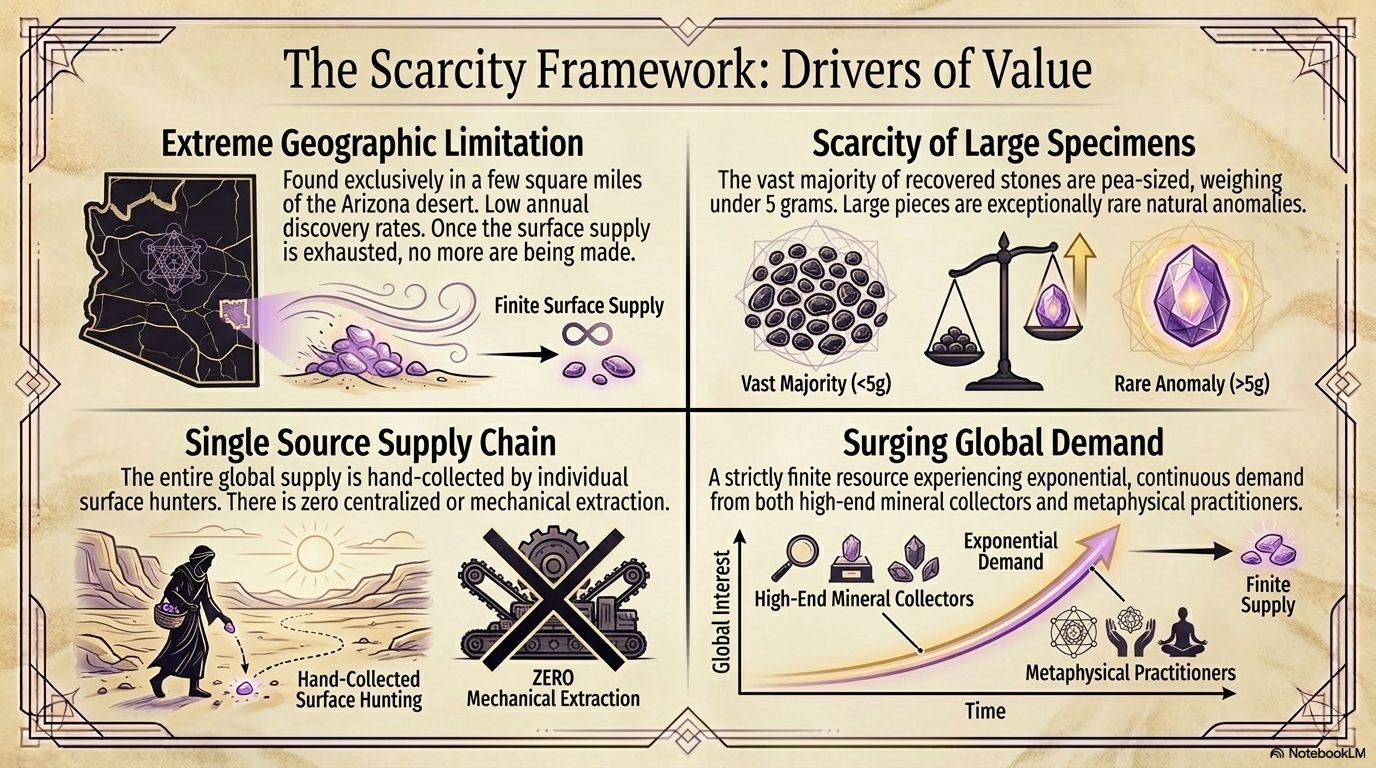
Extreme Geographic Limitation – Saffordite is found exclusively in a small region of the Arizona desert, with a low estimated total annual discovery.
Limited Supply & High Demand – It is a finite resource, not being continuously produced, with surging global demand from both collectors and metaphysical practitioners.
Single Source – The entire supply is hand-collected from the same few square miles, making price jumps common as demand outpaces what hunters can recover each year.
Scarcity of Large Specimens – The vast majority of stones found are the size of a pea, weighing under 5 grams, making larger pieces exceptionally rare and valuable.
This scarcity, combined with its unique hidden translucency, makes Saffordite a prized possession for any collector. It is the story of the Earth, patiently worked over millions of years, waiting to be found.
The Metaphysical Connection: Power and Purpose
While science explains its physical body, the metaphysical community recognizes the stone’s profound energetic signature. Ancient indigenous peoples of the Southwest recognized the value of these nodules, using them not just for tools but as items of significance.
- Why they are powerful: Volcanic glass is born from the ultimate transformational energy—fire and earth. Because Saffordite cooled instantly, it is believed to hold a highly focused, rapid-moving energetic frequency. Its famous lavender-violet glow (when backlit) associates it with the Crown and Third Eye chakras, connecting grounding earthly energy with higher spiritual awareness.
- How they are used: In modern contemplative practices, Saffordite is deeply valued for inner journeying. For those committed to mindfulness and meditation, holding a Saffordite serves as a powerful anchor. It is frequently used in crystal grid work to accelerate personal manifestation, clear energetic blockages, and facilitate deep, introspective focus during silent meditation.
The spiritual power of Saffordite is rooted in ancient legends. Known as the Cintamani Stone—a Sanskrit term meaning “the wish-fulfilling jewel”—it has been revered for centuries as a stone capable of opening the doors to wisdom and higher knowledge.
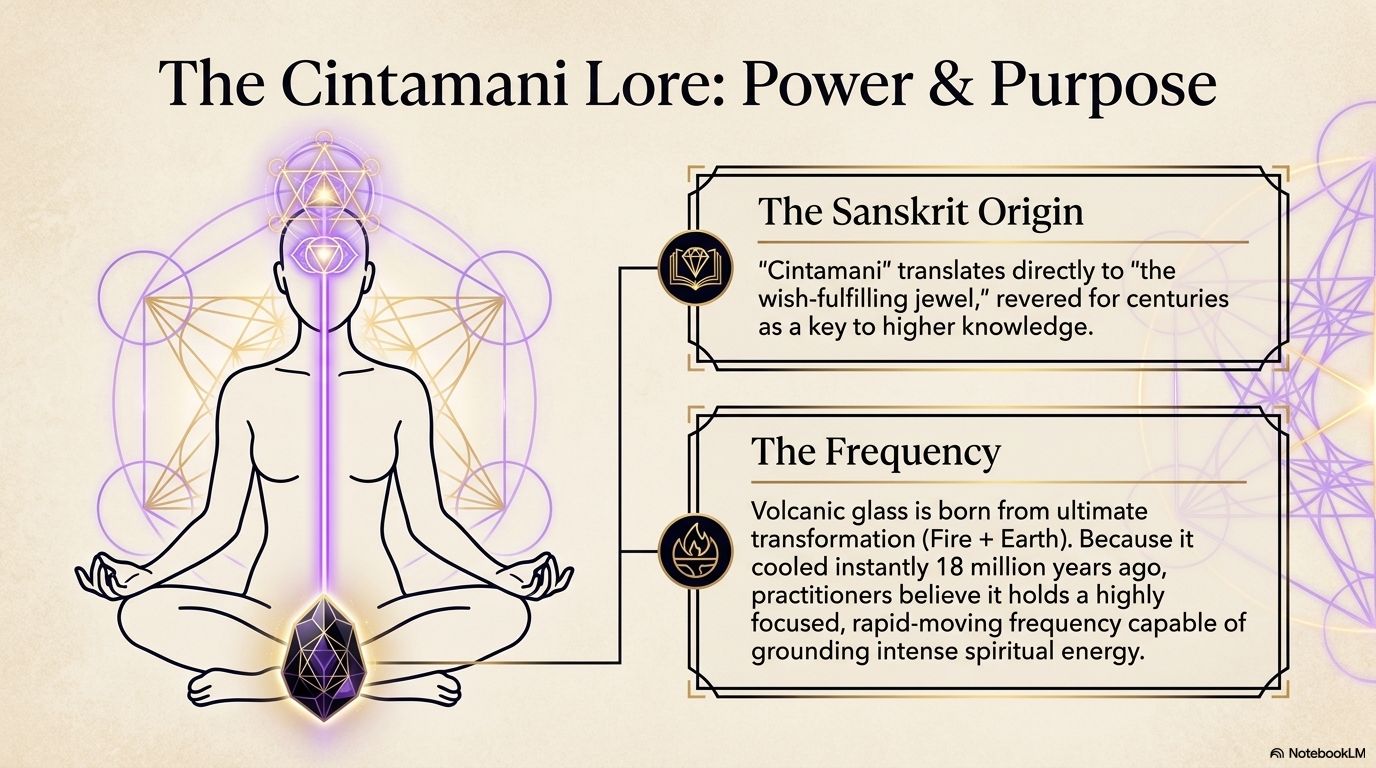
The metaphysical lore of the Cintamani is said to carry a frequency that aids in human evolution, believed by some to be a fragment of a celestial body that carries a divine mission for peace.
- Transformational Power: The stone’s dual nature—a rugged exterior hiding a luminous core—is seen as a powerful metaphor for the spiritual journey. It is believed to help the wearer “peel back the layers of the ego” to reveal the truth of the soul.
- High Vibrational Frequency: In energy work, Saffordite is said to possess one of the highest vibrational frequencies of any mineral, emanating pure Light and Love.
- “Stone of Awakening”: The stone is valued for helping to ground intense spiritual energy, and is considered a powerful tool for manifesting intentions and clearing energetic blockages.
How to Use Saffordite in Spiritual Practice
There are many ways to incorporate the powerful energy of Saffordite into your practice. These include:
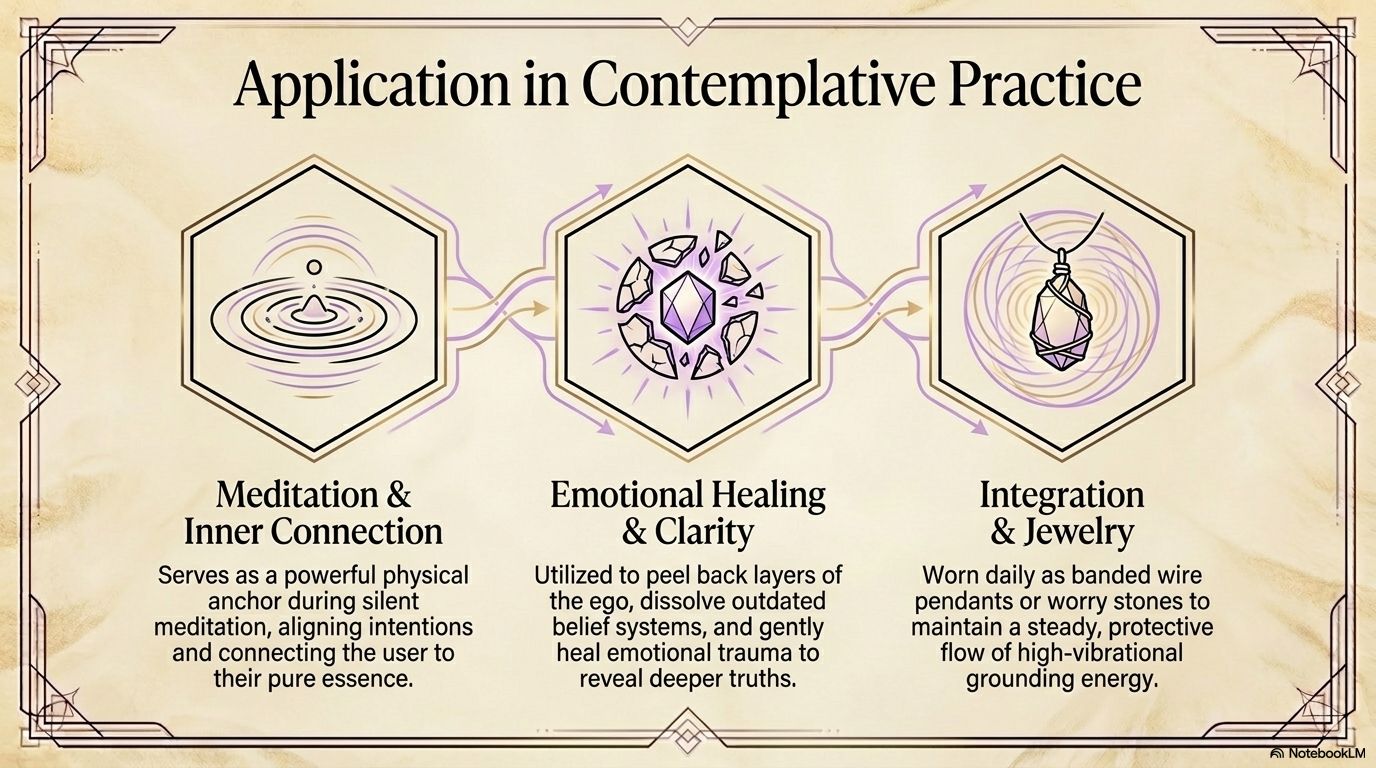
- Meditation and Inner Connection: Holding a Saffordite during meditation is said to enhance positive vibrations and align your intentions. It serves as a powerful anchor for spiritual work, allowing you to connect with your pure essence and higher purpose.
- Emotional Healing and Clarity: The stone is used to dissolve unhelpful thought forms and outdated belief systems, gently allowing you to let go of what no longer serves you. It is known to aid in healing from mental and emotional trauma, helping you become comfortable in knowing your truth.
- Integration and Jewelry: Wearing Saffordite as a pendant or worry stone keeps its high vibrational frequency close to your auric field throughout the day, providing a steady flow of clarity and grounding energy.
We have published several articles detailing how to incorporate Saffordites into your spiritual routines.
A Prized Possession
To hold a Saffordite is to hold a survivor. It survived the explosive birth of a volcano, millions of years of being crushed in ancient rivers, and millennia of chemical weathering in the desert.
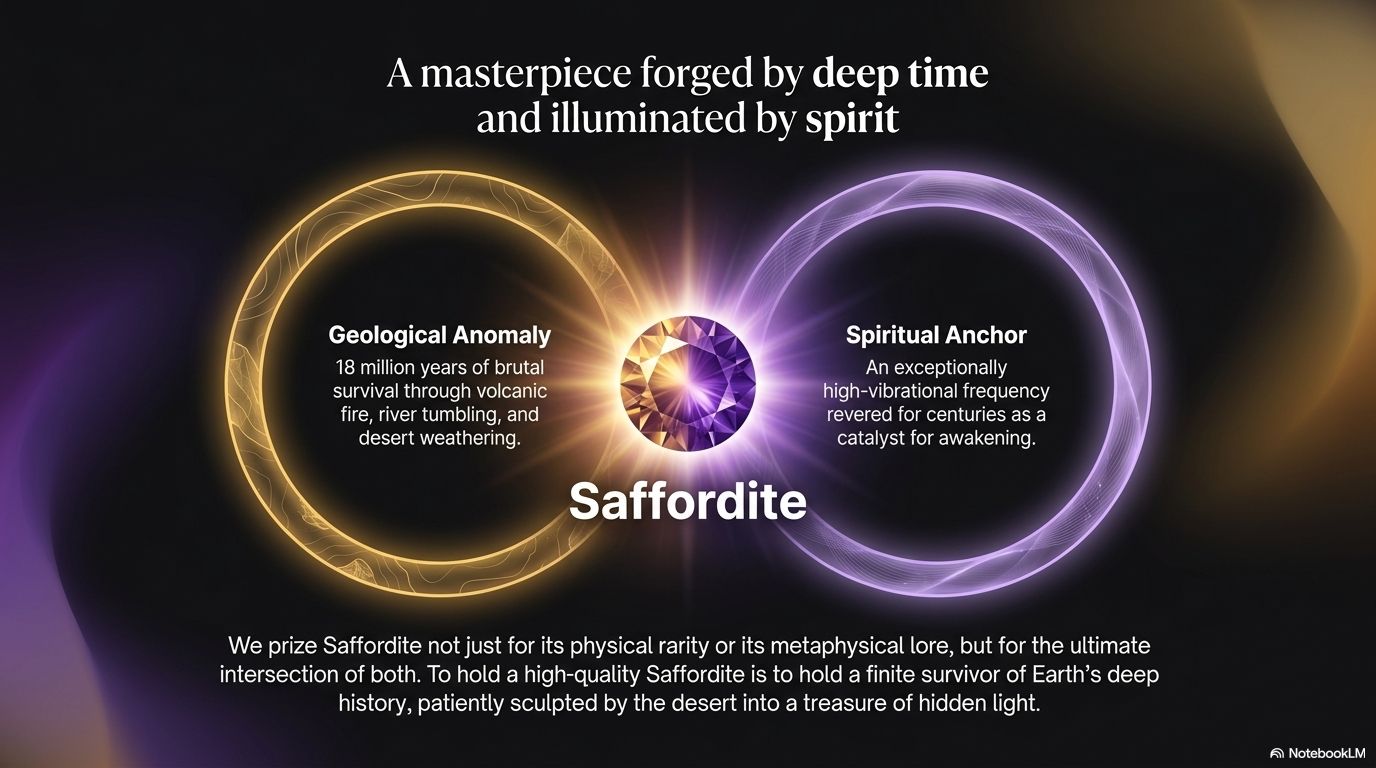
We prize them not just because they are beautiful, or because their violet glow is a geological marvel, but because they represent a perfect harmony of science and spirit. A high-quality Saffordite is a finite piece of Earth’s deep history, an anchor for spiritual growth, and a rare treasure that has literally been millions of years in the making.
Experience the Light of the Desert
Ready to experience the high-frequency energy of the desert for yourself? Browse our hand-selected, authentic collection of Arizona Saffordites. Every stone is unique, ethically sourced from the Safford region, and waiting to find its keeper.